
Growing Guide
Raised Beds vs In-Ground: The Answer Depends on Your Soil
Sources: USDA SSURGO, FEMA NFHL, EPA FRS (Superfund, UST, TRI)
Last updated:
 Recommended Depth
12-18 inches
USDA NRCS
Typical Cost
$50-200
Per 4x8 ft bed
Yield vs In-Ground
2-3x higher
Extension Services
The real question is "what does my soil need?"
The raised beds vs. in-ground debate is usually treated as a matter of opinion — personal preference, aesthetics, convenience. But it should be a data-driven decision. The right answer depends on three measurable properties of your specific parcel: soil drainage, contamination proximity, and flood risk.
Federal agencies have already measured all three. USDA SSURGO provides drainage class. EPA FRS tracks contamination sources. FEMA NFHL maps flood zones. Growable Ground queries all of them for your property boundary — and the results determine whether in-ground or raised beds make more sense.

Check YOUR soil to decide
See your drainage class, contamination proximity, and flood zone status to decide if raised beds are right for your site.
Three things about your exact spot that zone averages miss:
We read public map data for this spot — soil, climate, flood, and parcel records. How we handle your address.
25+ data sources analyzed in seconds
Three scenarios where raised beds are the better choice
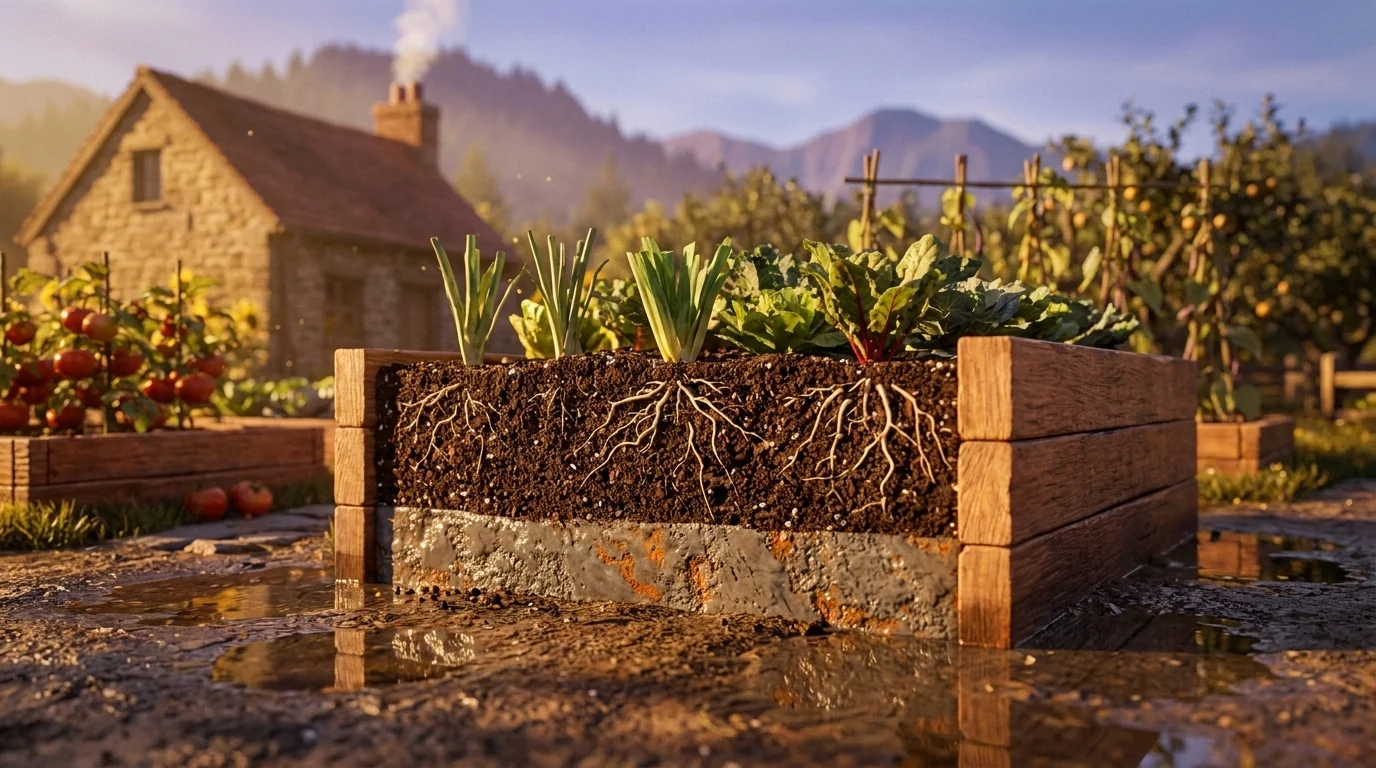
- Poor or very poor drainage: when SSURGO rates your soil "poorly drained" or "very poorly drained," water lingers near the surface and drowns roots most vegetables can't tolerate. Raised beds lift the root zone above it, bypassing the constraint. (For how drainage class is measured and what each rating means, see Drainage & Water.)
- Contamination proximity: If EPA data shows Superfund sites, underground storage tanks (USTs), or Toxics Release Inventory (TRI) facilities near your parcel, raised beds with imported soil reduce direct contact with potentially contaminated ground. This is especially relevant for food crops where soil contaminants can be taken up through roots.
- FEMA flood zone placement: Parcels mapped in FEMA 100-year flood zones (Zone A, AE, AH, AO, V, VE) face periodic inundation that deposits sediment and disrupts root systems. Raised beds provide elevation above minor flood events and recover faster from inundation.
Three scenarios where in-ground growing wins
- Well-drained soil with suitable pH: When SSURGO shows well or moderately well drained soil in the pH 6.0–7.0 range, in-ground planting gives roots access to deep soil moisture reserves and established soil biology that raised beds cannot replicate.
- No contamination concerns: If EPA data shows no Superfund, UST, or TRI facilities within proximity thresholds, native soil is safe for food production. In-ground avoids the cost and maintenance of imported growing media.
- Large-scale or perennial plantings: Fruit trees, berry bushes, and large-scale vegetable production require root volume that raised beds cannot economically provide. In-ground is the only practical option for orchards and market-scale operations.
How scoring changes between methods
Growable Ground scores each plant species separately for in-ground and container/raised bed growing contexts. In raised bed scoring, native soil constraints — pH mismatch, poor drainage, texture incompatibility — are partially bypassed because you control the growing medium.
Sun, frost, growing degree days, and climate still apply identically, and contamination proximity still factors in (raised beds cut soil contact but not airborne exposure). The net effect: species held back in-ground by soil alone can score markedly higher in a raised bed on the same parcel.
Crops that often gain the most in a raised bed
Acid-lovers (blueberry) and root crops (carrot, potato) benefit most when you control the mix and its depth.
Cost and effort comparison
Raised beds require purchasing growing media, building or buying bed structures, and replenishing soil over time as organic matter decomposes. In-ground growing has lower upfront costs but may require amendments (lime, sulfur, compost) depending on native soil properties.
So the cost question turns on your actual soil: if it is already within range, raised beds may be an expense you don't need; if it carries several constraints, a raised bed can beat years of amendment applications on both cost and effort.
Pro TipWhat a raised bed unlocks on your land
A raised bed is a narrow instrument, and that is its strength. When Growable Ground scores a plant against your parcel it checks each measured limit separately — winter cold, season length, summer heat, winter chill, pH, drainage. Filling a bed with soil you chose changes exactly two of them, because those are the two that come from the ground you are standing on.
- Soil pH. There is a band where lime or sulfur is the right answer and a bed would be overkill. Past that band the native reading blocks a plant outright — and a bed you filled takes your parcel's pH out of the question entirely, in the first season, rather than over the several seasons an amendment needs.
- Drainage — but only the wet side. When USDA SSURGO rates your soil poorly or very poorly drained, the limitation is structural: water sits where roots need air. Lifting the root zone above that layer is a physical fix, and it is the one case where the engine credits a bed with clearing drainage.
What a bed does not fix matters just as much. If your drainage problem is that the soil runs too dry, a raised bed makes it worse — a contained bed sheds water faster than open ground, and the honest fix is steady irrigation, not a structure. And a bed cannot touch winter cold, season length, summer heat, or chill hours — those come from your climate, not your soil. A plant blocked on any of those needs a cover, a longer season, or a greenhouse, and no amount of imported soil substitutes.
The "Grow more here" panel on your parcel page sorts blocked plants by the lightest fix that clears every limit each one fails, so a plant reaches the raised-bed card only when a cover or irrigation would not have been enough — and never when the real obstacle is your climate. That count comes from your parcel's own soil survey, so it is specific to your land.
How to decide for your specific land
| Your soil data shows | Recommendation |
|---|---|
| Well drained, pH 6.0–7.0, no contamination | In-ground preferred |
| Well drained, pH outside range, no contamination | In-ground with amendments |
| Poorly drained, any pH | Raised beds recommended |
| Contamination sources within proximity | Raised beds with imported soil |
| FEMA 100-year flood zone | Raised beds recommended |
Your Growable Ground report provides all of these data points for your specific parcel — so you can make this decision with evidence, not guesswork.
Check YOUR soil to decide
See your drainage class, contamination proximity, and flood zone status to decide if raised beds are right for your site.
Three things about your exact spot that zone averages miss:
We read public map data for this spot — soil, climate, flood, and parcel records. How we handle your address.
25+ data sources analyzed in seconds
Frequently Asked Questions
When should I use raised beds instead of planting in-ground?
Raised beds are the better choice when your native soil has poor drainage, when EPA data shows contamination sources nearby, or when your parcel falls in a FEMA flood zone. In these cases, imported growing media bypasses the constraint.
Are raised beds always better than in-ground?
No. If your native soil has good drainage, suitable pH, and no contamination concerns, in-ground growing gives plants access to deeper root zones, natural soil biology, and moisture reserves that raised beds cannot replicate.
Do raised beds protect against contamination?
Raised beds with imported soil reduce direct contact with contaminated native soil. However, they do not eliminate airborne contamination from nearby TRI facilities or wind-carried particulates. EPA data paired with prevailing wind-direction modeling can help assess whether airborne risk remains relevant.
How does Growable Ground score raised beds differently?
In raised bed scoring, native soil constraints (pH, drainage, texture) are partially bypassed. Sun, frost and climate still apply. Species that scored poorly in-ground due to soil may score well in raised beds on the same parcel. Nearby contamination never changes a score; where a mapped source sits near your land, food crops carry a “Raised bed or test first” note, and a raised bed of clean soil is exactly that advice.
Related Guides
See what this means where you are
This guide is national — a state's own zones, frost dates and soils change how it plays out. Start with your state's growing hub: