Sources: Standard horticultural IPM and disease-management practice
Diseases
16
Covered in this guide
Families
5
Fungal to viral, plus the impostor
Approach
Prevent first
Habits before sprays
Most plant diseases announce themselves the same few ways — a spot, a wilt, a powder, a rot — and most gardeners reach for a spray. But the spray is rarely the answer. Nearly every disease on this page is prevented by the same handful of habits, and the ones that are not preventable are usually managed by removing a plant, not treating it. Knowing which disease you are looking at tells you which of those two paths you are on.
Each entry covers three things: what it looks like, so you can identify it; how it spreads, so the moves make sense; and the move an experienced grower makes about it. Where resistant varieties are the real fix, we say so — and your state’s Cooperative Extension keeps the current list of what performs where you garden. No disease here is a verdict on your garden. Most are a cue to change one habit.
Free Report
Healthy soil grows disease-resistant plants.
Enter your address and we read the USDA soil survey for your exact parcel — drainage, texture, and pH — then score 1,085 plants against it, so you start with plants suited to your ground.
Three things about your exact spot that zone averages miss:
Your soil pHYour frost-free daysYour sun & shade
We read public map data for this spot — soil, climate, flood, and parcel records. How we handle your address.
25+ data sources analyzed in seconds
Fungal Leaf & Fruit Diseases
Fungi are the largest group of garden diseases, and nearly all of them play by the same rules: they need leaves wet, air still, and plants crowded. That is the good news — one prevention playbook (airflow, morning base-watering, resistant varieties, sanitation) works against almost the whole group.
Powdery Mildew
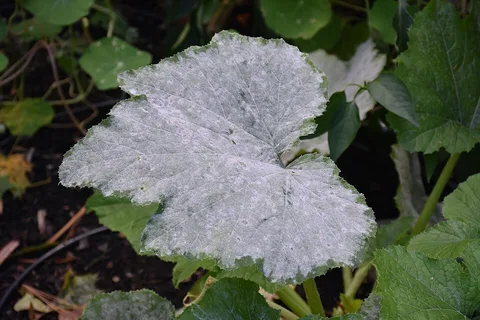
Powdery mildew coating a squash leafSchlaghecken Josef · CC BY-SA 4.0
What it looks like
A dusting of white-to-gray powder on the tops of leaves — squash, cucumbers, beans, phlox, and roses are the usual hosts. It starts as small round spots and spreads until whole leaves look flour-dusted, then yellow and dry from the edges in.
How it spreads
Wind-carried spores that, unlike most garden fungi, germinate on dry leaves in humid air — which is why it shows up in late summer’s warm days and cool, dewy nights even without rain. Crowded, shaded plantings hold the humidity it needs.
The move
Space and prune for airflow, water at the soil in the morning so leaves dry fast, and plant mildew-resistant varieties where you can — that is the single biggest lever. At first sign, pull the worst leaves; horticultural oil or a potassium-bicarbonate spray slows it when you catch it early.
Resistant cucurbit and rose varieties are widely available and vary by region — your Cooperative Extension lists the ones proven where you garden.
Downy Mildew
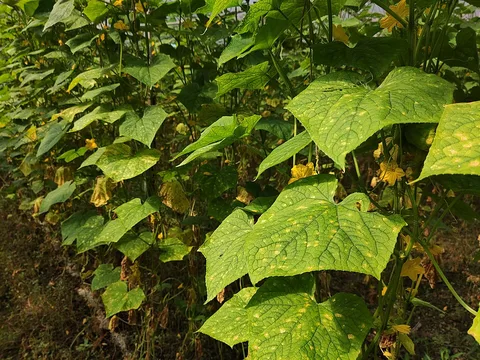
Downy mildew's angular yellow patches on cucumberWee Hong · CC BY-SA 4.0
What it looks like
Angular yellow patches on the tops of leaves — boxed in by the leaf veins — with a gray-purple fuzz on the undersides in damp weather. Common on cucurbits, basil, grapes, and lettuce. Unlike powdery mildew, it needs the leaf actually wet.
How it spreads
Water-loving spores that thrive in cool, wet, humid spells and move fast on splashing rain and overhead watering. It can blow in on regional weather fronts, arriving in a garden that had shown nothing the week before.
The move
Water at the base in the morning, space for airflow, and grow resistant varieties — basil and cucurbit breeders have made real progress here. Remove affected leaves early; copper-based options help in prolonged wet stretches if you catch it fast.
Downy-mildew-resistant basil and cucurbit varieties change the game — your Extension tracks which perform locally.
Early Blight
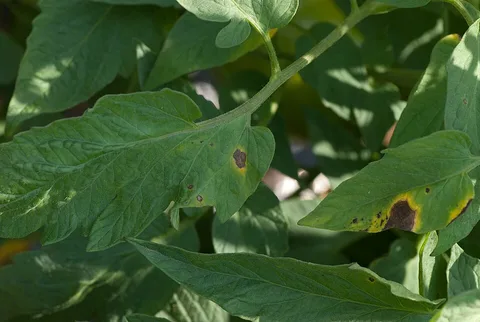
Early blight's target-ring lesions on tomatoDwight Sipler from Stow, MA, USA · CC BY 2.0
What it looks like
Dark brown spots with concentric rings — like a small target or bullseye — on the oldest, lowest tomato and potato leaves first, each spot ringed by a yellow halo. Leaves brown and drop from the ground up.
How it spreads
A fungus that overwinters in soil and old plant debris, then splashes up onto the low leaves with rain and irrigation. Warm, humid weather and stressed plants speed it along.
The move
Mulch to stop soil from splashing onto leaves, water at the base, stake and prune the lowest leaves for airflow, and rotate where you plant tomatoes and potatoes each year. Remove affected leaves as they appear — it is manageable and rarely fatal.
Tomato varieties with early-blight tolerance hold up noticeably better — your Extension lists the proven ones for your area.
Late Blight
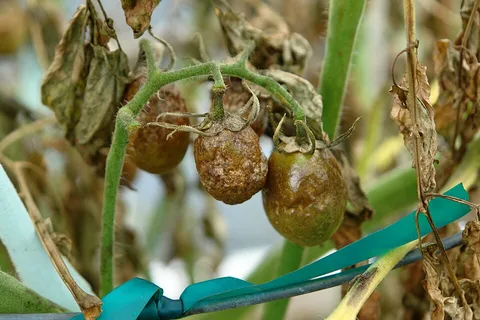
Late blight rotting tomato fruit
What it looks like
Fast-moving dark, greasy-looking blotches on tomato and potato leaves and stems, often with a faint white fuzz on the leaf underside in wet weather, and firm brown patches on the fruit. This is the disease behind the Irish potato famine — it can take a plant down in days.
How it spreads
Spores ride wind and splashing water for long distances and explode in cool, wet spells. It overwinters in living potato tissue, so cull piles and volunteer potatoes are the usual reservoirs.
The move
This is the one to act on fast. Start with certified disease-free seed potatoes and resistant tomato varieties, give plants full sun and airflow, and stake for quick drying. If it appears, pull and bag affected plants the same day — do not compost them — to protect your neighbors’ gardens too.
Late-blight outbreaks are tracked regionally in real time — your Cooperative Extension posts alerts when the risk is live nearby, which is half the battle.
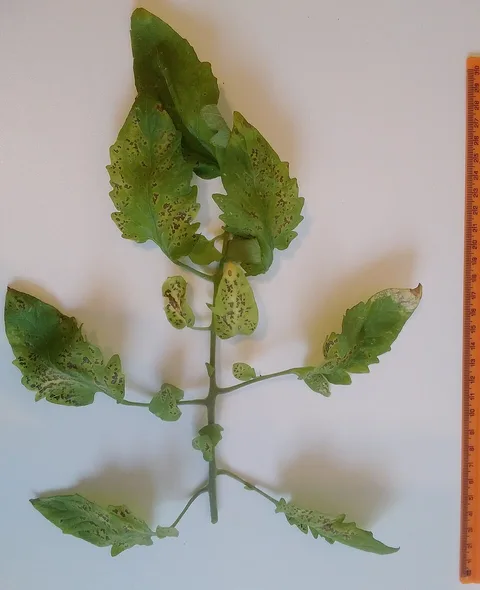
Septoria Leaf Spot
Septoria's many small spots on a tomato leafMerielGJones · CC BY-SA 4.0
What it looks like
Many small round spots with dark borders and pale gray-tan centers, often peppered with tiny black dots (the fungus’s fruiting bodies), on the lower tomato leaves. It works upward and yellows leaves fast, but it does not spot the fruit — the tell that separates it from early blight.
How it spreads
Overwinters in debris and on weeds in the nightshade family, then splashes up in warm, wet weather — the classic humid-summer tomato defoliator.
The move
Same playbook as early blight: mulch, base-watering, airflow, rotation, and prompt removal of spotted leaves. Clean up every scrap of tomato debris at season’s end — the spores overwinter in it.
No fully resistant tomato exists, but airflow and sanitation keep it in check; your Extension can confirm it versus early blight from a single leaf.
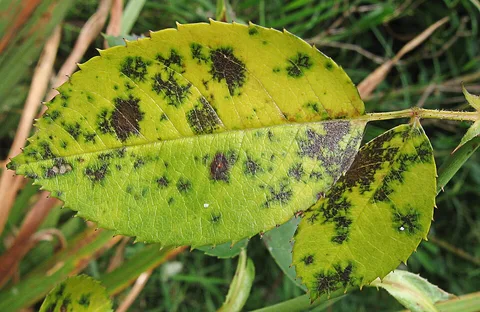
Black Spot
Also called: Rose black spot
Black spot on a rose leaf
What it looks like
Round black spots with feathery, fringed edges on rose leaves, the leaf around them yellowing until it drops. A badly hit rose can defoliate by midsummer.
How it spreads
A fungus that needs leaves wet for several hours to infect, so it flares in humid, rainy, or heavily dewed weather and spreads by splashing water.
The move
Grow disease-resistant roses — many modern shrub and landscape roses shrug it off — then give them sun and space, water at the base in the morning, and rake up fallen leaves, where the spores overwinter. Prune for an open center so air moves through.
Resistant rose varieties are the durable fix; your Extension and local rose societies keep the lists that perform in your climate.
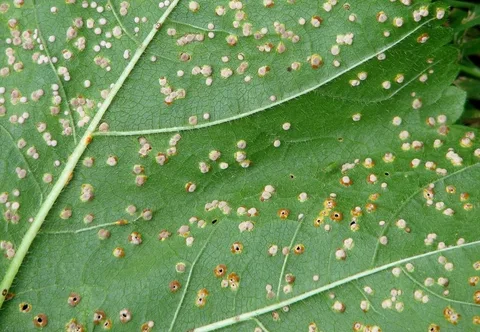
Rust
Rust pustules on a hollyhock leaf undersideEvelyn Simak · CC BY-SA 2.0
What it looks like
Raised orange, rusty-brown, or yellow pustules on leaf undersides — on beans, hollyhocks, snapdragons, roses, and many others — that rub off as colored powder, with yellow flecks showing on the leaf tops above them.
How it spreads
Wind-carried spores that germinate in humid weather and prolonged leaf wetness. Many rusts are host-specific, so the bean rust will not jump to your roses.
The move
Space for airflow, water at the base, and remove infected leaves promptly. Grow resistant varieties where they are offered and clean up debris in fall; sulfur applied early helps on ornamentals.
Rust-resistant bean and snapdragon varieties exist — your Extension lists what is proven regionally.
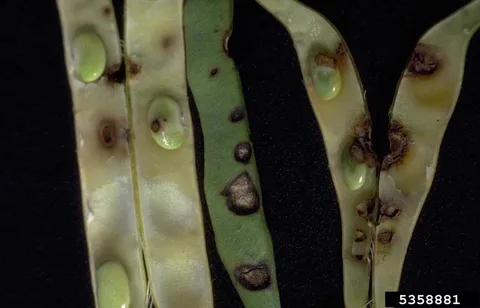
Anthracnose
Anthracnose lesions on bean podsHoward F. Schwartz, Colorado State University, Bugwood.org - · CC BY 3.0 us
What it looks like
Dark, sunken spots on fruit (beans, tomatoes, cucurbits, peppers) and irregular dark blotches along leaf veins; on ripe fruit the spots ooze pink spore masses in wet weather. On shade trees it shows as brown leaf blotches and early leaf drop.
How it spreads
Overwinters in seed and debris and spreads by splashing water in warm, wet conditions. Working among wet plants carries it from plant to plant.
The move
Use clean, certified seed, rotate crops, mulch, and stay out of the beds while foliage is wet. Remove infected fruit and debris. Airflow and base-watering are the through-line here, as with the other wet-weather fungi.
Certified disease-free seed and resistant bean varieties are the front line — your Extension can confirm the pathogen from a sample.
Gray Mold
Also called: Botrytis blight
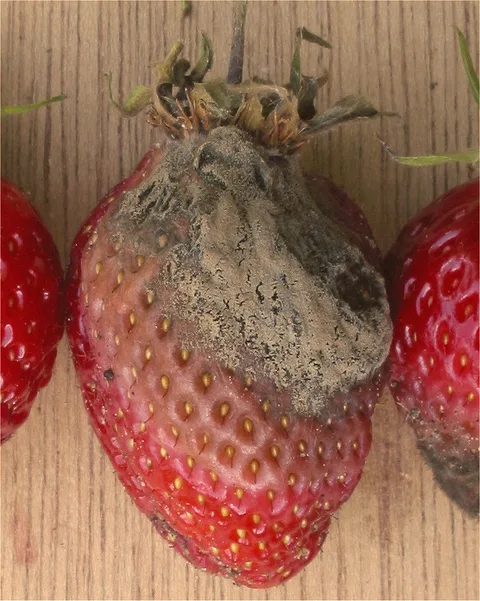
Gray mold (Botrytis) on a strawberryRasbak · CC BY-SA 3.0
What it looks like
A fuzzy gray-brown mold on flowers, fruit, and soft stems — strawberries, tomatoes, lettuce, and many ornamentals — usually starting on spent blooms or damaged tissue and spreading into healthy parts, which turn soft and rot.
How it spreads
Spores are everywhere; the fungus colonizes dead and damaged tissue first, then moves into healthy tissue. It thrives in cool, damp, still, crowded conditions — greenhouses and dense plantings especially.
The move
Airflow is the fix: space plants, prune for circulation, and remove spent flowers, ripe fruit, and dead leaves promptly. Water at the base, harvest ripe fruit quickly, and avoid bruising. Under cover, ventilate to drop the humidity.
Pro Tip
Notice how often the same three words repeat in the fungal moves — airflow, base-watering, resistant varieties. That is not a coincidence. Get those three habits right and you have prevented most of this whole page before it starts.
Soil-Borne & Vascular Diseases
Some diseases never touch the leaves — they enter through the roots and attack from the inside, clogging the plumbing that carries water up the plant. You cannot spray your way out of these. The wins are resistant varieties, crop rotation, and clean, well-drained soil.
Fusarium & Verticillium Wilts
Also called: Vascular wilt
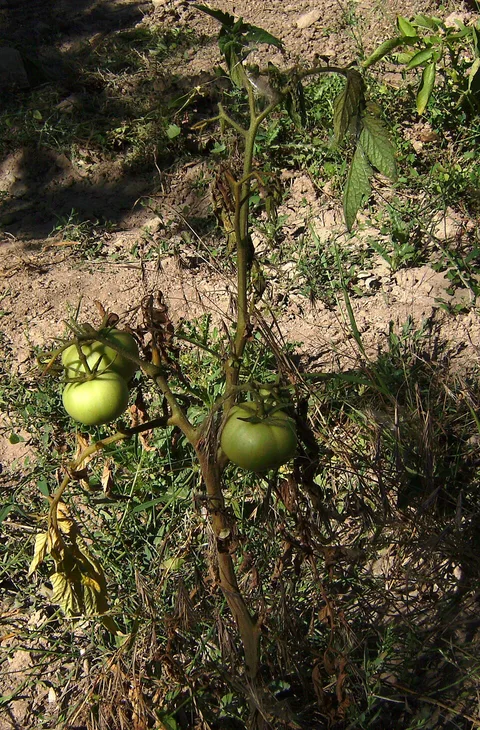
A tomato plant collapsing from vascular wiltVictor M. Vicente Selvas · CC BY-SA 3.0
What it looks like
A plant that wilts in the heat of the day and recovers at night, then stops recovering — often one side or one branch first, with the lower leaves yellowing. Slice a stem near the base and you will see brown streaking in the tissue just under the skin. Common on tomatoes, eggplant, potatoes, and many others.
How it spreads
Soil-borne fungi that enter through the roots and clog the vessels that conduct water. They persist in soil for years and travel on tools, water, and infected transplants.
The move
There is no cure once a plant is infected, so the win is prevention. Plant resistant varieties, rotate away from the nightshade family for several years, keep plants vigorous, and pull and destroy infected plants. Raised beds with clean soil sidestep an infested plot entirely.
The resistance codes on a plant tag (V for verticillium, F for fusarium) mean exactly this — your Extension lists resistant varieties bred for your area.
Root Rots
Also called: Phytophthora · Pythium
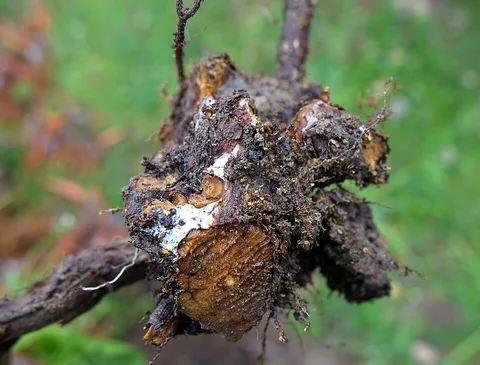
A root crown destroyed by root rotJerzy Opioła · CC BY-SA 4.0
What it looks like
Plants that yellow, stunt, and wilt for no obvious above-ground reason; pull one and the roots are brown, soft, and mushy instead of firm and white, sometimes with the outer layer sliding off. Seedlings and plants in soggy ground go first.
How it spreads
Water-mold pathogens that thrive in saturated, poorly drained soil and spread in standing water and runoff. Overwatering and a buried hardpan are the usual setup.
The move
This is a drainage problem first. Improve drainage, ease off watering, plant in raised beds or mounds where the soil stays wet, and do not plant into cold, waterlogged ground. Choose rot-tolerant rootstocks for trees and shrubs.
Fixing the water is the fix — the drainage guide walks it. Your Extension can confirm the pathogen if the pattern is unclear.
Damping-Off
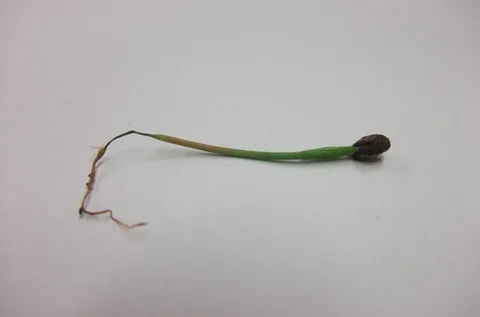
A seedling collapsed at the soil line by damping-offINAKAvillage211 · CC BY-SA 3.0
What it looks like
Seedlings that sprout fine, then topple — a thin, water-soaked, pinched spot at the soil line collapses the stem overnight. Or seeds that never emerge at all. A whole tray can go in a day or two.
How it spreads
A group of soil fungi and water molds that flourish in cold, wet, overcrowded seed-starting conditions with poor airflow.
The move
Start seeds in clean containers with fresh sterile mix, do not overwater, give good light and gentle air movement, and do not sow too thickly. Bottom-water and let the surface dry between waterings. Warmth speeds germination past the vulnerable stage.
Bacterial Diseases
Bacterial diseases spread in water and through wounds, and unlike fungi they do not answer to fungicides. Clean seed, dry foliage, rotation, and sanitation are the levers — prevention does almost all of the work here.
Bacterial Spot & Speck
No diagnostic open-license close-up of bacterial spot/speck lesions exists — look for small dark spots, sometimes yellow-haloed, on leaves and fruit in warm, wet weather.
What it looks like
Small dark spots — sometimes ringed by a yellow halo — scattered across tomato and pepper leaves and fruit; heavy infections give leaves a scorched, tattered look and blemish the fruit. Speck runs cool-and-wet, spot runs warm-and-wet, but the garden moves are the same.
How it spreads
Bacteria carried on seed and transplants and splashed plant to plant by rain and overhead watering; they enter through pores and wounds. Warm, wet, humid weather drives them.
The move
Start with clean, certified seed and healthy transplants, water at the base, stay out of wet foliage, rotate, and remove debris. Copper sprays give partial protection in wet spells. There is no cure mid-season — prevention and sanitation carry it.
Certified disease-free seed and resistant pepper varieties are the front line; your Extension can tell bacterial spot from the look-alike fungal spots.
Bacterial Wilt
No open-license image of the cucurbit bacterial-wilt test exists — confirm it yourself: cut a wilted stem, press the ends together and pull apart, and a fine sticky thread strings between them.
What it looks like
On cucumbers and melons: a vine that wilts and collapses seemingly overnight, often starting with one runner, with no spots or rot to explain it. The test: cut a wilted stem, press the two cut ends together and slowly pull them apart — a fine sticky thread strings between them.
How it spreads
Carried by cucumber beetles — the bacteria overwinter inside the beetles and are introduced when they feed. This is a pest-driven disease, which is the key to controlling it.
The move
Control the cucumber beetles and you control the wilt: row covers over young plants (lift them at flowering for pollination), prompt beetle management, and resistant varieties where available. Pull and destroy wilted plants so they do not feed more beetles.
Because the beetle is the vector, the pest guide is half of this fix. Your Extension confirms the local beetle timing.
Viral Diseases
Viruses are the hardest to treat because there is no treating them — an infected plant stays infected for life. The entire game is prevention: control the sap-sucking insects that carry them, keep hands and tools clean, and grow resistant varieties.
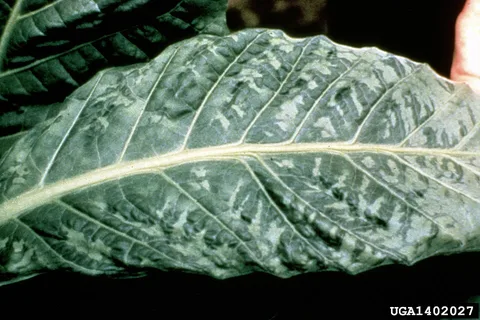
Mosaic Viruses
Also called: Tobacco mosaic · Cucumber mosaic
Mosaic-virus mottling on a leafR.J. Reynolds Tobacco Company Slide Set · CC BY 3.0 us
What it looks like
Leaves mottled in light-and-dark green or yellow, often puckered, curled, or narrowed to a fern-like shape; plants stunt and fruit comes in spotted or misshapen. Tomatoes, cucurbits, peppers, and beans are common hosts. It does not wash off or spread as discrete spots — the whole plant is affected.
How it spreads
Mostly by sap — on hands, tools, and especially aphids and other sucking insects that carry it plant to plant. Some viruses ride on seed. Once a plant has it, it has it for life.
The move
There is no cure, so this is about limiting spread: pull and destroy infected plants, control aphids, wash hands and tools between plants, do not handle plants when wet, and grow resistant varieties. Keep the aphids down and you keep the virus down.
Resistant varieties (for example, TMV-resistant tomatoes) are the durable answer; your Extension can confirm a virus versus a nutrient or herbicide look-alike.
Looks Like a Disease — Isn’t
Not everything that looks like a disease is one. This is the most common impostor in the vegetable garden, and it is worth knowing well, because the fix is completely different from anything you would do for a pathogen.
Blossom-End Rot
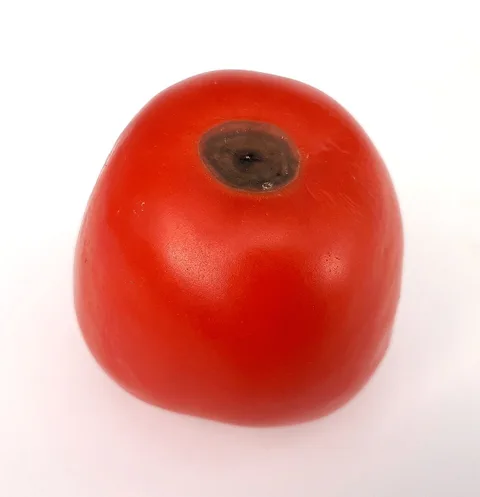
Blossom-end rot on a tomato
What it looks like
A sunken, leathery, dark brown-to-black patch on the bottom (the blossom end) of tomatoes, peppers, squash, and melons — right where the flower was. It looks like a disease and gets treated like one, but no pathogen is involved.
How it spreads
It does not spread — it is physiological. The fruit could not get enough calcium at a critical moment, almost always because water was uneven (a dry spell, then a soak) rather than because the soil is short on calcium.
The move
Steady, even moisture is the whole fix: mulch to hold soil moisture, water deeply and consistently rather than in feast-or-famine cycles, and go easy on high-nitrogen fertilizer. Most soils already carry plenty of calcium — a soil test confirms it. Early fruit often shows it; later fruit usually comes in clean once watering evens out.
If you want to rule out a real calcium or pH issue, a soil test settles it — the soil-report guide shows how to read one.
The Prevention Playbook
Almost every disease above is prevented by the same six habits. Master these and you rarely need anything stronger.
Space for airflow
Give plants room to breathe and prune for an open center. Still, humid air among crowded leaves is what nearly every fungus needs — spacing is the free fungicide.
Water at the base, in the morning
Keep water off the leaves, and where it lands, let the morning sun dry it fast. Wet leaves overnight are an open invitation.
Mulch as a splash barrier
A layer of mulch stops soil — and the spores overwintering in it — from splashing up onto the lowest leaves, where early blight and septoria always start.
Rotate crop families
Move tomatoes, potatoes, squash, and brassicas to a new spot each year so soil-borne diseases lose their host and starve out.
Choose resistant varieties
The single biggest lever. Resistance codes on a plant tag are decades of breeding working for you — your Extension lists what performs locally.
Clean up in fall
Most fungal and bacterial diseases overwinter in last year’s debris. A thorough end-of-season cleanup breaks the cycle before it restarts.
Start With Resistant Varieties
Resistance is the single biggest lever on this page — the crops the guide names most often are the ones where choosing a resistant variety changes the season. Each links to its full growing page, where you can score it against your own soil, sun, and climate.
Which specific varieties perform is regional — start from the resistance codes on the tag, then confirm against your Cooperative Extension’s local list.
We read your parcel's soil, sun, and climate and score 1,085 plants against the real conditions — because the best disease defense is a plant that belongs where you put it.
Three things about your exact spot that zone averages miss:
Your soil pHYour frost-free daysYour sun & shade
We read public map data for this spot — soil, climate, flood, and parcel records. How we handle your address.
25+ data sources analyzed in seconds
Frequently Asked Questions
Why does my plant have white powder on the leaves?
That is almost certainly powdery mildew — a fungus that coats leaf surfaces in warm days and cool, humid nights. It rarely kills the plant. Improve airflow, water at the base in the morning, remove the worst leaves, and choose resistant varieties next season.
How do I stop tomato blight?
Two different diseases go by "blight." Early blight (target-like spots on the lower leaves) is managed with mulch, base-watering, airflow, and rotation. Late blight (fast, greasy dark blotches) moves quickly and warrants pulling and bagging affected plants immediately — start with resistant varieties and certified seed potatoes.
Is blossom-end rot a disease?
No — and that is why fungicides do nothing for it. The dark leathery patch on the bottom of tomatoes and peppers is a calcium-delivery problem caused by uneven watering. Steady, even soil moisture (mulch helps) is the fix; most soils already carry plenty of calcium.
Do I have to spray to grow healthy plants?
Usually not. Spacing for airflow, watering at the soil in the morning, rotating crop families, cleaning up debris in fall, and choosing resistant varieties prevent the great majority of disease before it starts. Sprays are a supporting tool for specific problems, not the foundation.
The resistant-variety lists that actually hold up are regional. Your state’s Cooperative Extension keeps the current one, and every Growable Ground state growing page links yours directly. Think of Extension as the local complement to this national playbook — never the dead-end.

 Diseases