Every soil on this page is a mix of three particle sizes — sand (the largest), silt, and clay (the smallest) — plus organic matter and the story of how it got where it is. That story is the useful part: a soil laid down by a glacier behaves differently from one laid down by a river, even when a lab would call them similar textures. Texture sets how fast water moves; history sets everything else.
The soil names below are the ones our state growing pages use — click any soil chip on a state page and it lands here, on that soil’s entry. Each one covers the same four things: what the soil is, how it drains, what genuinely thrives in it, and how to work with it rather than against it. No soil on this list is a verdict. Every one of them is growing something well for somebody right now.
Free Report
Which of these is under YOUR land?
Enter your address and we read the USDA soil survey for your exact parcel — texture, pH, and drainage — then score 1,085 plants against it.
Three things about your exact spot that zone averages miss:
Your soil pHYour frost-free daysYour sun & shade
We read public map data for this spot — soil, climate, flood, and parcel records. How we handle your address.
25+ data sources analyzed in seconds
The Loams
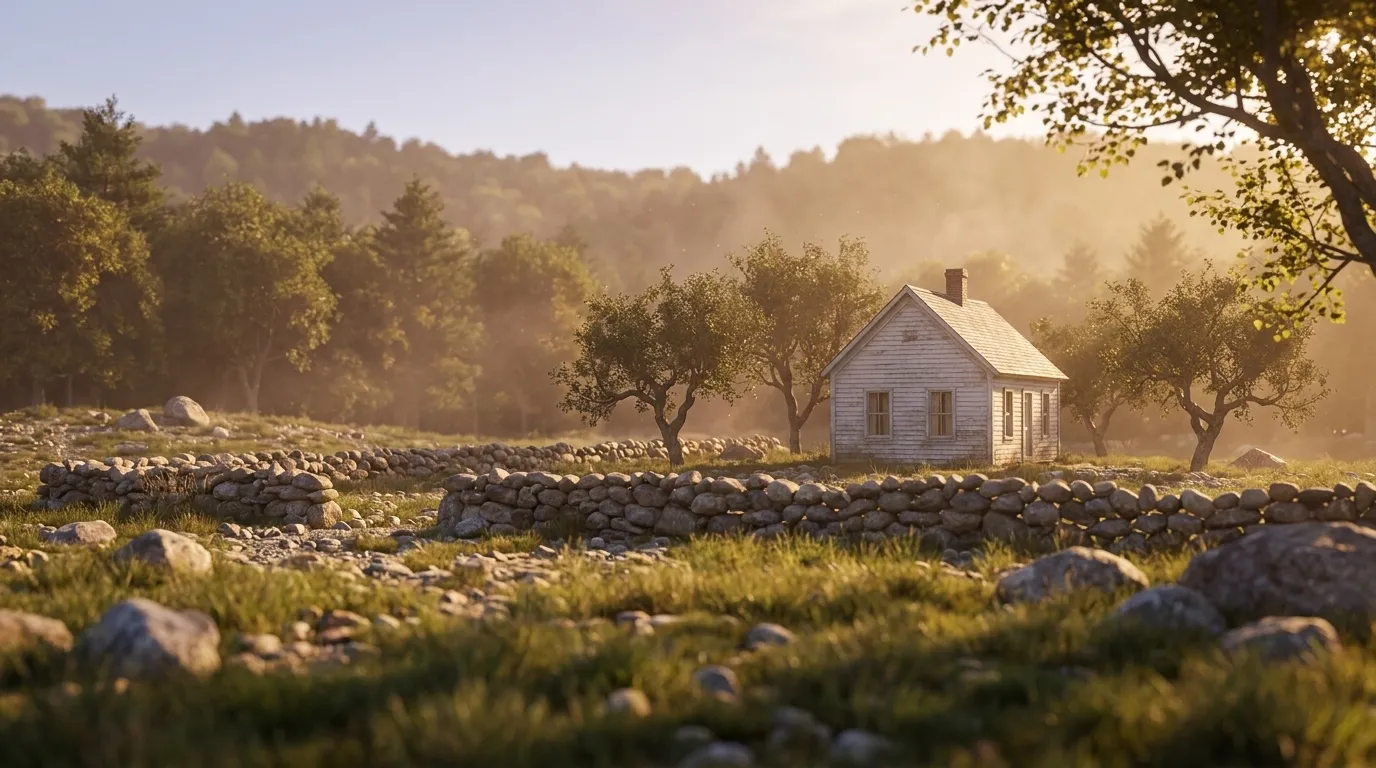
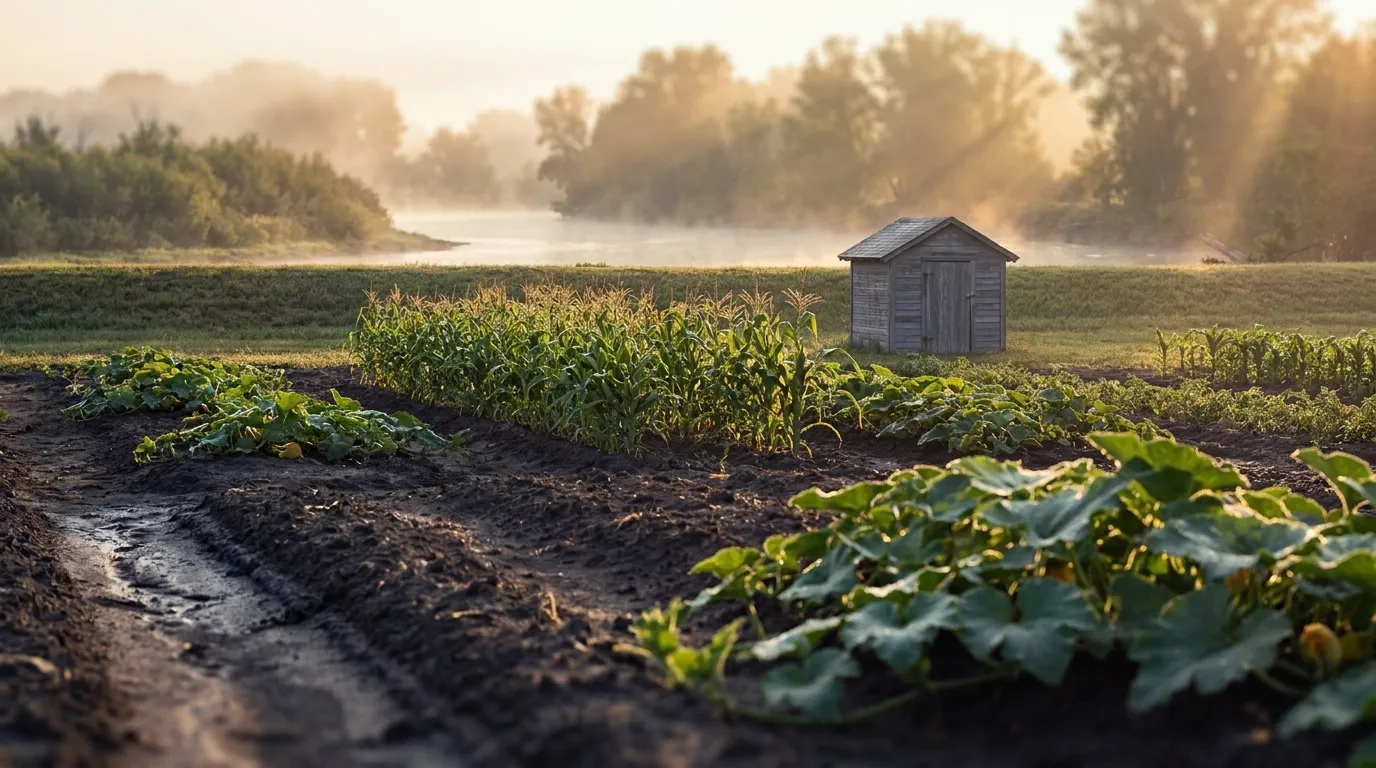
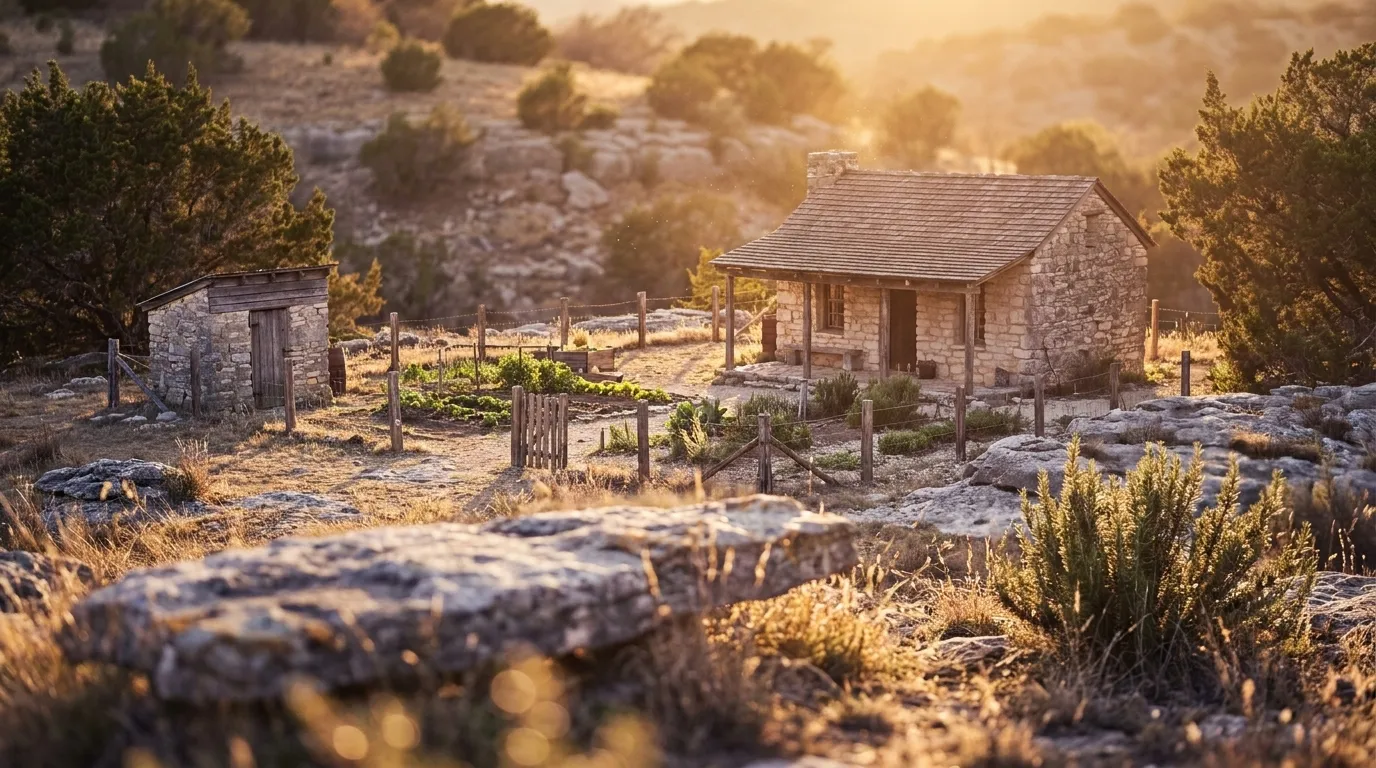
The kind of country where loam soils occur — an illustration, not a soil photo.
Loam is the balance point of the soil-texture triangle — sand, silt, and clay in proportions that hold water without drowning roots and hold nutrients without locking them up. Most of the soils American growers work are some flavor of loam, each tilted toward one parent material or another.
Loam
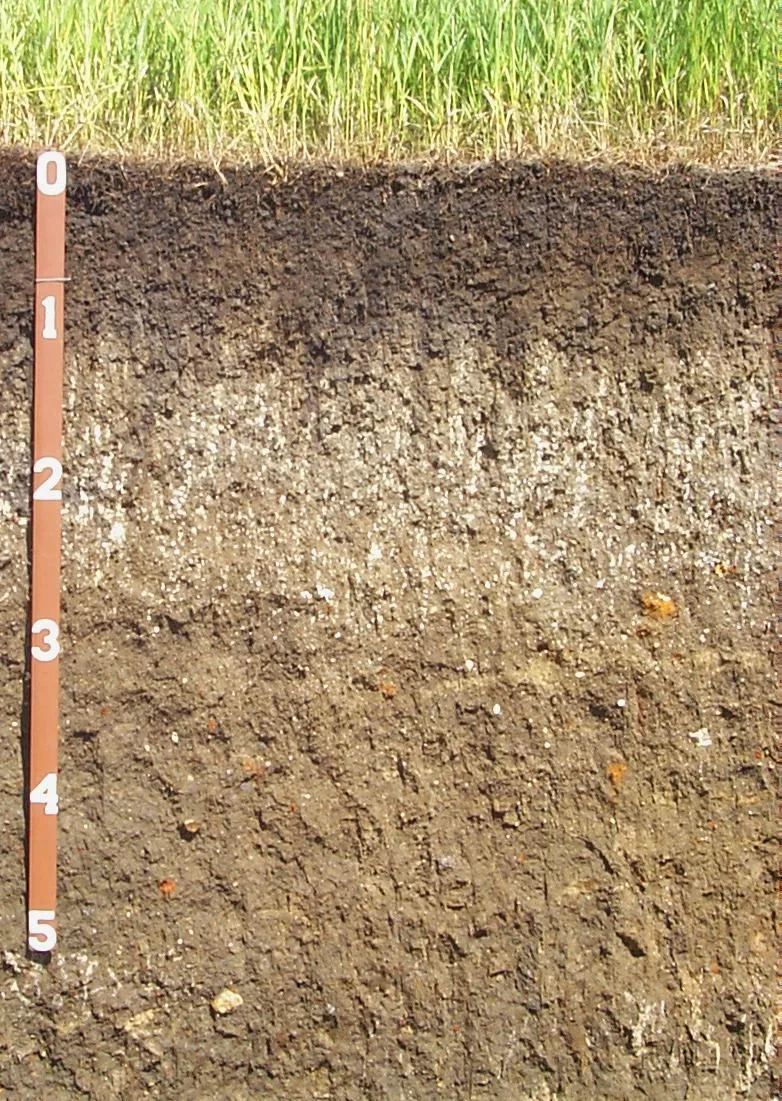
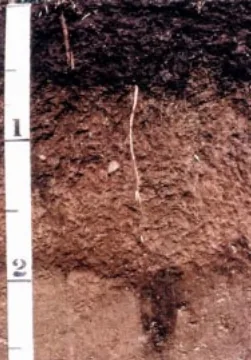
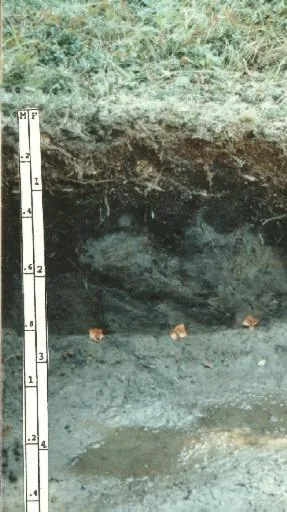
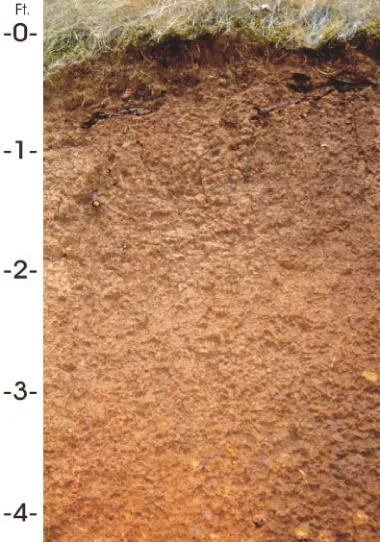
Soil profile: Houdek series, South Dakota
What it is
The reference soil — sand, silt, and clay in near-equal influence, usually with a healthy share of organic matter. Loam is what every other texture gets compared against, and what most soil amendment is quietly trying to approximate.
How it drains
Balanced. The sand fraction keeps water moving, the clay fraction holds enough back for roots to drink between rains. After a heavy storm, loam typically clears the root zone within a day.
What thrives
Nearly everything in the vegetable garden — tomatoes, peppers, beans, squash, brassicas — plus most fruit trees, berries, and herbs. Loam gives you the widest plant palette of any texture.
Working with it
Protect what you have: keep it covered with mulch or cover crops, add compost annually, and stay off it when it is wet so the structure you inherited stays intact.
Loam tilted toward sand — gritty between your fingers, quick to warm in spring, easy to dig in any season. It is the most common garden soil named on our state pages, and one of the most forgiving.
How it drains
Fast. The sand fraction opens the soil up, so water moves through the root zone quickly and the surface rarely stays soggy. The trade is that nutrients ride out with the water.
What thrives
Root crops love it — carrots, potatoes, radishes, and onions size up cleanly in ground they can push through. Melons, sweet potatoes, asparagus, and most herbs appreciate the warmth and the drainage.
Working with it
Feed it little and often: compost and mulch build its water- and nutrient-holding capacity year over year, and drip irrigation keeps moisture steady during dry stretches. It rewards attention faster than almost any other soil.
Where you’ll meet it
Everywhere, but especially the Atlantic and Gulf coastal plains — growers' state pages name it along the Coastal Plain, the Eastern Shore, the Tidewater, the Carolina Sandhills, and New Jersey's Pine Barrens.
Silt loam
Also appears on state pages as: Silt loam (Palouse) · Silt loam (Willamette)
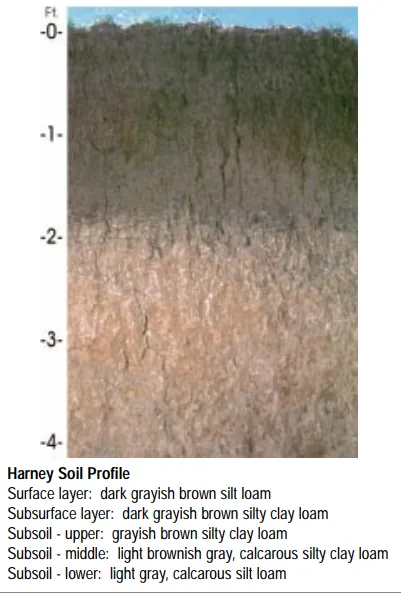
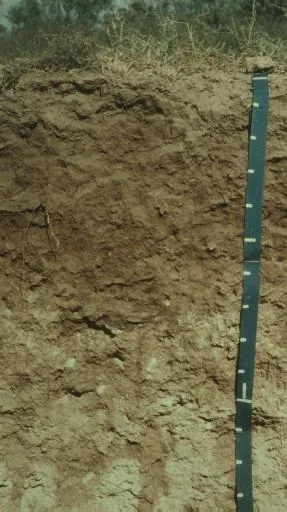
Soil profile: Harney series, Kansas
What it is
Loam dominated by silt — particles finer than sand, coarser than clay, with a smooth, floury feel when dry. Much of it began as wind-blown or water-carried dust that settled over millennia, which is why silt loams underlie some of the best farmland in the country.
How it drains
Moderate. Silt holds water well and releases it steadily, though the fine particles can crust after hard rain and compact under traffic.
What thrives
The full vegetable garden does well here, and small grains, corn, and leafy greens are classic silt-loam crops. Its steady moisture suits shallow-rooted plants that dislike drought stress.
Working with it
Keep the surface covered — mulch prevents crusting, and avoiding tillage when wet preserves the structure. A silt loam managed gently is close to loam in what it will let you grow.
Where you’ll meet it
State pages name two famous ones: the wind-laid silt loams of Washington's Palouse country and the valley-floor silt loams of Oregon's Willamette Valley.
Clay loam
No verified open-license photo yet — this loam is close kin to the loam and silt-loam profiles above.
What it is
Loam tilted toward clay — heavier in the hand, slower to dry, and richer in nutrients than its sandier cousins. Clay particles carry a surface charge that holds fertilizer and minerals where roots can reach them.
How it drains
Slow to moderate. Water lingers in the root zone longer than in loam, which is a gift in dry summers and a challenge in wet springs.
What thrives
Heavy feeders that appreciate steady moisture — brassicas, corn, beans, and many fruit trees. Perennials with strong root systems establish well once they are through the first season.
Working with it
Work it only when it crumbles, never when it smears, and let compost and cover-crop roots open the structure over time. Raised beds buy you earlier spring planting while the native clay loam feeds deep roots below.
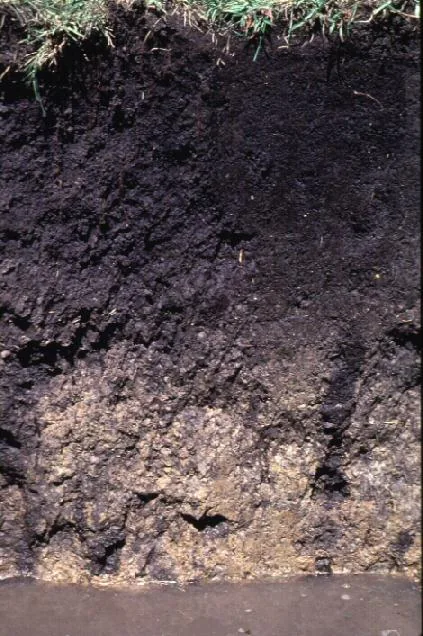
Prairie loam
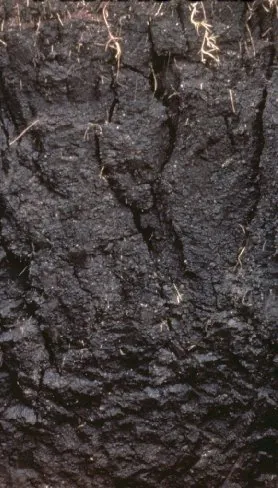
Soil profile: Drummer series, Illinois
What it is
The deep, dark loam built by thousands of years of prairie grass living and dying in place. Each generation of roots added organic matter meters down, producing the black topsoil the Midwest is famous for.
How it drains
Good. The crumb structure that prairie roots built lets water in and holds it like a sponge, releasing it steadily through the season.
What thrives
This is some of the most productive crop ground on Earth — corn, beans, squash, brassicas, and nearly any vegetable you plant. Prairie natives like coneflower and big bluestem are, unsurprisingly, right at home.
Working with it
The main job is stewardship: keep it covered, keep living roots in it as much of the year as you can, and it will keep doing what it has done for millennia.
Mountain loam
No single photo represents mountain loam honestly — it changes bench to bench. See the loam profile above for the base texture.
What it is
Loam formed on mountain slopes and valleys — usually shallower than lowland soils, mixed with rock weathered from the peaks above, and highly variable from one bench to the next.
How it drains
Usually good to fast, because slopes shed water and the rock fraction keeps the profile open. South-facing ground dries markedly faster than north-facing.
What thrives
Cool-season vegetables, berries, and hardy perennials suited to the elevation. Short seasons matter more than the soil here — choose varieties bred for quick maturity.
Working with it
Terraces and raised beds hold soil and moisture on sloping ground, and compost deepens a shallow profile faster than you would expect. Let your microclimate — aspect, frost pockets, wind — pick the planting spots.
Rocky loam
See the glacial-till profile — rocky loam is the same stone-threaded ground.
What it is
Loam threaded with stones — the signature of ground where glaciers, mountains, or shallow bedrock keep feeding rock into the topsoil. Every New England stone wall started as a rocky-loam garden bed.
How it drains
Good. The stones keep channels open through the profile, and rocky ground rarely waterlogs.
What thrives
Fruit trees, brambles, asparagus, herbs, and deep-rooted perennials thread between the stones happily. Root crops that need clean, straight runs — long carrots, parsnips — prefer a picked-over or raised bed.
Working with it
Pick the biggest stones out of your planting beds once and build raised beds where you want fine-textured ground; everywhere else, let the rocks do what they do well — anchor, drain, and hold daytime heat into the evening.
Coastal loam
No verified open-license photo yet — the coastal-sand and loam images bracket what this soil looks like.
What it is
Loam formed near the shore — often a blend of old marine sediments and wind-carried sand, tempered by the maritime climate that surrounds it.
How it drains
Good. The sand fraction keeps water moving, while the finer material holds enough moisture to carry plants between fogs and rains.
What thrives
Cool-season crops thrive in the mild maritime air above this soil — greens, brassicas, peas, and artichokes are classic coastal performers, along with berries and many herbs.
Working with it
Wind is usually the bigger constraint than the soil — a hedgerow or windbreak plus steady compost turns coastal loam into premium vegetable ground.
Where you’ll meet it
Named on the California state page, along the fog-tempered central and northern coast.
The Clays
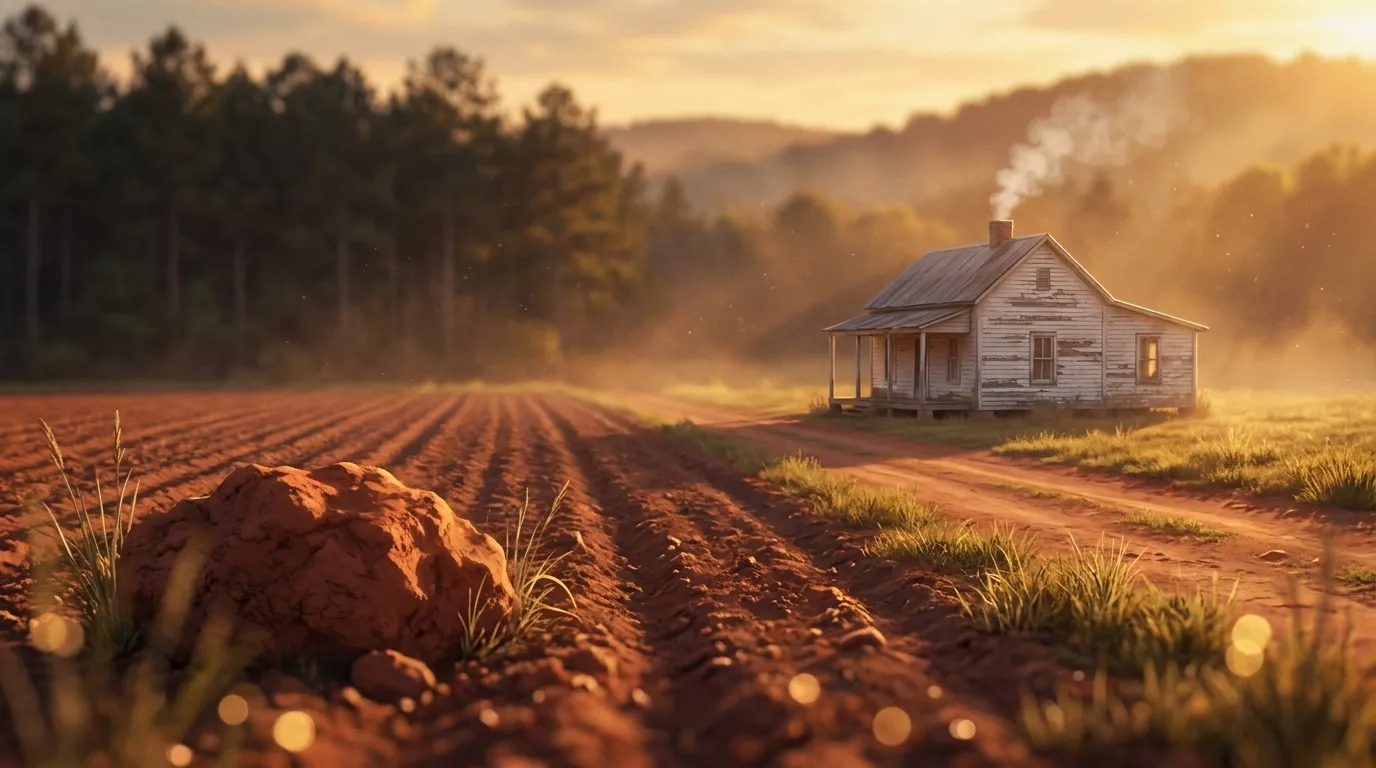
The kind of country where clay soils occur — an illustration, not a soil photo.
Clay particles are the smallest in the soil triangle — so small they stack into dense, plastic layers that hold water and nutrients tenaciously. Clay soils are slow to warm and slow to drain, but they are also some of the most fertile ground in the country once you learn their timing.
Clay
Also appears on state pages as: Clay (Red River Valley)
Soil profile: Vertic Argiustoll, Victoria County, TexasPhoto: Soil Science (soilscience.info, NC State), CC BY 2.0
What it is
Soil dominated by the finest particles in the triangle — so fine they are invisible individually, stacking into dense sheets that give clay its heft and its shine when wet. Clay holds more nutrients per shovelful than any other texture.
How it drains
Slow. Water enters clay reluctantly and leaves it the same way, so wet springs keep it cold and unworkable longer than lighter soils.
What thrives
Once established, heavy feeders prosper — brassicas, beans, corn, and many fruit trees ride clay’s nutrient supply and summer moisture reserve. Daylilies, roses, and prairie perennials handle it without complaint.
Working with it
Timing is the whole game: work it only when a handful crumbles rather than ribbons. Compost, cover crops, and never walking on beds transform clay over a few seasons — and raised beds give you a fast lane while that happens.
Where you’ll meet it
State pages name the lake-flat clay of the Red River Valley on the Minnesota–North Dakota line — glacial-lakebed ground that is famously fertile and famously flat.
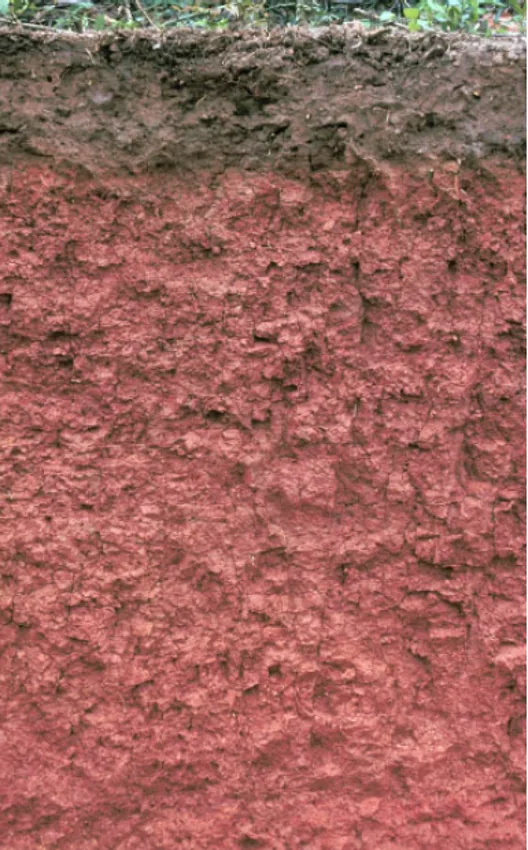
Red clay
Also appears on state pages as: Red clay (Piedmont) · Piedmont clay
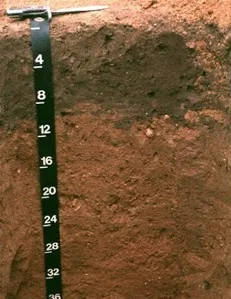
Soil profile: Cecil series, North Carolina
What it is
Clay stained red by iron oxides — the same chemistry as rust — weathered over long ages from the rock beneath. In the Southeast it is the region’s signature ground, exposed wherever a shovel or a rainstorm cuts the surface.
How it drains
Slow. Red clay seals under pounding rain and sheds water across the surface, then holds tight to what soaks in.
What thrives
Okra, southern peas, sweet potatoes, and muscadines are traditional red-clay performers, and many fruit trees root deep into it once through the first year. Azaleas and blueberries appreciate its typical acidity.
Working with it
Compost is the great red-clay opener — organic matter opens the structure and feeds the biology that keeps it open. Plant on slight mounds or in raised beds for drainage, and mulch heavily so rain lands soft.
Where you’ll meet it
The Piedmont — the rolling ground between the Appalachians and the coastal plain — is where state pages name it, from Virginia through Georgia.
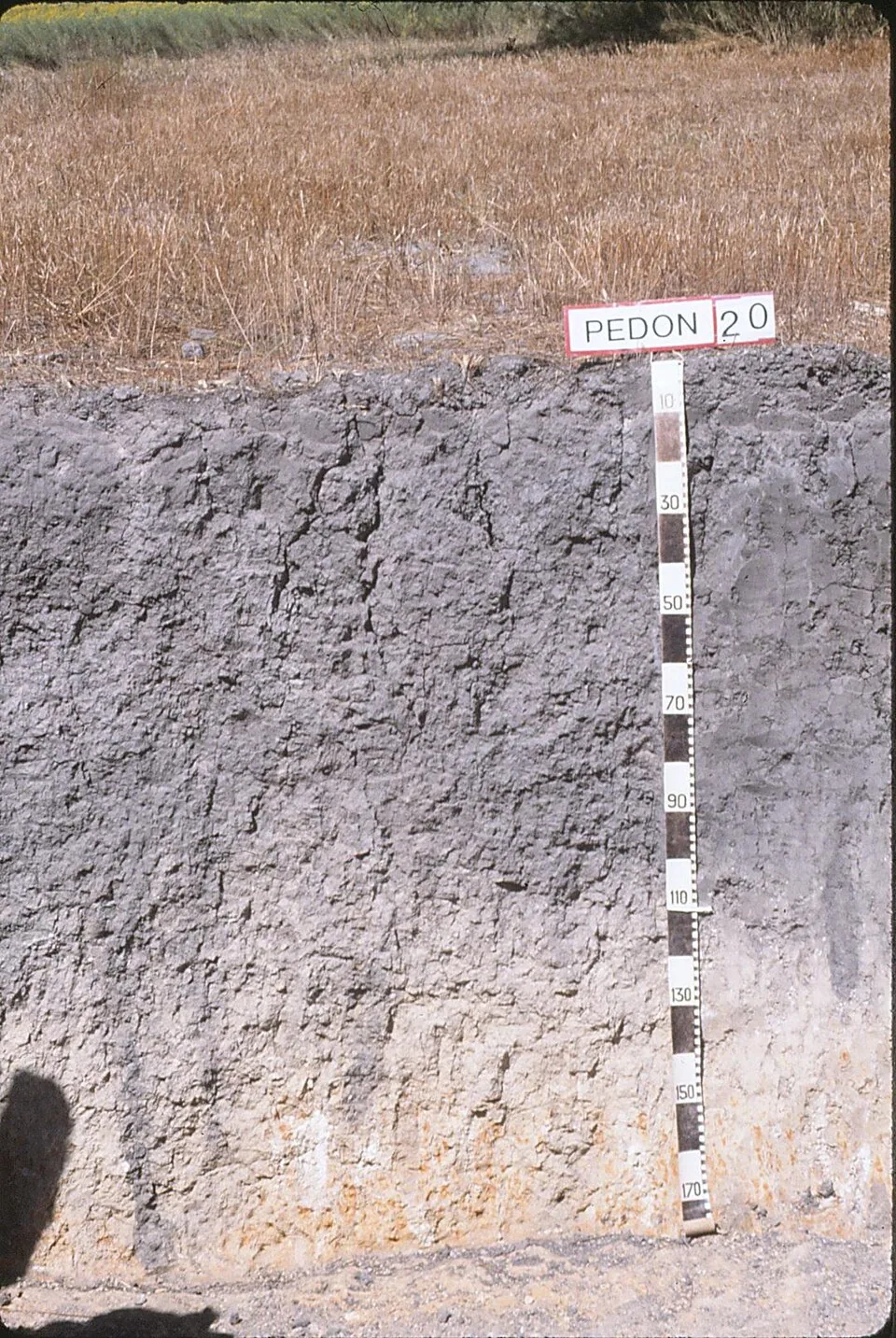
Black clay
Also appears on state pages as: Black clay (Blackland Prairie)
Soil profile: Vertisol (USDA soil order)
What it is
Deep, dark clay built from calcium-rich parent material under prairie grass — heavy, fertile, and dramatic. It swells when wet and shrinks when dry, opening cracks wide enough to lose a trowel in.
How it drains
Slow when wet and swollen; the same cracks that open in drought let the first rains plunge deep before the clay seals again.
What thrives
This is historically famous crop ground — corn, sorghum, and cotton country — and in the garden it grows vigorous tomatoes, okra, melons, and brassicas once warm. Its typical alkalinity suits figs, pomegranates, and many Mediterranean herbs.
Working with it
Respect the swell–shrink cycle: keep beds mulched to even out the moisture swings, water foundations of raised beds consistently, and choose lime-tolerant varieties rather than fighting the pH.
Where you’ll meet it
The Texas Blackland Prairie — the crescent of black ground running through the middle of the state — is the name it carries on the Texas page.
Adobe clay
No verified open-license photo yet — see the clay and caliche images for the arid-West clay register.
What it is
The dense, fine clay of the arid West — the same material that, mixed with straw and sun-dried, built the Southwest’s adobe walls. In the ground it bakes brick-hard in summer and turns slick in winter rains.
How it drains
Slow. Adobe sheds summer irrigation across its surface until it wets thoroughly, then holds that moisture for weeks.
What thrives
Established fruit trees, grapes, and olives do well with deep, infrequent watering, and native and Mediterranean plants are built for exactly this ground. Summer vegetables prosper where the top foot has been opened with organic matter.
Working with it
Water slowly and deeply — drip lines beat sprinklers here — and work compost in during the brief window when the clay is moist but not sticky. Raised beds give vegetables a running start while the native adobe anchors trees and vines.
Alkaline clay
Alkaline clay looks like any clay — the difference is pH, not appearance. See the clay profile above.
What it is
Clay with a high pH, common where limestone parent material or low rainfall keeps calcium carbonate in the profile. The chemistry changes which nutrients plants can reach — iron especially becomes hard to take up.
How it drains
Slow, like any clay — water is deliberate going in and deliberate leaving.
What thrives
Plants that evolved on limey ground shrug at the pH: asparagus, brassicas, beets, spinach, figs, lavender, and many stone fruits on tolerant rootstocks. Yellowing leaves with green veins on other plants is the iron signal to read.
Working with it
Choose lime-tolerant varieties first — it is far easier than lowering the pH of clay. Compost helps on both fronts, buffering the chemistry while opening the structure, and chelated iron rescues a struggling favorite.
Alluvial clay
See the alluvial river-profile — alluvial clay is its finest, slowest-draining fraction.
What it is
Clay laid down by rivers — the finest sediment, carried farthest and dropped last where floodwater slowed and spread. Valley floors and old floodplains carry it in deep, nutrient-rich beds.
How it drains
Slow, and often sitting over a shallow water table in low-lying valley positions — the flip side of all that fertility.
What thrives
Vigorous, moisture-loving crops: corn, squash, brassicas, celery, and cane fruit all pull hard from alluvial clay. Willows and many natives thrive where it stays damp.
Working with it
Plant the low, wet spots to what loves them and raise beds where you want early, workable ground. The fertility is already there — your job is mostly managing water.
The Sands
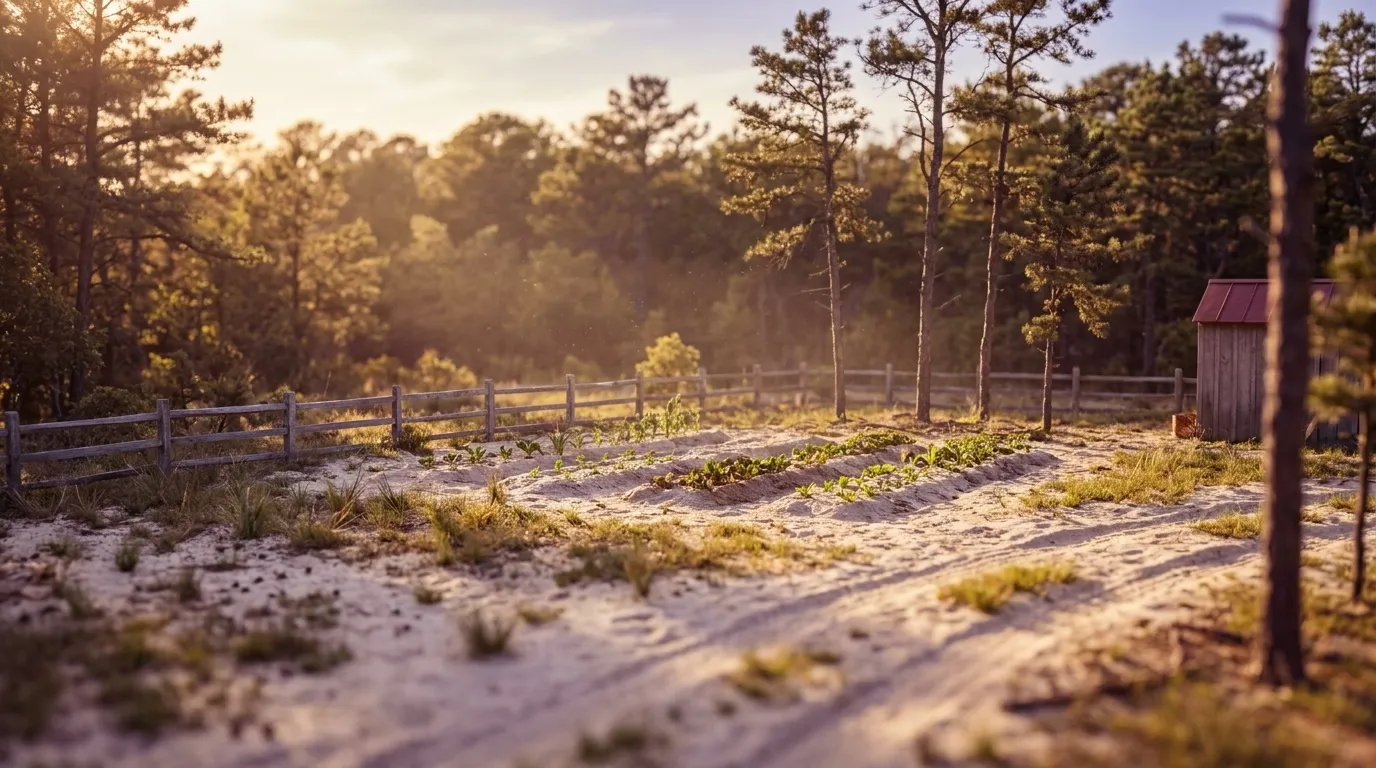
The kind of country where sandy soils occur — an illustration, not a soil photo.
Sand particles are the largest in the triangle, and the gaps between them make sandy soils the fastest-draining ground you can plant. Water and nutrients move through quickly — which is a constraint you manage and an advantage you use, depending on the crop.
Sandy soil
Also appears on state pages as: Sandy
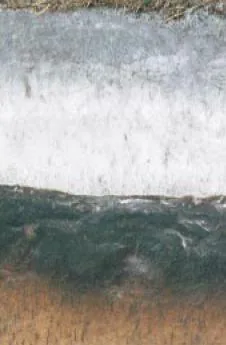
Soil profile: Myakka series, Florida
What it is
Ground dominated by sand-size particles — loose, gritty, quick to warm, and the easiest soil there is to dig. What it lacks in holding capacity it repays in workability and early springs.
How it drains
Very fast. Water passes through in hours, not days, taking dissolved nutrients along with it.
What thrives
Carrots, radishes, potatoes, and sweet potatoes size up beautifully; melons, watermelon, and herbs like rosemary and thyme love the warmth and the dry feet. Many natives and drought-adapted perennials prefer it outright.
Working with it
Think of it as a container you refill: compost every season, mulch always, and small frequent doses of water and fertility beat big occasional ones. Every year of organic matter makes it hold a little more.
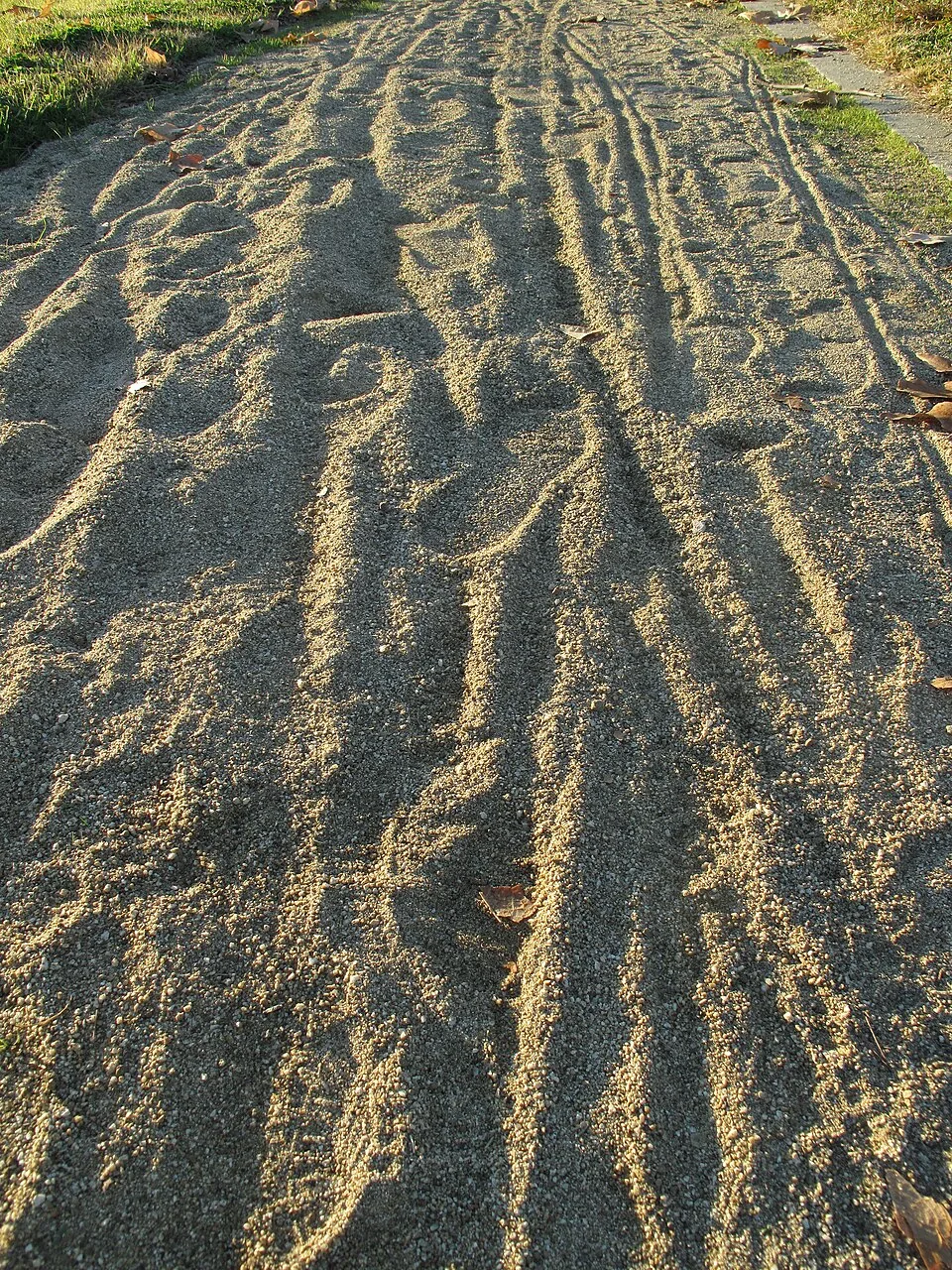
Coastal sand
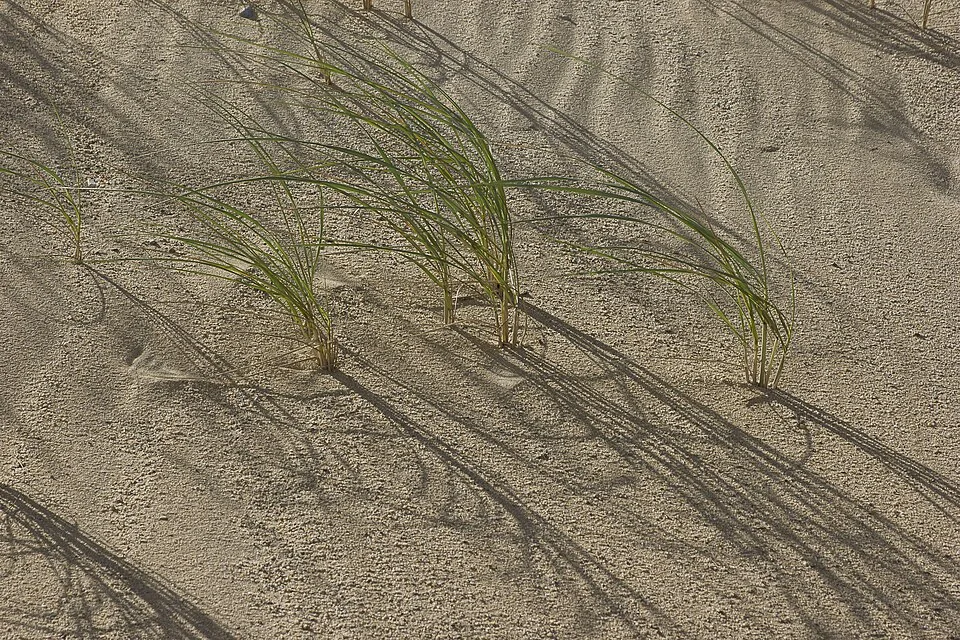
Dune sand and beach grass, Cape Cod National Seashore
What it is
Beach- and dune-derived sand reworked by wind and waves — often carrying shell fragments that nudge the pH upward, and always paired with salt-bearing coastal air.
How it drains
Extremely fast. Rain and irrigation vanish through it almost as fast as they land.
What thrives
Salt-tough plants earn their keep here: beach plum, bayberry, seaside goldenrod, rugosa roses, and hardy herbs like rosemary. Vegetables produce well in amended beds sheltered from the wind.
Working with it
Build up rather than dig in — compost-rich raised beds over the sand give vegetables everything the native ground withholds, while windbreaks and mulch slow the constant drying.
Desert sand
Soil profile: Aridisol (USDA soil order)
What it is
The loose, mineral sand of arid basins — low in organic matter because so little grows and decays there, but rich in unweathered minerals waiting on water.
How it drains
Very fast at the surface, though hard mineral layers can lurk beneath and pond water where you least expect.
What thrives
Desert natives are the honest first choice — mesquite, palo verde, agave, desert wildflowers. With shade cloth, drip irrigation, and compost, raised desert beds grow exceptional peppers, melons, and winter greens.
Working with it
Garden with the desert calendar: plant the mild seasons, irrigate by drip, mulch deeply, and concentrate compost where you plant instead of spreading it thin. Small, intensively-kept beds outperform sprawling ones here.
Sandy outwash
See the glacial-outwash profile — sandy outwash is the same meltwater-sorted sand and gravel.
What it is
Sand and gravel sorted and dropped by glacial meltwater rivers — the glacier ground the rock, and the rushing water sorted it by size as the ice retreated. Outwash plains are flat, stone-free at the surface, and deeply drained.
How it drains
Very fast, often to considerable depth — outwash rarely holds a puddle.
What thrives
Potatoes are the classic outwash crop, along with carrots, asparagus, and bush fruits. Pines and oaks dominate the native cover for the same reason: they handle the droughtiness.
Working with it
Irrigation plus organic matter is the formula — outwash responds dramatically to both. Mulch is worth double here, holding moisture the sand would otherwise surrender by noon.
Coral sand
No verified open-license photo yet — see the shell-rock image for the coral/limestone chemistry.
What it is
Sand made not from rock but from ground-up coral and shell — calcium carbonate through and through, which keeps the pH firmly alkaline.
How it drains
Extremely fast, like all sands, with the added quirk that the lime chemistry never washes out.
What thrives
Tropical plants adapted to limestone coasts: coconut palm, sea grape, papaya, and many bougainvilleas and natives of coral shorelines. Vegetables grow well in imported-soil or compost-filled beds.
Working with it
Grow acid-preferring plants in containers with their own soil, and build organic matter relentlessly for everything else — compost is both the water reservoir and the nutrient bank on coral ground.
Ice-Age Legacies
The kind of country where ice-age soils occur — an illustration, not a soil photo.
The last glaciation bulldozed, ground, and sorted the northern half of the country, then left the debris behind when the ice melted. If you garden north of roughly the Ohio and Missouri rivers, there is a good chance your soil is something a glacier made.
Glacial till
Soil profile: Lester series, Minnesota
What it is
The unsorted everything a glacier carried — clay, silt, sand, gravel, and boulders — dropped in place when the ice melted. Till is why northern fields grow a fresh crop of stones every spring: frost keeps heaving them up from the jumble below.
How it drains
Variable by the shovelful. Sandy till drains freely; dense, compacted till (hardpan) can perch water above it after snowmelt and heavy rain.
What thrives
Apples, stone fruits, brambles, and the whole northern vegetable garden do well on till — much of New England and the upper Midwest farms it. Deep-rooted perennials work through the stony structure happily.
Working with it
Learn your till’s personality one test hole at a time: where it drains, plant almost anything; where it perches water, choose raised beds or moisture-tolerant plants. The stones you pull make honest bed edging — growers here have been doing exactly that for centuries.
Where you’ll meet it
The glaciated North — till is the default ground across New England, the Great Lakes states, and the northern plains.
Glacial outwash
Soil profile: Antigo series, Wisconsin
What it is
What meltwater rivers made of the glacier’s load: sorted sand and gravel laid out in broad plains and terraces beyond the ice front. Unlike till, outwash is orderly — the water graded it by size.
How it drains
Fast and deep. Outwash plains are among the best-drained ground in the glaciated states.
What thrives
Root crops, asparagus, bush fruits, and orchard trees on drought-tolerant rootstocks. Anything that resents wet feet considers outwash a gift.
Working with it
The constraint is droughtiness, not structure — steady irrigation and annual compost turn outwash into first-class vegetable ground.
Glacial silt
No verified open-license photo yet — it behaves like the silt-loam profile above.
What it is
Rock flour — stone ground so fine by the moving ice that it floats in water — settled out in calm meltwater and left behind as smooth, floury soil.
How it drains
Moderate to slow. The fine particles hold water well but can compact and crust, and they erode easily when left bare.
What thrives
Vegetables and small fruits do well on its steady moisture; greens, brassicas, and root crops appreciate the fine, stone-free tilth.
Working with it
Keep it covered and keep off it when wet — mulch and minimal tillage protect a structure that rebuilds slowly. Treated gently, glacial silt behaves like premium silt loam.
Loess
Also appears on state pages as: Prairie loess
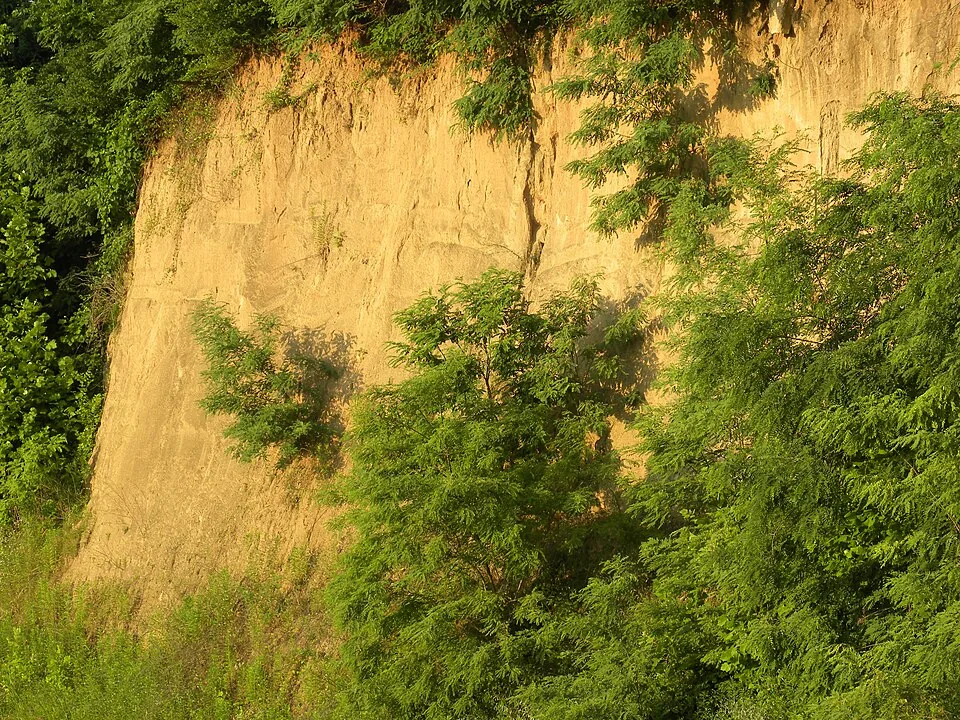
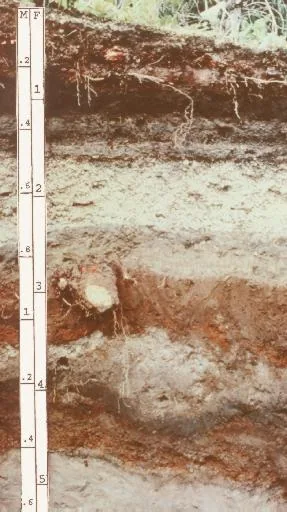
Loess bluff exposure, Vicksburg, Mississippi
What it is
Wind-blown silt lifted off glacial outwash plains and laid down in deep, uniform blankets — in places dozens of feet thick. Loess is stone-free, easy to dig, and underlies much of the world’s great grain land.
How it drains
Good — it absorbs rain readily and holds it in reach of roots — but it erodes faster than any other soil when left bare on a slope.
What thrives
Nearly everything: corn, small grains, and the full vegetable garden thrive in loess country, which is exactly why so much of it is farmed.
Working with it
Cover is everything — mulch, cover crops, and contour beds keep this superb soil where it belongs. Manage erosion and loess asks very little else of you.
Where you’ll meet it
The deep loess belts of the Midwest and the prairie states, where state pages name it outright.
The floor of a vanished glacial lake — fine silt and clay that settled through still water for centuries, exposed as dead-flat, stone-free plains when the lakes drained.
How it drains
Slow. The flatness that makes lakebed ground easy to farm also gives water nowhere to go, and the fine texture holds it.
What thrives
Famously productive for sugar beets, beans, corn, and vegetables — old lakebeds are some of the most valuable farmland in the northern states.
Working with it
Drainage is the historic project on lakebed ground; in a garden, raised beds accomplish in a weekend what field tile does at farm scale. The fertility underneath is worth it.
Permafrost
Soil profile: Gelisol (USDA soil order)
What it is
Ground that stays frozen year-round below a shallow "active layer" that thaws each summer. Everything a grower does happens in that top layer — often just a foot or two of workable soil over the ice.
How it drains
Slow in summer, because meltwater cannot percolate through the frozen floor beneath — the active layer stays cool and often waterlogged.
What thrives
Cold-adapted, fast-maturing crops under the long subarctic daylight: potatoes, cabbage, kale, broccoli, and hardy greens famously reach remarkable size in the land of the midnight sun.
Working with it
Raised beds are transformative here — lifting roots away from the frozen floor warms the soil weeks earlier and drains the melt. Dark mulch, cold frames, and quick varieties do the rest.
Where you’ll meet it
Named on the Alaska state page — the defining ground of the far north.
Pro Tip
State pages name a state’s dominant soils — but soil changes lot by lot. The USDA soil survey maps it at the field level, and your report reads the exact map units under your parcel boundary. Two neighbors can garden on two different soils.
Water-Laid Soils
The kind of country where water-laid soils occur — an illustration, not a soil photo.
Rivers, floods, and tides sort soil by particle size and lay it down in layers. Water-laid soils are often the deepest and most fertile in a region — the reason river valleys have been farmed continuously for as long as anyone has farmed.
Alluvial
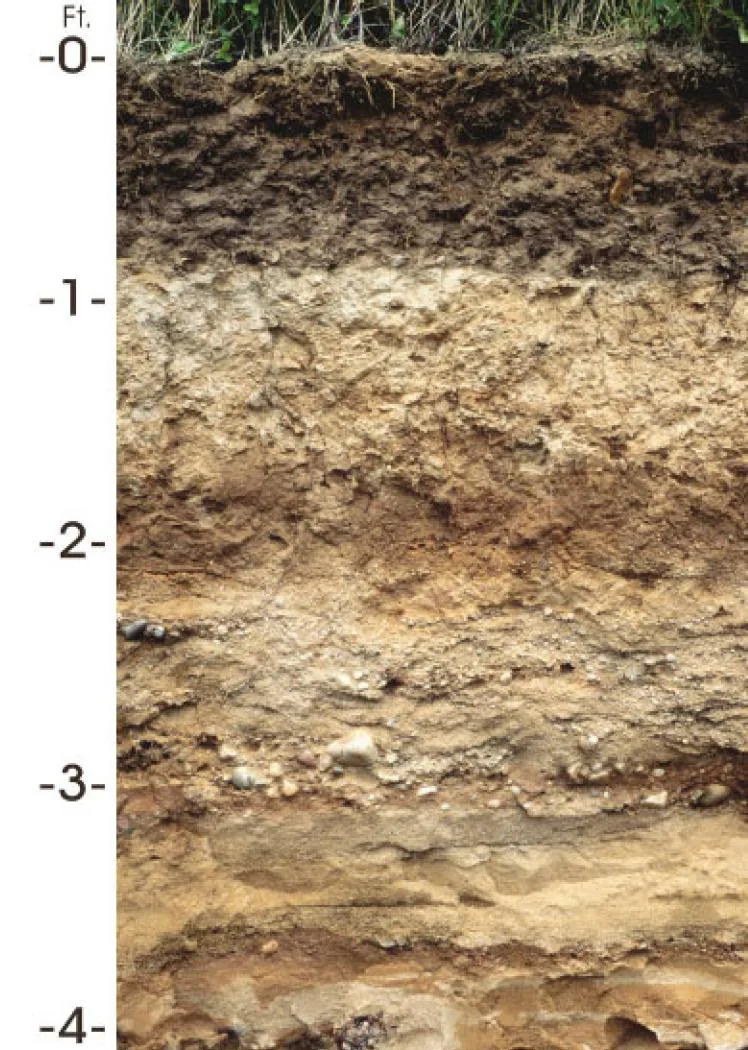
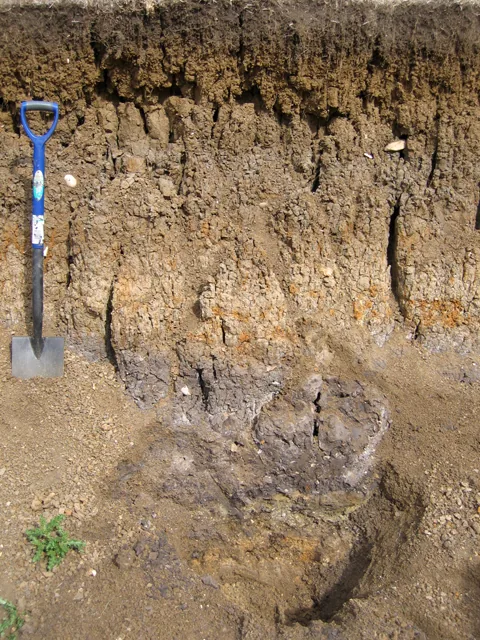
River-alluvium profile (Fladbury series), Great Ouse floodplainPhoto: Rodney Burton, Geograph, CC BY-SA 2.0
What it is
Soil delivered by rivers — sediment lifted upstream and laid down wherever floodwater slowed. Alluvial ground is young, layered, and continually re-enriched, which is why river-valley farms are the oldest farms there are.
How it drains
Usually good: rivers sort their loads, and most alluvial soils have enough sand and silt to move water while holding plenty for roots. Low-lying pockets can run wet.
What thrives
Nearly everything — vegetables, orchards, vines, and berries all prosper on alluvium. Its depth lets roots go as far down as they care to.
Working with it
Know your flood risk before you site permanent plantings, and otherwise count yourself lucky — alluvial ground mostly asks you to keep up with it.
River silt
Also appears on state pages as: River valley silt
See the alluvial profile — river silt is its fine, fertile bottomland fraction.
What it is
The fine fraction of a river’s load — smooth, fertile silt spread across valley floors and bottomlands by generations of floods.
How it drains
Moderate. It holds moisture generously through dry spells; in the lowest bottomland positions it can stay wet late into spring.
What thrives
Bottomland silt grows legendary sweet corn, squash, melons, and greens — the moisture-holding fertility suits big, thirsty crops.
Working with it
Plant the wetter ground late or raise it, and keep the surface mulched so it neither crusts nor blows. Little else in a region grows vegetables better.
Tidal marsh
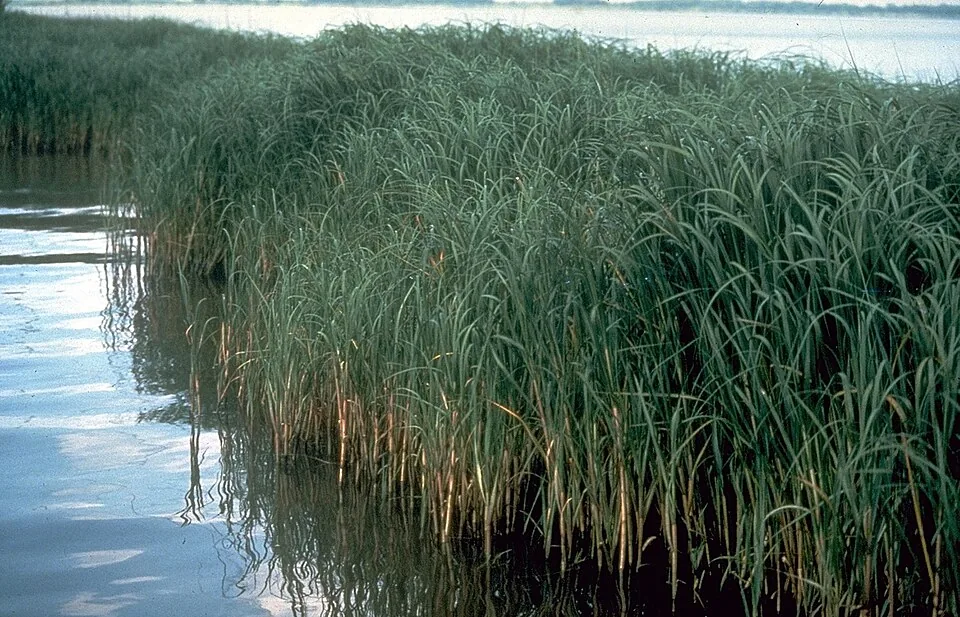
Salt-marsh cordgrass (Spartina alterniflora) at the marsh edge
What it is
Soil built where the tide meets the land — fine sediment and marsh-grass peat, saturated with brackish water and rich in organic matter. It is as much wetland as soil.
How it drains
Tide-ruled: saturated on the flood, briefly drained on the ebb. Conventional beds are not what this ground is for.
What thrives
Salt-marsh natives — cordgrass, sea lavender, marsh elder — and the wildlife economy they support. Upland edges above the tide line grow salt-tolerant shrubs and gardens in raised, protected beds.
Working with it
Work above it rather than in it: garden the upland margin in raised beds, and treat the marsh itself as the storm buffer and habitat it is. Many marshes also carry wetland protections worth checking before any digging.
Marl
No verified open-license photo yet — a soft, pale, lime-rich clay.
What it is
A lime-rich mix of clay and calcium carbonate laid down in shallow, calm water — soft and pale, historically dug and spread on acid fields as a liming material.
How it drains
Slow. Marl compacts easily and holds water, and its carbonate chemistry keeps the pH firmly alkaline.
What thrives
Lime-loving plants take to it readily — brassicas, spinach, asparagus, figs, and many Mediterranean herbs. Tropical fruits on tolerant rootstocks manage it in the far South.
Working with it
Choose alkaline-tolerant varieties and build organic matter to open the structure; for acid-preferring plants, containers or raised beds with their own soil are the honest path.
The Organic Soils
The kind of country where organic soils occur — an illustration, not a soil photo.
Where ground stays wet enough for long enough, dead plants stop decomposing all the way and accumulate instead. The result is soil that is mostly organic matter — black, spongy, and extraordinarily fertile once the water is managed.
Muck
Also appears on state pages as: Muck (Everglades) · Muck (Black Dirt region)
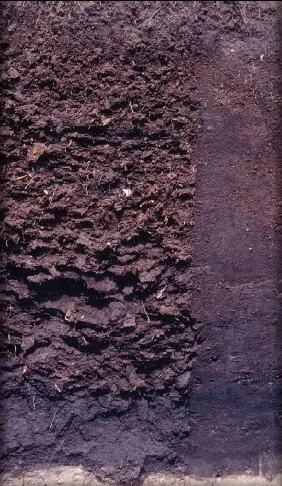
Soil profile: Histosol (USDA soil order)
What it is
Black, crumbly soil that is mostly decomposed organic matter — the floor of a drained marsh or shallow lake where plant remains accumulated faster than they could rot. Muck is among the most fertile ground a vegetable grower will ever touch.
How it drains
It holds water like a sponge by nature; farmed muck is managed with ditches and water control, and it can dry, shrink, and even blow when left bare.
What thrives
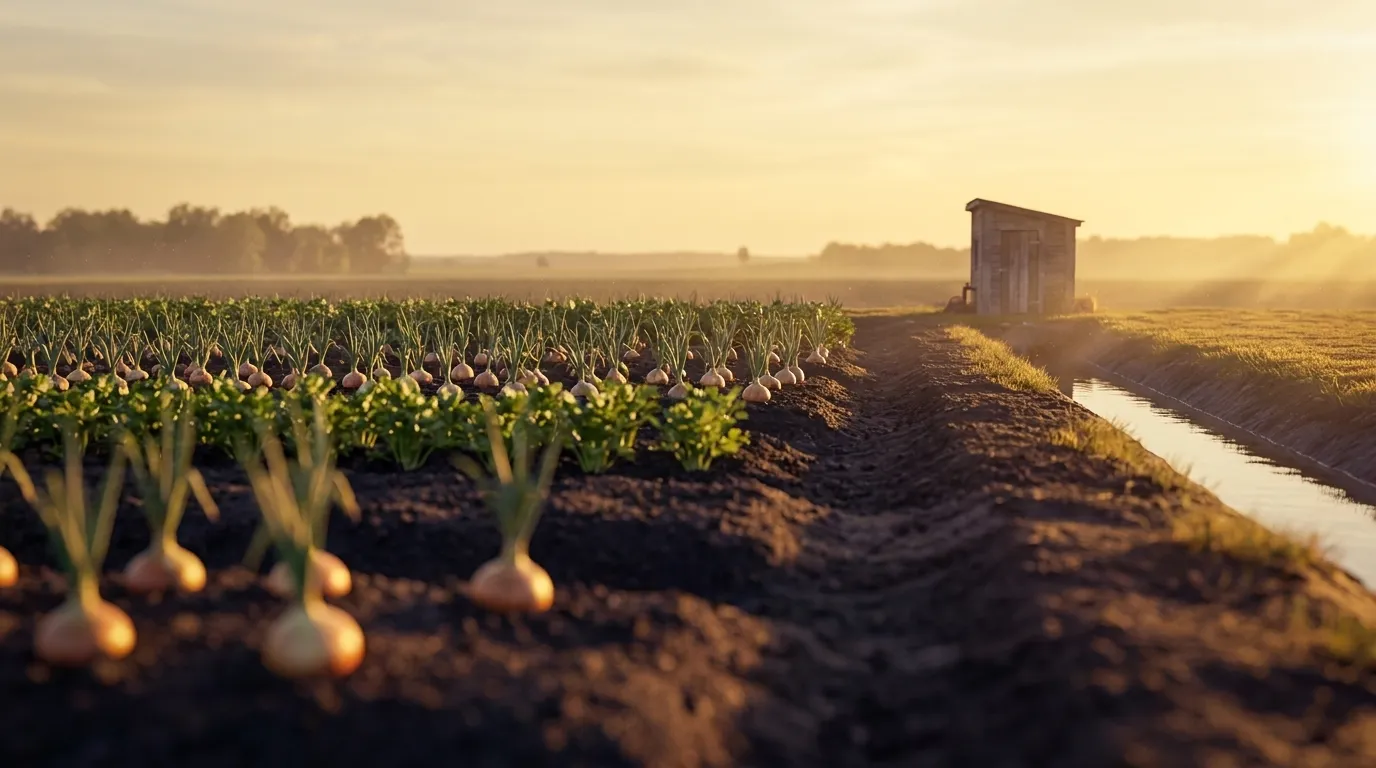
Muck is celebrated vegetable ground — onions, celery, carrots, lettuce, and greens grow to prize quality in it. Its loose, black tilth is what root and leaf crops dream of.
Working with it
Manage water first and keep it covered — bare muck oxidizes and subsides year by year. Cover crops and windbreaks protect the capital; the fertility takes care of the rest.
Where you’ll meet it
State pages name two storied muck lands: the Everglades agricultural ground of Florida and New York’s Black Dirt region, an old glacial lakebed turned onion country.
Peat
Also appears on state pages as: Peat bog
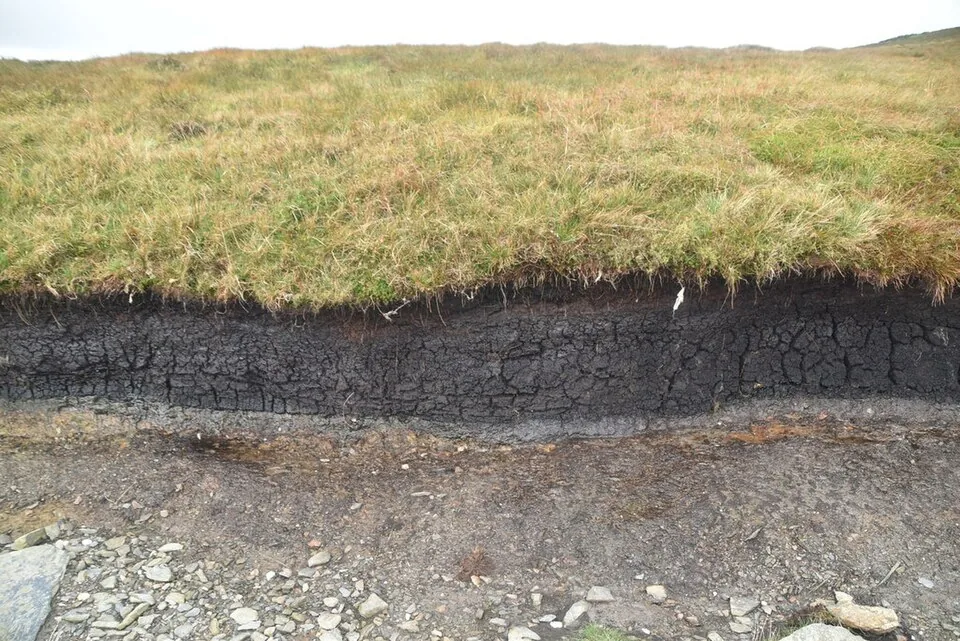
Peat bank under moor grassPhoto: N Chadwick, Geograph, CC BY-SA 2.0
What it is
Partly-decomposed plant material accumulated in cold, waterlogged bogs — spongy, acidic, and slow to give up its stored organic matter. A peat bog is a living archive; peat soil is what you get at its edges and drained margins.
How it drains
Saturated by default — peat forms precisely because water excludes the oxygen decomposition needs. Drained peat holds moisture beautifully but can stay cold late into spring.
What thrives
Acid-lovers are at home: blueberries and cranberries are the classic peatland crops, with rhododendrons, azaleas, and bog natives alongside.
Working with it
Lean into the acidity with berries rather than fighting it with lime, and manage the water table instead of trying to erase it. Intact bog beyond your beds is worth leaving be — it is doing quiet work for the whole watershed.
Rock-Born & Arid Ground
The kind of country where rock-born soils occur — an illustration, not a soil photo.
Some soils never traveled — they weathered in place from the bedrock beneath them, and they carry that rock's chemistry. Others formed under dry skies where evaporation, not rainfall, wrote the rules. Both reward growers who match the plant to the chemistry instead of fighting it.
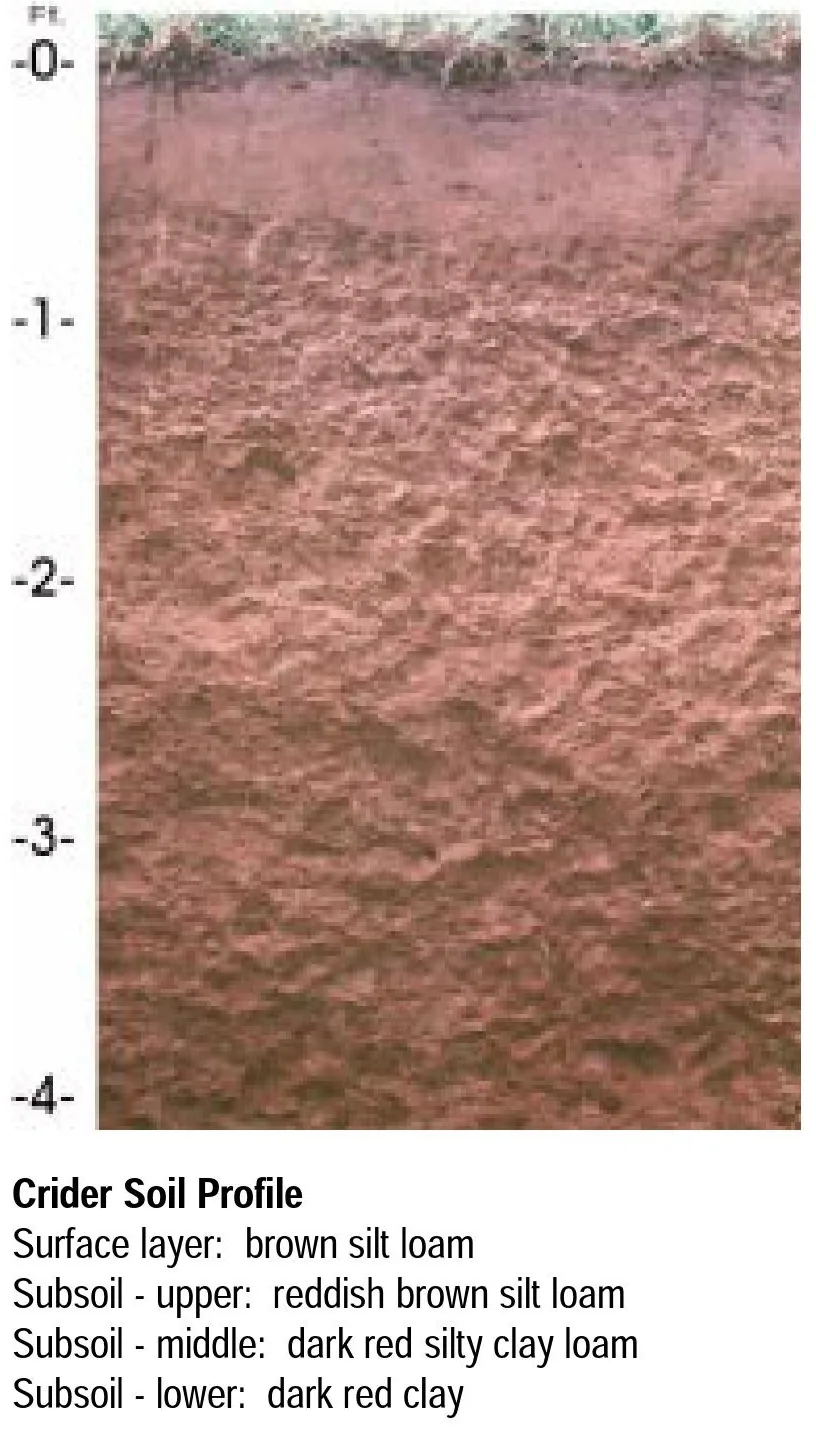
Limestone-derived
Soil profile: Crider series, Kentucky
What it is
Soil weathered in place from limestone bedrock — typically thin over rock, well-supplied with calcium, and alkaline in reaction. Sinkholes, springs, and caves often share the neighborhood.
How it drains
Good to fast: fractured limestone under the soil carries water away quickly, and shallow profiles dry sooner than deep ones.
What thrives
Lime-loving plants prosper — lavender, thyme, sage, brassicas, beets, figs, and wine grapes have limestone pedigrees worldwide. Many native wildflowers of glade and prairie are limestone specialists.
Working with it
Match plants to the chemistry and the shallowness: alkaline-tolerant varieties in the ground, acid-lovers in containers, and compost to deepen what the bedrock keeps thin.
Shale-derived
No verified open-license photo yet — clayey, plate-littered ground; see the limestone profile for the rock-born register.
What it is
Soil weathered from shale — compressed ancient mud that splits into thin plates. It breaks down into clayey, often channery ground littered with flat rock fragments.
How it drains
Two-natured: the clay fraction holds water while the shale fragments and fractured bedrock open channels, so hillside shale soils often drain better than their texture suggests.
What thrives
Orchards and vineyards have long favored shale hillsides — the drainage and the heat the rock holds suit deep roots. Brambles, asparagus, and hardy perennials establish well.
Working with it
Build organic matter to loosen the clay between the plates, and use the slope: shale hillsides shed frost and water downhill, which your fruit trees will appreciate.
Chert-derived
No verified open-license photo yet — gravelly, flinty ground; see the decomposed-granite image for the stony texture.
What it is
Soil formed over chert — hard, flinty silica nodules that survive when the limestone around them dissolves away. The result is gravelly, stony ground with sharp fragments through the whole profile.
How it drains
Fast. The chert fragments keep the soil open, and water rarely lingers.
What thrives
Deep-rooted, drought-tolerant plants: fruit trees, grapes, brambles, and native prairie and glade species that evolved on stony Ozark-type ground.
Working with it
Raised beds spare your trowel and your carrots from the gravel; elsewhere, mulch generously and let the stones do their quiet work of drainage and heat storage.
Basalt-derived
Soil profile: Jory series, Oregon
What it is
Soil weathered from basalt — dark volcanic lava rock — inheriting its rich supply of iron, calcium, and magnesium. Basalt country tends toward fertile, red-brown ground.
How it drains
Generally good; basalt soils range from stony and fast-draining on young flows to deeper clay loams on old ones.
What thrives
Wine grapes, orchard fruit, and vegetables all do famously well on basalt-derived soils — volcanic mineral wealth shows up in the harvest.
Working with it
These soils mostly reward ordinary good care — compost, mulch, and steady water. Where the profile is stony and shallow, raised beds deepen your options.
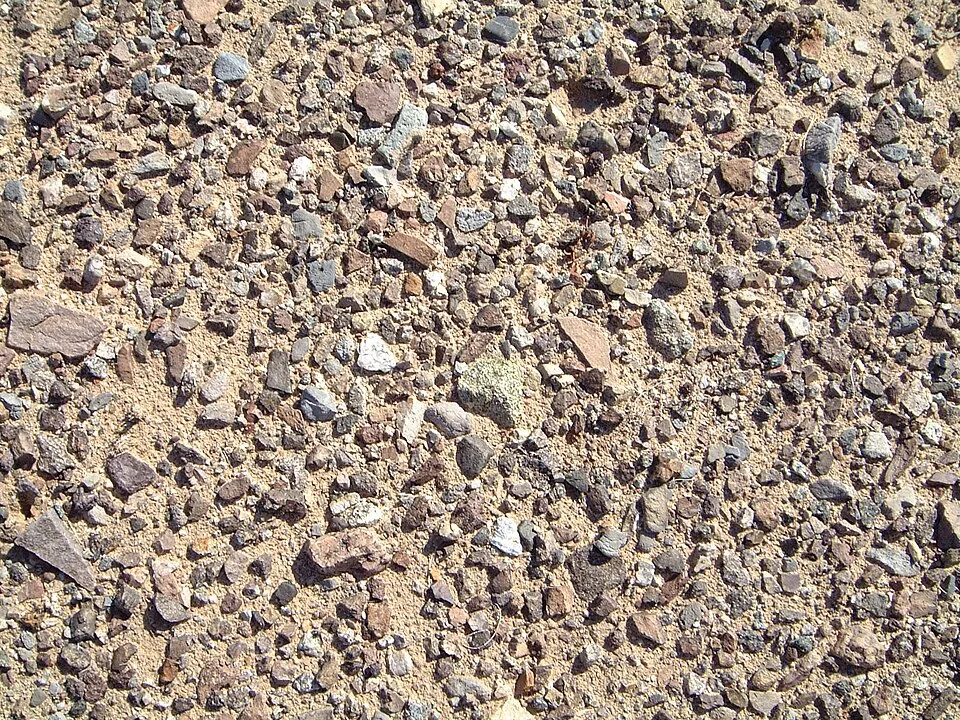
Decomposed granite
Decomposed granite, up closePhoto: Downtowngal, CC0 (public-domain dedication)
What it is
Granite rotted in place into coarse, gritty crumbs — the sharp-sanded ground of foothill and mountain country, often sold by the yard for pathways under the same name.
How it drains
Very fast. Water moves through the gritty matrix almost immediately, and nutrients follow.
What thrives
Plants that demand sharp drainage love it: lavender, rosemary, salvias, California natives, succulents, and wine grapes on hillside sites.
Working with it
Plant the unthirsty things straight into it and build compost-rich basins or raised beds for vegetables. Mulch moderates its boom-and-bust moisture cycle.
Caliche
Also appears on state pages as: Alkaline caliche
Caliche exposure, central TexasPhoto: Loadmaster (David R. Tribble), CC BY-SA 3.0
What it is
A hardened layer of calcium carbonate — lime cemented into rock-like sheets beneath arid-country topsoil, where scarce rainfall carries dissolved lime down and evaporation locks it in place.
How it drains
The layer itself is nearly waterproof: water perches on top of it, and roots stop where it starts unless it is broken.
What thrives
Desert natives handle caliche country naturally — mesquite, desert willow, agave, and wildflowers. Vegetables and fruit trees succeed where planting holes punch through the layer or beds rise above it.
Working with it
For trees, break through the caliche at the bottom of the planting hole so water and roots can escape; for vegetables, build up with raised beds and imported soil. Alkaline-tolerant plant choices spare you a chemistry fight.
Alkaline soil
Also appears on state pages as: Alkaline
Alkaline soil is defined by pH, not looks — it ranges from sand to clay. The label, not a photo, is the point.
What it is
Ground with pH above neutral — the norm in dry country, where rainfall never fully leaches the calcium and other bases out of the profile. The chemistry governs which nutrients roots can actually reach.
How it drains
Alkalinity is chemistry, not texture — these soils range from fast sands to slow clays. What they share is the high pH, not a drainage habit.
What thrives
A long roster of garden plants is comfortable above pH 7: asparagus, beets, spinach, brassicas, figs, pomegranates, lavender, and most Mediterranean herbs among them.
Working with it
Start from plant choice — alkaline-tolerant varieties turn the pH into a non-issue. Compost gently buffers the chemistry, and chelated iron answers the yellowing-leaf signal on sensitive favorites.
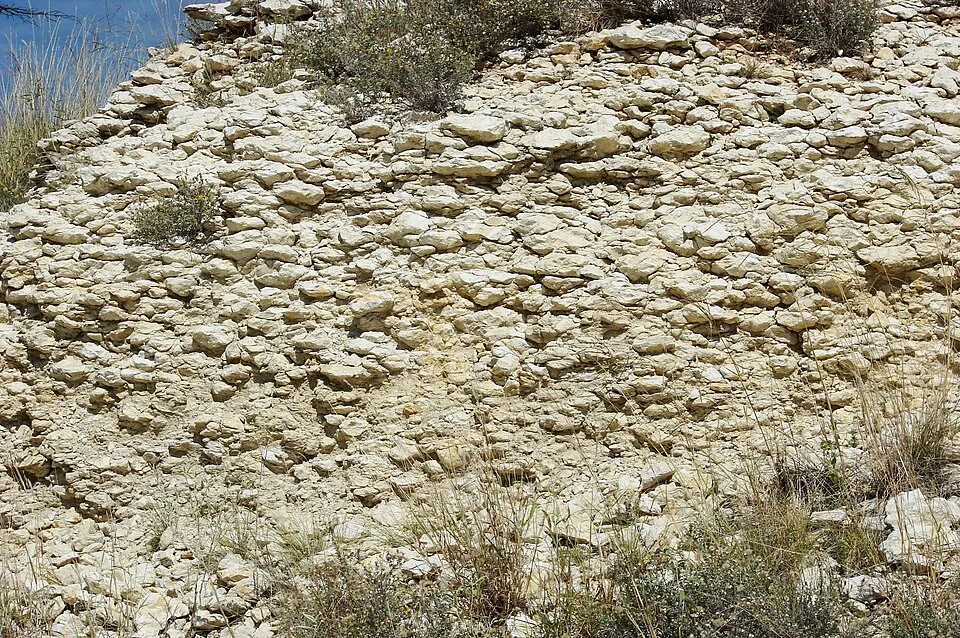
A natural mosaic of tightly-fitted stones armoring the desert floor — wind and water removed the fine material over millennia and left the pebbles locked in place like tile.
How it drains
The pavement sheds most rain across its surface; what soaks through meets fine, often lime-rich material beneath.
What thrives
The desert’s own — creosote, ocotillo, cactus, and the wildflower seed bank that erupts after wet winters. Food growing happens in built beds, not in the pavement.
Working with it
Leave the pavement intact where you can — it is the desert’s own erosion armor — and garden in raised beds, containers, or amended basins beside it. Drip irrigation and afternoon shade make small desert plots remarkably productive.
Shell-rock
Also appears on state pages as: Shell-rock (Keys)
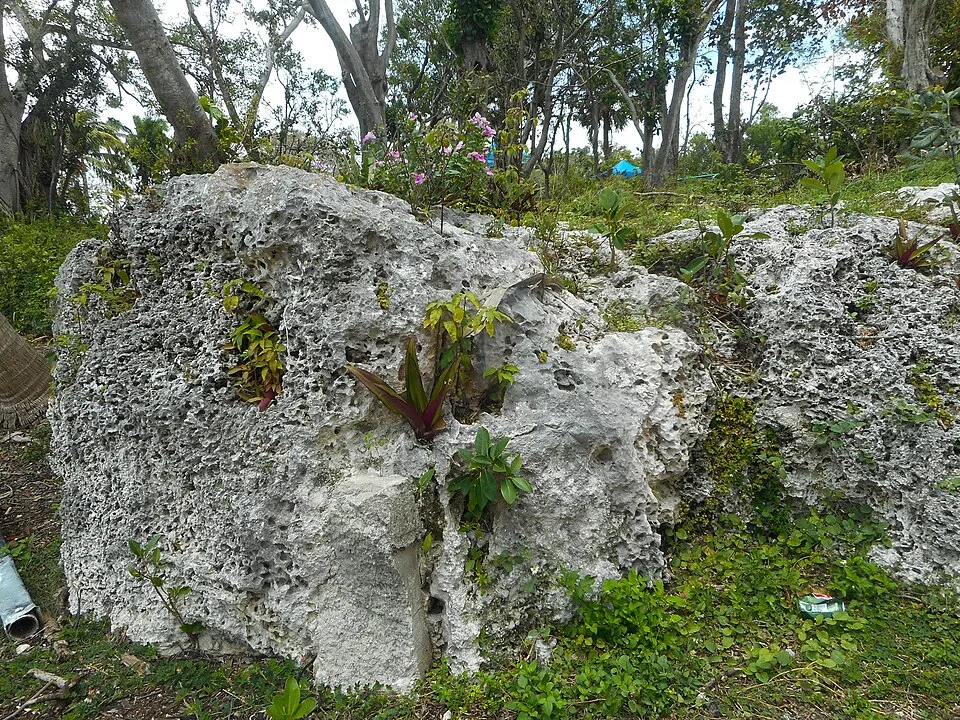
Shell-and-coral limestone outcrop, Miami Rock Ridge, FloridaPhoto: Daniel Di Palma, CC BY-SA 4.0
What it is
Porous limestone made of ancient shells and coral — less a soil than a rock you garden on, with pockets of organic material collected in its holes and hollows.
How it drains
Instant. Water disappears into the porous rock, and the lime chemistry keeps everything alkaline.
What thrives
Tropical trees famously root right into it — coconut palm, sea grape, gumbo limbo, key lime and other citrus on tolerant rootstocks — finding water in the rock’s own pores.
Working with it
Garden in raised beds and containers of imported soil for vegetables, and plant trees into augered or excavated pockets backfilled with compost. Growers on shell-rock have been doing exactly this for generations, to excellent effect.
Where you’ll meet it
The Florida Keys, where the state page names it.
Laterite
Soil profile: Oxisol (USDA soil order)
What it is
The deep-red, iron- and aluminum-rich soil of long-weathered tropical ground — rained on and leached for so long that most other minerals have washed away, leaving the rust-colored oxides behind. It can harden dramatically when exposed and dried.
How it drains
Generally good — the oxide-rich structure stays open — though hardened layers shed water where the surface has baked.
What thrives
Tropical perennials adapted to leached ground: mango, banana, pineapple, cassava, and taro are grown on lateritic soils throughout the tropics.
Working with it
Organic matter is the currency — compost and mulch rebuild what eons of rain leached out, and keeping the surface covered prevents hardening. Feed it steadily and it grows the tropics’ whole pantry.
Volcanic Soils
The kind of country where volcanic soils occur — an illustration, not a soil photo.
Ash and lava weather into some of the most mineral-rich soils on the planet. Volcanic ground is young by soil standards, light to work, and generous with nutrients — the reason volcanic regions worldwide are famous for what they grow.
Volcanic ash
Also appears on state pages as: Volcanic
Soil profile: Andisol (USDA soil order)
What it is
Soil built from erupted ash — glassy mineral particles that weather quickly into some of the most fertile, moisture-holding ground on Earth. Ash soils are young, light, and mineral-rich.
How it drains
Excellent and unusual: ash soils drain freely yet hold remarkable amounts of plant-available water in their porous structure — the best of both habits.
What thrives
Volcanic regions grow celebrated crops the world over: orchards, berries, vegetables, coffee, and wine grapes all prosper on ash-derived soils.
Working with it
Mostly, say thank you — steady organic matter and ordinary care keep ash soil doing what it does naturally. Phosphorus can bind tightly in some ash soils, so a soil test is worth running if growth lags.
Pumice
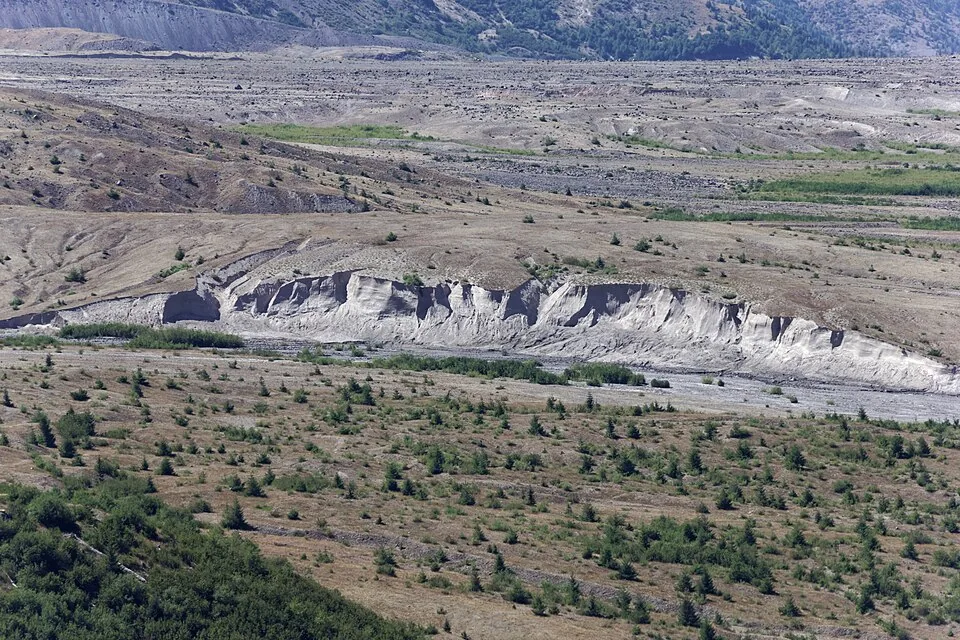
Pumice plain, Windy Ridge, Mount St. HelensPhoto: Dirtsc, CC BY-SA 4.0
What it is
Frothy volcanic glass — rock so full of gas bubbles it can float — erupted and settled in beds of lightweight gravel. Pumice ground is airy, sterile-clean, and slow to weather into fine soil.
How it drains
Very fast between the particles, yet each porous pebble holds water inside itself — the reason pumice is prized as a potting-mix amendment.
What thrives
Conifers and hardy natives colonize pumice plains naturally; in cultivation it suits drought-tolerant perennials, and vegetables succeed in compost-enriched beds.
Working with it
Add the organic matter the young rock has not had time to make — compost transforms pumice ground quickly, and its built-in aeration means roots never suffocate.
Human-Made Ground
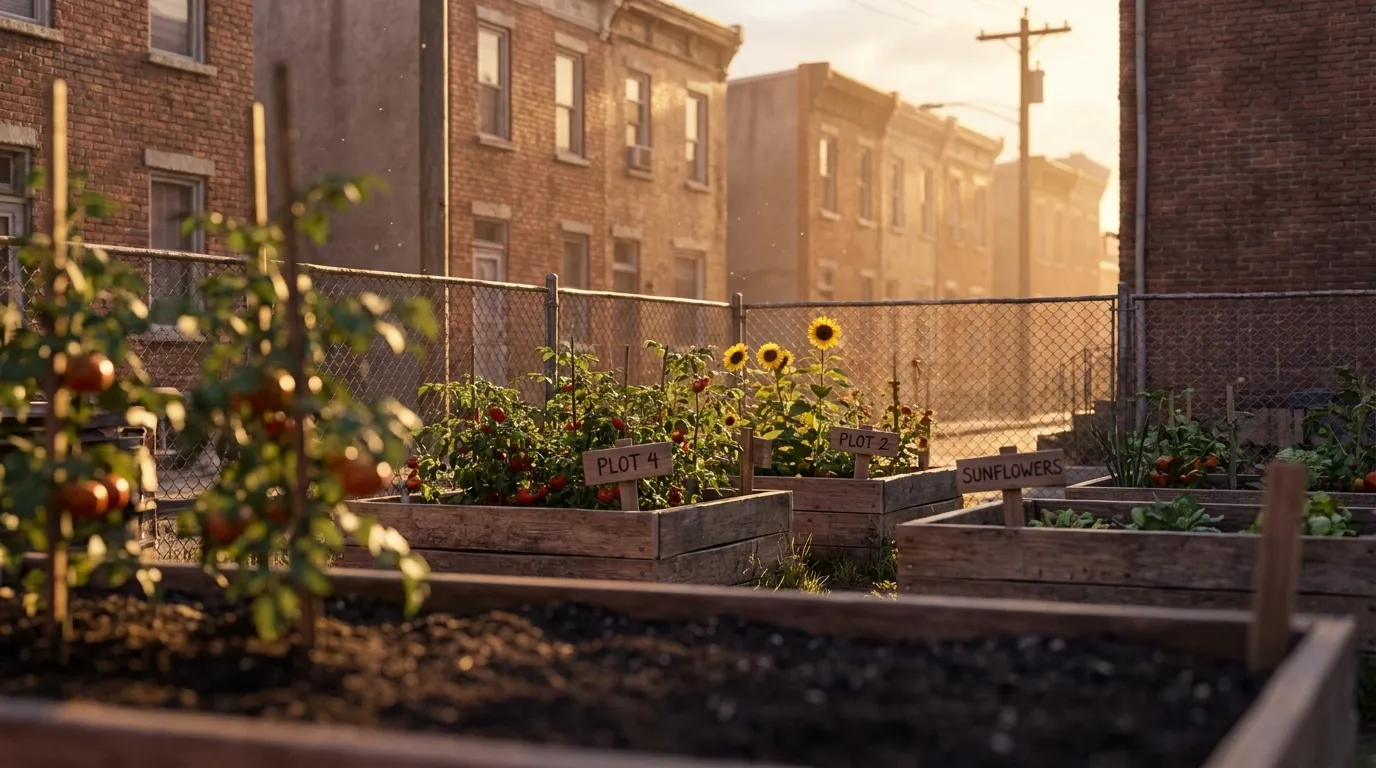
The kind of country where human-made ground occurs — an illustration, not a soil photo.
In cities and on long-settled land, the "soil" underfoot is often material people put there — construction fill, regraded subsoil, buried debris. It grows things, but it deserves a closer read than natural ground before you plant food in it.
Urban fill
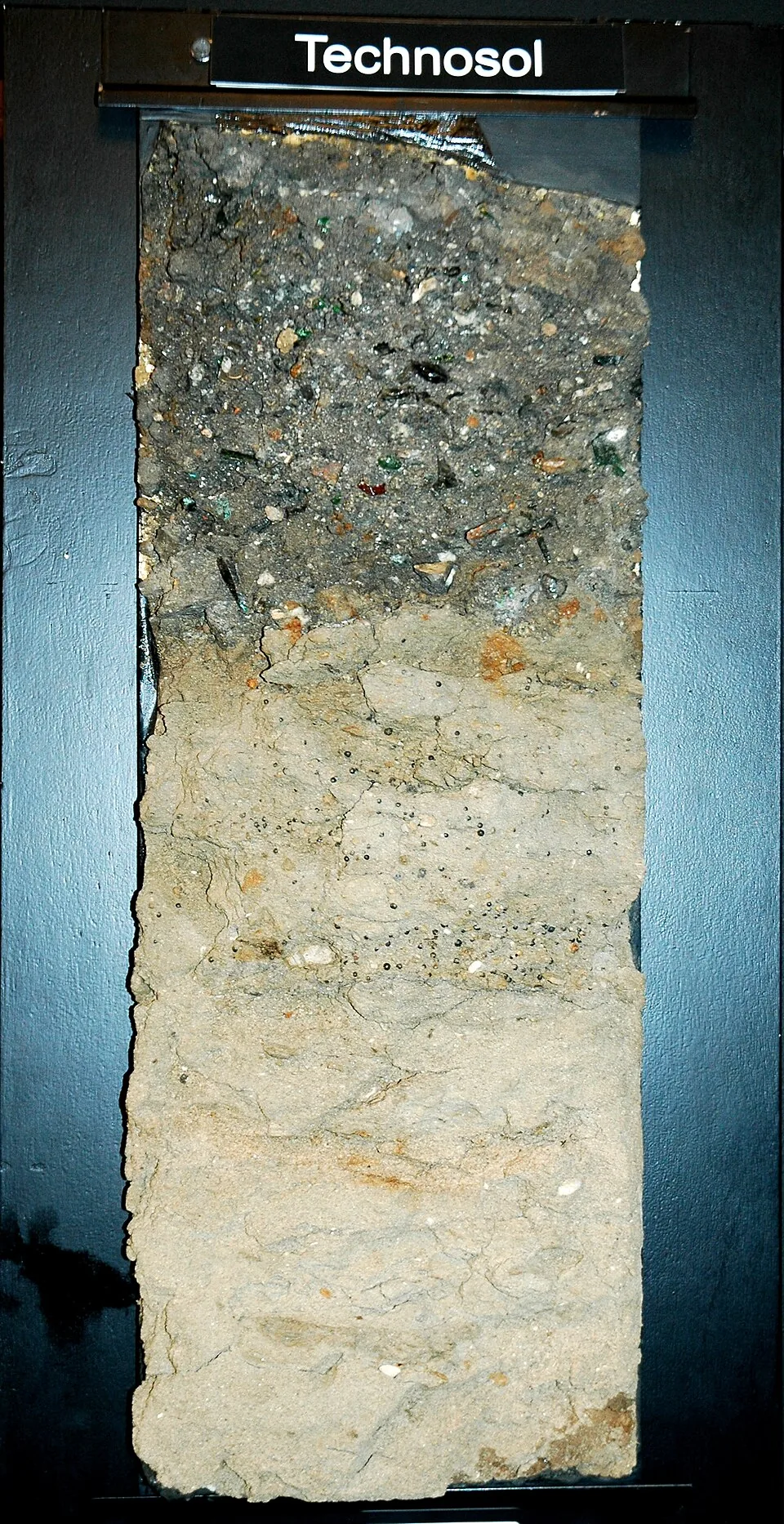
Technosol monolith: made ground with buried debrisPhoto: Rockwurm / ISRIC World Soil Information, CC BY-SA 3.0
What it is
Ground people assembled: construction debris, regraded subsoil, imported dirt, and whatever a site’s past left behind, layered over the original land. No two urban-fill yards are alike, because no two site histories are.
How it drains
Unpredictable — buried rubble can drain like gravel while compacted fill sheds water like pavement, sometimes within the same yard.
What thrives
Plenty, once you know what you are working over: street trees, tough perennials, and productive raised-bed vegetable gardens are the backbone of urban growing.
Working with it
Read the ground before you plant food in it — a soil test for pH, texture, and lead is inexpensive and definitive, and our reports check the federal contamination record around any address. Raised beds with clean soil are the urban grower’s reliable answer while you learn what is below.
Free Report
See the soil under your address
We read your parcel's USDA soil survey — texture, pH, drainage — and score 1,085 plants against the real conditions on your land.
Three things about your exact spot that zone averages miss:
Your soil pHYour frost-free daysYour sun & shade
We read public map data for this spot — soil, climate, flood, and parcel records. How we handle your address.
25+ data sources analyzed in seconds
Frequently Asked Questions
How do I find out which soil type my land has?
The USDA has already mapped it: SSURGO, the federal soil survey, records the soil type, texture, pH, and drainage class for nearly every field in the country. A Growable Ground report reads the SSURGO map units under your exact parcel boundary and translates them into growing decisions.
Can I grow vegetables in clay soil?
Yes — clay holds more nutrients than any other soil texture, and heavy feeders like brassicas, beans, and corn do well in it. The keys are timing (work it only when it crumbles, never when it smears), annual compost to open the structure, and raised beds where you want earlier, faster-draining ground.
Which soil type is best for a vegetable garden?
Loam and sandy loam give the widest plant palette — balanced drainage, easy digging, steady nutrients. But the more useful question is what suits the soil you already have: every soil type on this page has crops that genuinely thrive in it, and matching the plant to the ground beats rebuilding the ground.
What is glacial till?
Glacial till is the unsorted mix of clay, sand, gravel, and boulders a glacier dropped when it melted — the default ground across New England, the Great Lakes states, and the northern plains. It varies shovelful to shovelful, drains well where sandy and slowly where compacted, and grows everything from apples to the full northern vegetable garden.
Sources & further reading
USDA NRCS — the national soil survey behind these soil-type descriptions
SSURGO — field-mapped soil data for your specific parcel

 Soil Types