Weather Protection: Frost, Wind, Hail, Heat & Salt
Sources: Standard protected-culture and season-extension practice
Stresses
10
Covered in this guide
Categories
4
Cold to coastal salt
Approach
Shelter
Cover, screen, mulch, time it
You cannot change the weather, but you can change how much of it reaches your plants. A layer of cloth over a bed on a frosty night, a screen that slows a drying wind, a little shade over the lettuce in a heat wave — small, cheap interventions that turn weather from a threat into a manageable variable. Most of the moves here trap or block something (cold, wind, sun, salt) with a physical barrier, which is why the same handful of tools — row cover, cold frame, cloche, shade cloth, windbreak, mulch — solve most of the problems.
A barrier is the whole idea — a hedge that slows a drying wind is the same move as cloth over a bed on a frosty night.
Each entry covers three things: what the weather does to the plant, the damage it leaves, and the protective move that works. The best protection of all is knowing your own numbers — your real frost dates, your hardiness zone, your rainfall — so you can plant at the right time and choose plants built for your conditions. Growable Ground reads all three from your exact parcel; the guides below explain each.
Free Report
The best weather protection starts before you plant.
Enter your address and we read your real frost dates, hardiness zone, and rainfall — then score 1,085 plants against them, so what you plant is built for the weather you actually get.
Three things about your exact spot that zone averages miss:
Your soil pHYour frost-free daysYour sun & shade
We read public map data for this spot — soil, climate, flood, and parcel records. How we handle your address.
25+ data sources analyzed in seconds
Cold & Frost
Cold is the most predictable garden weather to defend against, because it runs on a calendar you can look up: your first and last frost dates. Most cold damage comes from being caught out — a tender plant set out a week too early, or left uncovered on the one clear, still night the temperature dips. A few layers of cloth and a little timing turn the shoulders of the season from a gamble into extra weeks of harvest.
Late Spring Frost
Includes: Last-frost damage
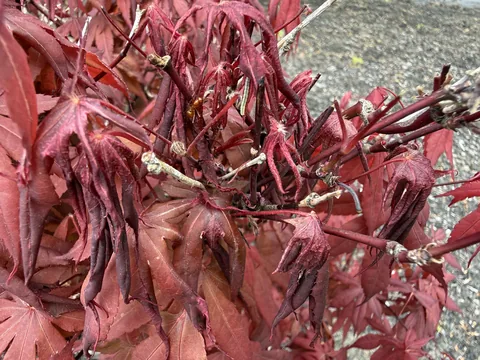
Leaves damaged by a late spring frostFamartin · CC BY-SA 4.0
What it does
A clear, calm, cold night after a warm spell — the classic radiation frost — settling on tender growth that has been lulled out early. The risk runs right up to your average last-frost date and, on a cold year, a week or two past it.
The damage
Blackened, water-soaked, then limp foliage on the most tender plants (tomatoes, peppers, basil, squash), worst on the tops and outer leaves that faced the open sky. Frost pockets — low spots where cold air pools — get hit while ground ten feet upslope is untouched.
The move
Timing first: hold tender transplants until your last-frost date has genuinely passed, and harden them off before they go out. When a late frost threatens an early planting, cover the plants at dusk with floating row cover, an old sheet, or a cloche — anything that traps ground heat — and lift it in the morning. Water the soil the day before a frost night, since moist soil holds and releases more warmth than dry. Site tender crops on a gentle slope, never in the low frost pocket.
Your real last-frost date is specific to your coordinates, not your state — Growable Ground reads it for your exact parcel from NOAA normals, and the /guides/frost-dates guide explains how.
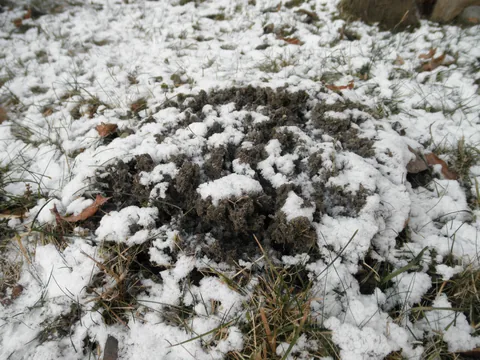
Frost heaving lifting the soilMichal Maňas · CC BY 3.0
What it does
The deeper, longer cold that ends the season — an early-fall killing freeze, or a mid-winter snap that tests whether your perennials are truly hardy to your zone. Unlike a light dusting, a hard freeze reaches the water inside stems and roots.
The damage
Whole-plant collapse of anything frost-tender in fall, split bark and dead branch tips on marginally hardy shrubs and trees, and heaved perennials whose crowns are pushed out of the ground by repeated freeze-thaw.
The move
Extend the fall with the cold-frame and low-tunnel end of the toolkit — a double layer over hardy greens keeps them cropping well past the first freeze. For perennials, the real protection is planting within your hardiness zone in the first place, then a deep mulch applied after the ground freezes to hold it frozen and stop the freeze-thaw heaving. Wrap or cage the trunks of marginal young trees, and site them out of the coldest exposure.
Whether a plant survives your winter is a hardiness-zone question — the /guides/hardiness-zones guide explains your zone, and Growable Ground scores every plant against the real zone at your address.
Pro Tip
On a still, clear night, cover trumps cold-hardiness — the danger is radiation frost, where heat rises off the ground into an open sky. Anything you drape over a plant, even an old bedsheet, catches that escaping warmth and holds it around the leaves. Just make sure the cover reaches the ground to trap the heat, and lift it in the morning.
Wind, Hail & Storms
Wind is the stress gardeners underestimate. It does not just snap stems in a storm — a steady, dry wind pulls moisture from leaves faster than roots can replace it, quietly stunting and scorching plants on open ground all season. Hail and heavy storms add sudden, violent damage. The through-line is the same: slow the air down with a windbreak, and have a way to cover fast when a storm is coming.
Wind Desiccation
Includes: Windburn · Wind exposure
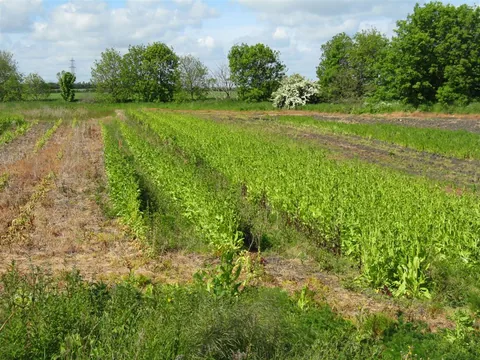
A field windbreak (shelterbelt)
What it does
Not a storm but a steady, drying wind — the prairie, plains, and open-ridge condition — that runs day after day and pulls water out of leaves faster than the roots can refill them. It is the most overlooked garden stress because it does its damage slowly and invisibly.
The damage
Plants that are stunted, one-sided (growth leaning away from the prevailing wind), and browned or "scorched" along the windward leaf edges despite adequate soil moisture. Evergreens brown on the windward side over winter; new transplants simply fail to establish.
The move
Slow the wind down — a windbreak that cuts wind speed protects a zone downwind many times its own height, so even a single row of shrubs, a slat fence, or a burlap screen transforms the beds behind it. A permeable windbreak that filters the wind beats a solid wall, which throws damaging turbulence. Keep exposed plants well watered so they can keep up with the moisture loss, mulch to hold soil moisture, and shelter tender transplants with individual collars until they root in.
Hail
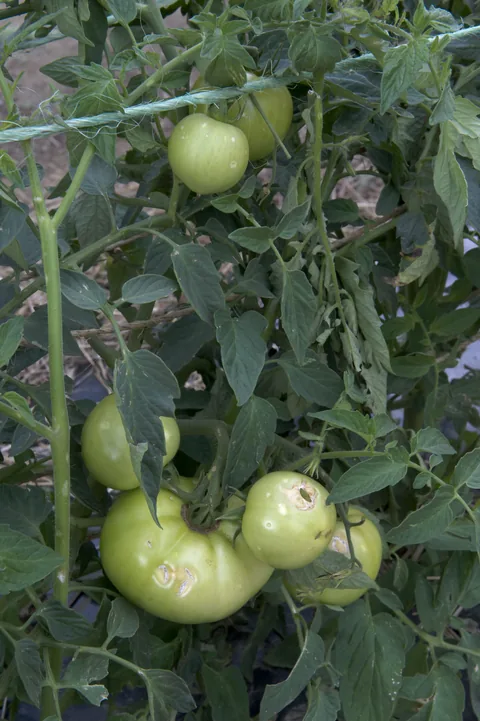
Tomato foliage shredded by hailDwight Sipler from Stow, MA, USA · CC BY 2.0
What it does
Sudden, violent, and localized — a summer storm drops ice that shreds a garden in minutes and leaves the one next door untouched. There is no stopping it mid-fall; the defense is a cover you can deploy when the forecast turns and a plan for after.
The damage
Leaves torn, stripped, and shot full of holes, stems bruised and broken, and fruit pocked with bruises and gouges that later rot. The tell that it was hail and not insects: the damage is all on the upper, sky-facing surfaces and hits every plant at once.
The move
When hail is forecast, cover high-value beds with anything rigid or cushioning you can deploy fast — a low tunnel, a cold frame lid, floating row cover over hoops, even buckets over individual plants. After a hit, resist pulling plants: most vegetables recover, so trim the shredded and broken growth, feed and water to push new growth, and watch the bruised fruit for rot. A permanent hoop frame over the most valuable beds lets you throw cover on in minutes.
Hail risk is regional and seasonal — the severe-storm belt of the Plains and Mountain West sees it far more than the coasts. Your Cooperative Extension can tell you your local hail season so you have covers ready.
Storm & Hurricane Wind
Includes: Gale damage · Downburst
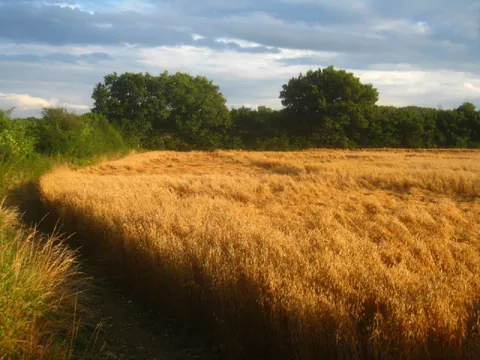
Wheat lodged (flattened) by windScriniary · CC BY-SA 2.0
What it does
The sudden violent wind of a thunderstorm, gale, or landfalling tropical system — the event that flattens corn, snaps tomato stakes, and uproots top-heavy plants in a single afternoon.
The damage
Lodged (flattened) rows of corn and grain, snapped or leaning stems, uprooted transplants and shrubs, and — after a coastal storm — salt-burned foliage well inland from the wind-driven spray.
The move
Stake and cage before you need to, not after — a tomato already tied to a stout stake and a young tree guyed at planting ride out a blow that fells their unsupported neighbors. Grow shorter, sturdier varieties on the most exposed ground, and give storm-prone gardens a permanent windbreak. Ahead of a forecast blow, harvest what is ready, lay down and secure tall row cover, and move containers to a sheltered wall. After, right and re-stake what you can within a day, before roots dry out.
Snow & Ice Load
Includes: Snow load · Ice storm
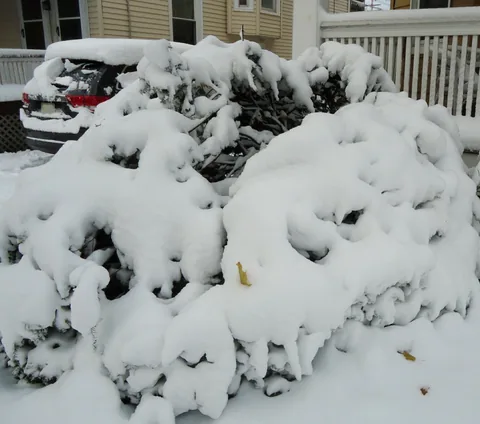
Branches bent under snow load
What it does
Wet, heavy snow or a glaze of ice that piles onto branches and evergreen foliage until the weight splays, bends, or snaps them. The damage is mechanical — the cold itself the plant can take; the load it cannot.
The damage
Split crotches and snapped limbs on shrubs and young trees, multi-stemmed evergreens and arborvitae splayed permanently open, and low tunnels or cold frames collapsed under an overnight dump.
The move
Design for it where it is common: choose strong-branched, single-leader trees, and tie or wrap columnar evergreens and arborvitae for winter so a load cannot splay them. Gently sweep wet snow off flexible branches with an upward motion before it accumulates, but leave ice alone — brittle frozen wood breaks when you try to knock the ice free. Build season-extension structures with a steep enough pitch and strong enough hoops to shed the snow you actually get.
Heat & Sun
Too much sun and heat is as real a stress as too little. Intense light scorches tender transplants and exposed fruit, and a heat wave shuts photosynthesis down and makes plants drop their flowers. The moves are the mirror image of frost protection — instead of trapping warmth, you throw light shade, and you keep the water and mulch that let a plant cool itself.
Heat Stress
Includes: Heat wave · High-temperature stress
Lettuce bolted to seed in heatM J Richardson · CC BY-SA 2.0
What it does
A stretch of extreme heat that pushes plants past the temperature at which they can photosynthesize and set fruit. Cool-season crops bolt; fruiting crops simply stop.
The damage
Midday wilting that recovers overnight (mild) versus wilting that does not (serious), lettuce and spinach bolting to seed, and tomatoes, peppers, and beans dropping their blossoms so no fruit sets during the hottest weeks.
The move
Throw light shade over the most heat-sensitive crops with 30–50% shade cloth on hoops through the worst of the afternoon sun — it drops leaf temperature without starving the plant of light. Water deeply and early so plants face the heat fully charged, and mulch heavily to keep the root zone cool and moist. Time cool-season crops for spring and fall rather than fighting midsummer, and choose heat-set varieties bred to fruit through it.
Which weeks bring your heat, and which varieties are proven to set fruit through it, are local — your Cooperative Extension publishes the heat-tolerant variety lists for your area.
Sunscald & Transplant Sunburn
Includes: Sunscald · Leaf scorch · UV burn
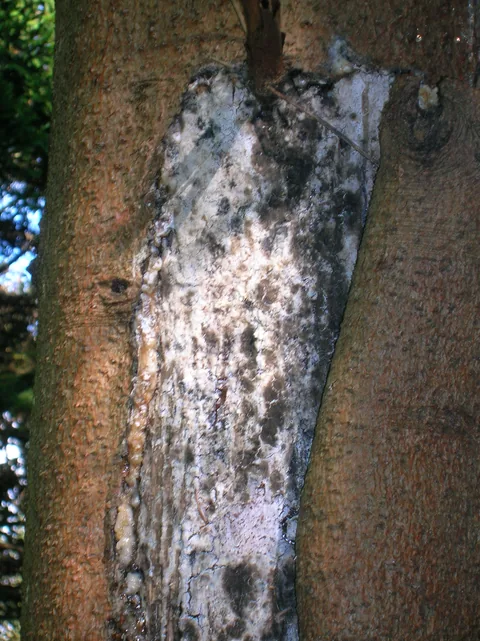
Sunscald on a young trunk
What it does
Direct, intense sun on tissue not conditioned for it — a seedling rushed out of a dim windowsill into full sun, exposed fruit on a defoliated plant, or the thin bark of a young trunk on a bright winter day. Intensity climbs with elevation, so high-desert and mountain gardens burn tissue that a lowland garden would not.
The damage
Bleached, papery, dead patches on the sun-facing side of leaves and fruit (a sunscalded tomato or pepper shows a pale, sunken, leathery patch that then rots), and cracked, dead bark on the south or southwest side of young tree trunks.
The move
Harden transplants off — a week of increasing outdoor exposure — before they face full sun, and shade them with cloth or a shingle for their first days out; at high elevation, extend the hardening and shade longer. Keep enough leaf canopy to shade the fruit rather than over-pruning, and paint or wrap young trunks to reflect winter sun. A light shade cloth over the most exposed beds takes the edge off the strongest light.
High-altitude and high-desert sun is measurably stronger — New Mexico and the Mountain West burn tender transplants that survive at sea level. Extend hardening-off and first-week shade accordingly.
Drought & Water Stress
Includes: Dry spells
No open-license close-up cleanly separates drought-wilted foliage from ordinary heat wilting on Wikimedia Commons — the honest hits are field- or satellite-scale. Rather than force a weak or duplicate-looking wilt image, this entry is a labeled note; the signature (persistent wilting, blossom-end rot, bolting) is described in text and the fix cross-links to the drainage-and-water guide.
What it does
A prolonged dry stretch, often paired with heat and wind, that empties the soil water faster than rain or irrigation refills it. In arid regions it is the baseline condition, not an event.
The damage
Persistent wilting, dulled and grayed foliage, dropped flowers and small fruit, blossom-end rot on tomatoes and peppers (a calcium-uptake failure driven by uneven water), and stunted, bitter, or bolted crops.
The move
Water deeply and less often to send roots down, and deliver it at the root zone with drip or soaker lines so little is lost to evaporation. Mulch heavily — the single highest-leverage move in a dry garden — to cut evaporation and hold soil moisture even. Build soil organic matter so it holds more water, group thirsty crops together, and in truly arid gardens lean on drought-adapted and native plants that expect it. Sunken basins around plants catch and hold scarce rain where the roots are.
How much water your site actually needs depends on its rainfall, soil, and drainage — the /guides/drainage-water guide covers reading your soil, and Growable Ground reads your parcel’s rainfall and soil directly.
Salt & Coastal Exposure
A coastal garden gets a stress inland gardens never see: salt, carried on the wind and in the soil. Salt spray burns exposed foliage, and salt in the ground pulls water back out of roots. The fix is a layered defense — a salt-tough outer shelterbelt to catch the spray, and salt-tolerant plants where the exposure is worst.
Salt Spray & Coastal Exposure
Includes: Salt burn · Salt injury
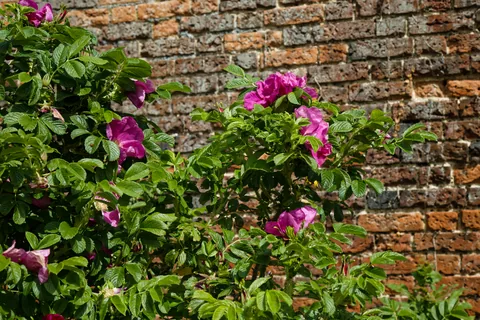
A salt-tolerant rugosa rose hedgeAcabashi · CC BY-SA 4.0
What it does
Wind-driven salt off the ocean, coating exposed foliage, plus salt accumulating in coastal soil and after coastal storms drive spray far inland. Road-salt runoff does the same to gardens near winter-treated pavement.
The damage
Browned, burned leaf tips and margins on the seaward side of the plant, one-sided "flagging" where growth survives only on the sheltered side, and — from soil salt — overall stunting and scorch as the salt pulls water back out of the roots.
The move
Layer the defense: a tough, salt-tolerant outer shelterbelt (bayberry, rugosa rose, eastern red cedar, and other proven coastal plants) catches the spray and creates a protected zone behind it for less-tolerant crops. Rinse valuable plants with fresh water after a salt-laden blow, improve drainage and add organic matter so rain can flush salt down through the soil, and keep the least-tolerant plants well back from the direct exposure. For road-salt, redirect the runoff and flush the bed in spring.
The proven salt-tolerant plants for your stretch of coast are regional — your Cooperative Extension and coastal or Sea Grant program publish the local seaside plant lists.
Nearly every fix in this guide comes from the same short kit. Learn these six and you can answer most of what the weather throws at you.
Floating row cover
Lightweight fabric draped over a bed, usually on hoops. Traps warmth against frost, filters strong sun, and doubles as a pest and bird barrier. The most versatile single tool you can own.
Cold frame & low tunnel
A permanent box with a clear lid, or a hooped tunnel — season extension at both ends, keeping hardy greens cropping well past the first freeze and getting spring going weeks early.
Cloche
A clear cover over a single plant — a jar, a jug, a bell. The simplest way to shelter one transplant through a cold snap or its first exposed days.
Shade cloth
Knitted fabric (typically 30–50%) that cuts the sun without starving the plant of light. The mirror image of frost cover — for heat waves, sunscald, and tender transplants.
Windbreak
A permeable barrier — shrubs, a slat fence, burlap — that slows the wind and protects a long zone downwind. Filters, never blocks: a solid wall throws damaging turbulence.
Mulch & water
A deep mulch and deep, timely watering are the quiet foundation — they hold soil moisture and warmth, buffer temperature swings, and carry plants through heat, drought, and freeze-thaw.
Plants That Take the Weather
The surest protection is choosing plants built for the stress your site actually gets. These are well-known heat-, drought-, and salt-tough species — each links to its full growing page, where you can score it against your exact conditions.
Local exposure varies plant by plant and yard by yard, so treat these as a starting shortlist, not a guarantee — your own frost dates, rainfall, and coastal setback still decide what thrives.
We read your parcel's frost dates, hardiness zone, sun, and rainfall and score 1,085 plants against the real conditions — the surest weather protection is choosing plants your site can carry.
Three things about your exact spot that zone averages miss:
Your soil pHYour frost-free daysYour sun & shade
We read public map data for this spot — soil, climate, flood, and parcel records. How we handle your address.
25+ data sources analyzed in seconds
Frequently Asked Questions
How do I protect plants from a late frost?
Cover them at dusk with floating row cover, an old sheet, or a cloche — anything that traps the day’s ground heat — and lift it in the morning. Water the soil the day before, since moist soil holds and releases more warmth overnight than dry. The surest protection, though, is timing: hold tender transplants until your real last-frost date has passed.
What is the difference between a row cover, a cold frame, and a cloche?
They are the same idea at three scales. A cloche is a clear cover over a single plant; floating row cover is lightweight fabric draped over a whole bed (usually on hoops); a cold frame is a permanent low box with a clear lid. All trap warmth to extend the season at both ends — you pick the one that fits the plant and the amount of cold you need to beat.
How do I stop wind from drying out my plants?
Slow the wind down with a windbreak. A permeable barrier — a row of shrubs, a slat fence, a burlap screen — that filters the wind protects a long zone downwind, far better than a solid wall, which throws damaging turbulence. Keep exposed plants well watered and mulched so they can keep up with the moisture the wind pulls out of their leaves.
Can plants recover from hail damage?
Usually, yes. Resist pulling shredded plants — most vegetables bounce back. Trim off the broken and torn growth, water and feed to push new growth, and watch any bruised fruit for rot. Next time hail is forecast, a low tunnel, cold-frame lid, or row cover on hoops thrown over the beds is your fast defense.
When each stress arrives, and how hard, is specific to your site — your real frost dates (from the NOAA U.S. Climate Normals), your hardiness zone (from the USDA Plant Hardiness Zone Map), and your rainfall and drainage decide it. Growable Ground reads all of them from your exact address, and your Cooperative Extension keeps the local heat-tolerant and salt-tough variety lists — the local complement to this national playbook.

 Stresses