Pest Playbook
Beat the Squash Vine Borer
Sources: University of Minnesota Extension, University of Wisconsin–Madison Extension
Squash vine borer · Melittia cucurbitae
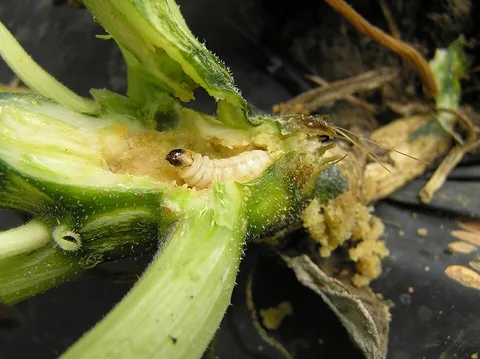
A squash or pumpkin vine that looks fine one morning and collapses the next is the classic sign of the squash vine borer. The clear-winged adult — which flies like a wasp — lays its eggs one at a time at the base of the plant from mid-June through July, and the fat white larva that hatches tunnels straight into the stem.
Look closely at a wilting plant and you will find a hole near the base packed with moist, greenish-orange sawdust-like frass. That is the tell: the damage you see is the larva already at work inside, which is why chasing the borer after the wilt rarely saves the plant — and why the whole game is prevention.
How to know it’s squash vine borer
The borer breaks the rule that moths fly at night, which makes the adult far easier to spot than most gardeners expect — and the frass easier still.
- Adult:
- About a half-inch long, with a metallic green first pair of wings, a clear second pair usually folded out of sight at rest, and an orange abdomen dotted with black. It flies in daylight and buzzes loudly enough to notice.
- Egg:
- Flat, brown, and about a twenty-fifth of an inch — laid one at a time rather than in a cluster, at the base of a susceptible plant.
- Larva:
- White or cream with a brown head, growing to almost an inch. You will normally only ever see it by slitting a stem, because it spends its entire feeding life inside one.
- The frass:
- A hole near the base of the plant packed with moist, greenish-orange, sawdust-like frass. This is the earliest sign you can act on — it is there before the vine collapses.
Commonly confused with: a wasp
University of Minnesota Extension notes the adults are unique in that they fly during the day and mimic wasps. So the "wasp" hovering low around your squash in early July is worth a second look — that is the egg-laying moth, and seeing it is your cue to cover.
What’s really going on
The wilt is a symptom, not the start. By the time a vine collapses, the larva is already tunneling inside the stem — and not all squash are equally at risk: butternut and other Cucurbita moschata types are usually left alone, while zucchini and other C. pepo squash are the borer’s favorites.
What it means for you
Because the borer is inside before the plant shows it, your single biggest lever is a decision you make before planting — which squash to grow. Variety choice, then cover timing, does more than any spray after the fact.
The year it runs on
Generations: One generation a year.
Where it spends the winter: In the soil. After feeding, the larva exits the stem and burrows one to two inches down to pupate, and stays there until the following summer.
- Late June to early July: Adults emerge from cocoons in the ground and begin laying eggs singly at the base of squash, pumpkins and other susceptible vines.
- About a week later: The eggs hatch and the larvae bore directly into the stems.
- Four to six weeks: Larvae feed through the center of the stems, blocking the flow of water to the rest of the plant — this is the period during which the vine is being killed from the inside.
- End of feeding: Larvae leave the stems and burrow into the soil to pupate, where they wait out the winter.
These dates are Minnesota’s, recorded by University of Minnesota Extension, where the borer is active from mid-June through July. Rather than trusting a calendar borrowed from another state, UMN recommends watching for the adults yourself starting the last week of June — they are drawn to yellow, so a yellow pan or bowl of water with a drop of dish soap in it will catch them. Check it daily; the first catch is your cover-now signal.
What the damage actually costs you
The feeding is internal, so nothing looks wrong until the plumbing of the vine has already failed.
- Wilting is the first symptom, and at first it may show only in strong afternoon sun, with the plant looking normal again by morning.
- Left alone, the affected vines collapse and die outright.
- Holes near the base packed with moist greenish or orange frass.
- Over time the base of the plant turns mushy or rots away completely.
How much the plant can take: Very little, once the larva is in. Several larvae may attack a single plant, and UMN reports that entire crops can be lost in a year of high borer numbers — which is why this playbook spends its effort on variety choice and cover timing rather than on rescue.
The move
Two moves carry it — variety choice and cover timing — with a late succession as cheap insurance. All from University of Minnesota Extension IPM:
- 1
Grow a resistant type
Butternut squash and other Cucurbita moschata varieties are usually not attacked, and cucumbers, melons, and watermelons are largely spared too. Where borers are heavy, that variety swap is the surest defense.
- 2
Cover early, uncover to pollinate
Place floating row covers over your vine crops as soon as they start to vine — this blocks the egg-laying moth — then remove the cover once the plants flower so bees can pollinate.
- 3
Plant a late succession
Sow a second planting of summer squash in early July. It matures after the moth’s single flight has passed, giving you a borer-free crop.
- 4
If a borer is already in
As soon as you notice wilting, use a sharp knife to slit the affected stem lengthwise and remove the larva, then mound moist soil over the wound so the vine can re-root past it.
Sources: University of Minnesota Extension. Squash vine borers in home gardens; University of Wisconsin–Madison Extension. Squash Vine Borer
The plants in this playbook
See how these plants fit your land
Enter your address for your USDA zone, your site type, and a starting plant list scored for your soil and sun. Free, no account.
We read public map data for this spot — soil, climate, flood, and parcel records. How we handle your address.
Why did my squash plant suddenly wilt and die?
A sudden wilt on squash or pumpkin usually means a squash vine borer larva is tunneling inside the stem. Look for a hole near the base packed with moist, sawdust-like frass. By the time the plant wilts the larva is already inside, so prevention — resistant varieties and row covers — beats treatment.
What squash is resistant to the squash vine borer?
Butternut squash and other Cucurbita moschata varieties are usually not attacked by the squash vine borer, and cucumbers, melons, and watermelons are largely spared. Zucchini and other Cucurbita pepo squash are the borer’s favorites, so a variety swap is the surest defense where borers are heavy (University of Minnesota Extension).
When should I put row covers on squash for vine borers?
Place floating row covers over vine crops as soon as they start to vine, to block the egg-laying moth. Remove the cover once the plants flower so bees can pollinate. A second planting of summer squash in early July matures after the moth’s single flight has passed.
Sources (2)
- University of Minnesota Extension. Squash vine borers in home gardens
- University of Wisconsin–Madison Extension. Squash Vine Borer
Related pest playbooks