Pest Playbook
Stop Japanese Beetles Skeletonizing Your Garden
Sources: University of Minnesota Extension
Japanese beetle · Popillia japonica
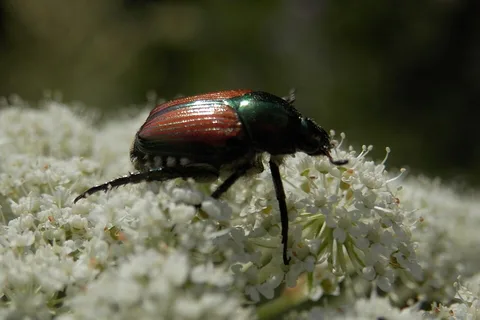
Metallic copper-and-green Japanese beetles feed in groups on the tops of leaves in midsummer, favoring roses, grapes, beans, and hundreds of other plants. They skeletonize leaves — eating the soft tissue and leaving a lace of veins behind — and the damage looks far worse than it usually is.
The beetle you see on the leaves and the white grub chewing grass roots under your lawn are the same insect at two life stages, which is why "controlling Japanese beetles" is really two separate jobs. On a healthy, well-watered plant the adult feeding is mostly cosmetic, so the goal is to protect a few high-value plants through the flight, not to wipe the beetle out.
How to know it’s japanese beetle
The white tufts along the sides are the mark that separates a Japanese beetle from every other metallic green beetle in the garden.
- Adult:
- Roughly a third to a half-inch long, with a metallic green head and thorax and copper-brown wing covers.
- The tufts:
- Five white patches of hair along each side of the abdomen, plus two more at the tip. This is the diagnostic feature — the green-and-copper coloring alone is not enough.
- Grub:
- A C-shaped white to cream grub with a distinct tan head and legs that are easy to see, anywhere from an eighth of an inch up to about an inch long.
Commonly confused with: other white grubs in the lawn
Above ground the adult is unmistakable once you check for the tufts. Below ground it is the opposite: UMN notes Japanese beetle grubs look like other white grubs and can only be positively distinguished by examining the pattern of spines and hairs on the underside of the tip of the abdomen. If you are treating a lawn on the assumption that the grubs are this beetle, that assumption is worth verifying first.
What’s really going on
The pheromone traps sold to catch Japanese beetles backfire. Research at the University of Kentucky found more beetles fly toward a trap than are ever caught in it, so a trap usually causes more damage to nearby plants than if none were there at all.
What it means for you
That flips the instinct. The single most common purchase for this pest makes it worse — so skip the trap, and instead put your effort into hand-picking and shielding the few plants you most want to protect during the few weeks of flight.
The year it runs on
Generations: One generation a year, but the adult and the grub are two different problems on two different schedules.
Where it spends the winter: As a nearly full-grown third-instar grub, dug deep into the soil of lawns, pastures and other grassy areas.
- Spring: Grubs move back up near the soil surface to finish feeding and pupate.
- Late June to early July: Adults begin emerging from the ground. They can fly several miles to feed.
- July and August: Peak adult feeding, with some activity into September. Females tunnel one to three inches down to lay eggs repeatedly through both months, as many as 60 eggs in total.
- About two weeks after laying: Eggs hatch and the grubs begin feeding mainly on the roots of lawn grasses, passing through three growth stages over the summer.
- As the soil cools in fall: The full-sized grubs dig deeper to overwinter.
These are University of Minnesota Extension’s dates. UMN also notes that adults feed for six to eight weeks and that most feeding is finished by mid to late August, so the practical instruction is not a date at all: start looking in your own yard in late June, and begin removing beetles the moment you see the first ones.
What the damage actually costs you
Adults skeletonize leaves — eating the tissue between the major veins and leaving a lace of veins behind — while the grubs work on grass roots underground.
- Lace-like leaves on roses, grapes, lindens, apples, cherries, birch, raspberries, basil and hundreds of other plants; damaged leaves turn brown and may drop.
- Beetles feeding in dense clusters on one plant while an identical neighboring plant is barely touched — damaged leaves release odors that recruit more beetles.
- In turf, dead patches that can be rolled back like a loose carpet, because the roots holding them down are gone.
- Moles, skunks and crows digging up a lawn, which damages the turf further as they hunt the grubs.
How much the plant can take: More than most people assume. UMN is explicit that adult damage usually affects only the appearance of plants, and that healthy mature trees and shrubs tolerate a lot of feeding without long-term injury; roses survive it even when the blooms are ruined. Healthy turf typically tolerates up to 10 grubs per square foot. Young or already-stressed plants are the exception and can be stunted or killed.
The move
The moves that actually work, from University of Minnesota Extension IPM:
- 1
Skip the trap
Japanese beetle traps use pheromone and floral lures that pull in more beetles than they catch, increasing damage to nearby plants. Don’t hang one to protect a home garden.
- 2
Hand-pick into soapy water
When numbers are small, handpick or knock the beetles into a bucket of soapy water and check plants daily. Removing them early matters, because leaves already damaged attract still more beetles.
- 3
Net your high-value plants
Fine netting can shield a prized plant during the flight — but don’t cover a plant that is blooming and needs pollination. Handpick it until it sets fruit, then cover it.
- 4
Treat the grubs only in the lawn
For the turf grubs, milky spore (Paenibacillus popilliae) or parasitic nematodes (Heterorhabditis bacteriophora) target the larvae without harming beneficial insects. Water nematodes in so they don’t dry out.
Source: University of Minnesota Extension. Japanese beetles in yards and gardens
The plants in this playbook
See how these plants fit your land
Enter your address for your USDA zone, your site type, and a starting plant list scored for your soil and sun. Free, no account.
We read public map data for this spot — soil, climate, flood, and parcel records. How we handle your address.
Why are Japanese beetles all over one plant and not the others?
Because feeding recruits more feeding. University of Minnesota Extension notes that leaves already damaged attract still more beetles, so whichever plant they land on first snowballs — which is why removing them early matters more than removing them thoroughly. Host preference does the rest: roses, grapes and beans are among the hundreds of plants they favor, and the untouched neighbor simply is not on that list. Handpick daily from the plant they have chosen rather than treating the whole garden.
How do I get rid of Japanese beetles naturally?
Handpick or knock the beetles into soapy water and check plants daily, since damaged leaves attract more beetles. Protect high-value plants with fine netting (but not while they are blooming and need pollination). For the lawn grubs, milky spore or parasitic nematodes target the larvae without harming beneficial insects (University of Minnesota Extension).
Are Japanese beetle grubs the same as the beetles?
Yes — the white grubs that chew grass roots under a lawn are the larval stage of the same Japanese beetle whose adults skeletonize garden leaves. They are two problems: net or hand-pick the adults on your plants, and treat grubs only where they are damaging turf.
Sources (1)
- University of Minnesota Extension. Japanese beetles in yards and gardens
Related pest playbooks