Pest Playbook
Stop Squash Bugs — Starting With Where They Sleep
Sources: University of Minnesota Extension
Squash bug · Anasa tristis
Adult squash bugs are flattened, dark gray to dark brown insects about five-eighths of an inch long, with alternating orange and brown stripes along the abdomen. They feed by sucking sap out of the leaves of squash and pumpkins, leaving yellow spots that turn brown, and enough feeding disrupts the flow of water and nutrients badly enough to wilt the plant. Young seedlings and plants in flower are the most vulnerable; a large, sturdy plant tolerates feeding that kills a small one.
They are also a disease vector — University of Minnesota Extension names the squash bug as the vector of yellow vine decline. And they are genuinely hard to catch in the act: adults and nymphs both hide under the leaves when disturbed, and they move fast. Which is why the moves that work best are the ones you make when squash bugs are nowhere in sight.
How to know it’s squash bug
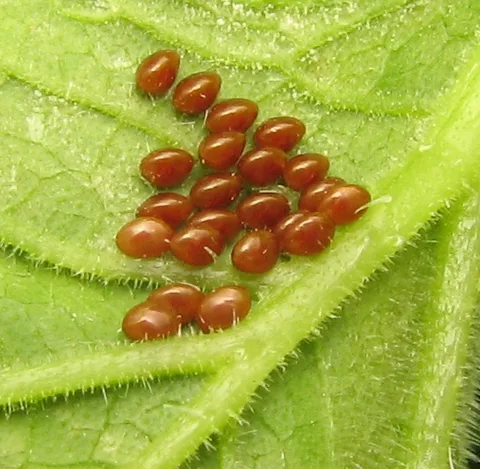
The eggs are the most useful stage to learn, because they are laid in a pattern you can find deliberately rather than stumble on.
- Adult:
- Large and flattened, five-eighths of an inch long, usually dark gray to dark brown, with alternating orange and brown stripes along the edge of the abdomen.
- Egg:
- Oval, a sixteenth of an inch, yellowish to bronze, laid in small clusters of about 20 on the undersides of leaves — characteristically in the V where two veins meet, and sometimes on the stems.
- Young nymph:
- A light green abdomen with black head and legs, starting around a tenth of an inch.
- Older nymph:
- Progressively light gray then brownish-gray with black legs and antennae, up to about half an inch across five growth stages.
- Behavior:
- Both adults and nymphs hide under the leaves when disturbed and move quickly, which is why hand-picking alone rarely clears them.
Commonly confused with: the brown marmorated stink bug (Halyomorpha halys)
Both are brown and both are about five-eighths of an inch, so size and color decide nothing. The squash bug has an abdomen edge striped in alternating orange and brown; the brown marmorated stink bug is marbled and carries two white bands on its antennae. It matters because the advice diverges: one is a cucurbit specialist you manage in the squash patch, the other is a broad fruit feeder that will also try to overwinter in your house.
What’s really going on
You are probably housing them. Where squash bugs are a consistent and severe problem, University of Minnesota Extension’s advice is to avoid straw mulches — they give squash bugs the extra shelter they seek at night. And the adults that start next season live through the winter as adults in sheltered places: under plant debris, around buildings, under rocks. Then they fly to the new cucurbits in spring.
What it means for you
So the two highest-leverage decisions happen when you are not thinking about squash bugs at all — what you mulch with, and how clean you leave the bed in fall. In season the useful window is narrow and early: treatment is most effective on freshly hatched nymphs, which is why monitoring egg numbers is what times anything. For a home garden, UMN’s verdict on the sprays is short: insecticides are normally not required to manage squash bugs.
The year it runs on
Generations: One generation a year, though some summers produce a partial second.
Where it spends the winter: As unmated adults tucked into sheltered places — under plant debris, around buildings, under rocks.
- Spring: Overwintered adults come out and fly to growing cucurbit plants to feed and mate.
- Early June onward: Females begin appearing in gardens and lay egg clusters through mid-summer.
- About 10 days: Eggs hatch. On farms, where the timing is scouted deliberately, UMN puts hatch at seven to 10 days after laying.
- Four to six weeks: Nymphs mature. Because the stages overlap, every life stage can be present at once through the season.
- Fall: Adults and nymphs group together on the squash fruits once the vines die back. The adults move to shelter for winter; the nymphs die at freezing.
These are University of Minnesota Extension’s Minnesota dates. The instruction that travels is the scouting one: start looking for egg masses in July, and treat the freshly hatched nymphs, because both UMN’s garden and farm guidance agree that control works on nymphs and not on adults.
What the damage actually costs you
Squash bugs pierce and suck sap, so the damage reads as a plant losing its water supply rather than as chewed tissue.
- Yellow spots on the leaves that eventually turn brown.
- Wilting where feeding is heavy, because the flow of water and nutrients is disrupted.
- Young seedlings and flowering plants failing outright — these are the two most vulnerable moments.
How much the plant can take: It depends entirely on plant size. UMN notes larger, sturdier plants are more tolerant of feeding damage while young plants may die of it, which is why the same number of bugs is an emergency in June and an annoyance in August. One thing does not scale away: the squash bug transmits yellow vine decline, a disease UMN describes as new to the region.
The move
Habitat first, then the egg stage. All from University of Minnesota Extension:
- 1
Crush the eggs — this is the whole game
Females lay small clusters of about 20 oval, yellowish-to-bronze eggs on leaf undersides, especially in the V where veins meet, from early June through mid-summer. They hatch in about 10 days. Scouting the undersides and crushing what you find is the single habit that outperforms everything else, because treatment of any kind works best on freshly hatched nymphs.
- 2
Rethink the straw
Where squash bugs are a consistent and severe problem, avoid straw mulches — they supply the extra night shelter the bugs seek. Remove plant debris during the growing season too, to cut down the places they hide during the day.
- 3
Trap them under a board overnight
Lay boards or pieces of newspaper beside the plants. Squash bugs group underneath at night; collect and destroy them in the morning. Dropping adults and nymphs into a pail of soapy water works too, but only where a few plants are affected — they hide under the leaves and move quickly when disturbed.
- 4
Clean the bed out in fall
Adults overwinter under plant debris, around buildings and under rocks. Cleaning up cucurbits and other plant matter in fall reduces the number of overwintering sites. This is the move that lowers next year’s population rather than this year’s — which is exactly why it gets skipped.
- 5
Where pressure is high, grow the tolerant types — and keep plants sturdy
Studies have shown butternut and buttercup squash and sweet cheese pumpkins tolerate squash bug feeding better than other varieties. Note that is tolerance, not immunity: the bugs still arrive, the plant just carries the damage. Proper fertilization and watering do the same work, since larger, sturdier plants take feeding that kills young ones.
Source: University of Minnesota Extension. Squash bugs
The plants in this playbook
See how these plants fit your land
Enter your address for your USDA zone, your site type, and a starting plant list scored for your soil and sun. Free, no account.
We read public map data for this spot — soil, climate, flood, and parcel records. How we handle your address.
Does straw mulch attract squash bugs?
It shelters them. University of Minnesota Extension advises avoiding straw mulches where squash bugs are a consistent and severe problem, because straw gives the bugs the extra shelter they seek at night. Removing plant debris during the season helps for the same reason. (Note the tension with cucumber beetles, where UMN says thick straw at the base of established plants makes egg-laying harder — so match the mulch to the pest you actually have.)
Why do squash bugs come back every year?
Because the adults survive the winter on site. They overwinter as adults in sheltered places — under plant debris, around buildings, under rocks — and fly to the growing cucurbits in spring to feed and mate. University of Minnesota Extension recommends cleaning up cucurbits and other plant matter in fall specifically to reduce the number of overwintering sites, which is the move that lowers next year’s numbers.
Do I need to spray for squash bugs?
Usually not. University of Minnesota Extension states plainly that insecticides are normally not required to manage squash bugs in home gardens. If something is applied, it is most effective on freshly hatched nymphs, which is why monitoring egg numbers is what times it — adults hide under leaves and move quickly, making them a poor target.
What are the bronze eggs under my squash leaves?
Squash bug eggs. They are oval, about a sixteenth of an inch long, yellowish to bronze, and laid in small clusters of roughly 20 on leaf undersides — especially in the V between veins, though they also turn up on stems. They hatch in about 10 days, so crushing them on sight is the highest-value habit in the whole playbook.
Sources (1)
- University of Minnesota Extension. Squash bugs
Related pest playbooks