Pest Playbook
Cucumber Beetles: Which of Your Plants Is Actually at Risk
Sources: University of Minnesota Extension
Striped cucumber beetle · Acalymma vittatum
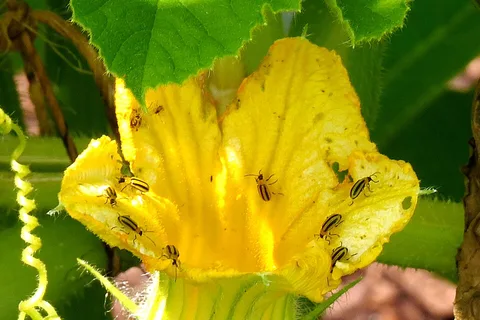
Striped cucumber beetles are about a fifth of an inch long, with yellow wing covers marked by three lengthwise black stripes, a black head and antennae, and an orangish prothorax behind the head. The spotted cucumber beetle is a similar size and color but carries twelve black spots instead of stripes. Both work cucurbits — squash, cucumbers, melons — and both chew the foliage, blossoms and, at high numbers, the stems and fruit.
University of Minnesota Extension’s guidance is to concentrate on the striped beetle. Spotted cucumber beetles do not survive northern winters; the adults migrate up from the southern United States in late June or early July, they are rare early in the season, and their numbers are usually too low to require treatment. The striped beetle is the one that matters — and it matters far more on some of your plants than on others.
How to know it’s striped cucumber beetle
Two species share the name and the crop, and telling them apart tells you where the larvae are and whether the beetle overwintered on your land at all.
- Striped cucumber beetle:
- About a fifth of an inch long and a tenth wide, with yellow wing covers carrying three lengthwise black stripes, a black head and antennae, and an orangish section directly behind the head.
- Spotted cucumber beetle:
- The same size, shape and coloring, but with 12 black spots instead of stripes.
- Larva:
- Small — about three-eighths of an inch — and creamy white. Both species live and pupate underground, so you will not find them on the plant.
- Egg:
- Pale orange-yellow, laid in groups at the base of plants.
Commonly confused with: each other
Stripes versus spots is the whole test, and it is worth making. UMN records that the striped beetle may survive mild winters in leaf litter and lays its eggs at the base of your cucurbits, where the larvae then feed on the roots. The spotted beetle does not survive Minnesota winters at all — it migrates up from the southern United States in late June or early July and lays its eggs on corn and other grasses instead. Same damage on the leaves; completely different question about where it came from.
What’s really going on
The same beetle is a nuisance on one plant and a death sentence on the one beside it, because striped cucumber beetles carry the bacterium that causes bacterial wilt and only some cucurbits are susceptible. University of Minnesota Extension is explicit: pumpkins and winter squash tolerate high levels of defoliation once they are past the third true-leaf stage, and striped beetles seen on them later in the summer can be ignored, causing little or no damage. Melons and cucumbers are susceptible to bacterial wilt, which makes them very vulnerable to beetle feeding all season long — and cantaloupe and muskmelons are severely affected.
What it means for you
"Do I need to act?" therefore has two different answers on the same trellis. On pumpkins and winter squash the beetles matter in one short window — cotyledon through the third true leaf, when heavy feeding can kill a seedling outright — and then largely stop mattering. On cucumbers and melons the risk never lifts, because feeding can deliver a disease the plant cannot be cured of. That is what should decide where your row cover, your scouting minutes and your patience go.
The year it runs on
Generations: One generation a year for both species.
Where it spends the winter: The striped beetle, unreliably, in leaf litter through mild winters. The spotted beetle does not overwinter in the North at all and arrives each year as migrants.
- First week of June: Striped beetles become active in southern Minnesota and feed on the blossoms of flowering plants.
- Late June to early July: Spotted beetles arrive as migrants from the South.
- After mating: Striped beetles lay eggs in the soil at the base of cucumbers, squash and other hosts. Eggs hatch in several weeks and the larvae feed on roots and underground stems.
- 40 to 60 days from egg to adult: Larvae pupate in the soil and emerge later in the summer as adults, returning to the plants to feed on flowers and foliage.
These dates are Minnesota’s, and the overwintering half of this account is specifically a northern one — the striped beetle’s marginal survival and the spotted beetle’s annual migration are both statements about cold winters. Further south both assumptions change, so treat the sequence as reliable and the calendar as local.
What the damage actually costs you
The chewing is the smaller half of the problem. The striped beetle also carries the bacterium that causes bacterial wilt.
- Feeding on foliage and blossoms, extending to stems and fruit where numbers are high.
- Complete defoliation of small plants by striped cucumber beetles.
- Cucumbers and melons wilting and dying prematurely — the signature of bacterial wilt rather than of the feeding itself.
- Cosmetic scarring on fruit late in the season.
How much the plant can take: Sharply age-dependent, and different by crop. UMN puts the most damaging window at the third true-leaf stage, when the plants are small; after that, pumpkins and winter squash tolerate high levels of defoliation. Melons and cucumbers get no such reprieve, because their susceptibility to bacterial wilt keeps them vulnerable all season. Once plants are flowering, beetles move onto pollen and flowers and that feeding does not reduce yield at all.
The move
Protect the vulnerable crops and the vulnerable stage. From University of Minnesota Extension:
- 1
Cover the seedlings, uncover to pollinate
A floating row cover or similar barrier through early-to-mid June keeps striped cucumber beetles off plants during the stage that can kill them. Remove it when the plants start flowering: most cucurbits require insect pollination, and the cover keeps pollinators out as effectively as it keeps beetles out.
- 2
Count true leaves, not calendar days
Watch plants closely from the cotyledon through the third true-leaf stage, when heavy feeding kills. Once squash and pumpkin have four or more leaves they tolerate feeding, and UMN’s garden threshold shifts from counting beetles to checking whether 25 percent of a plant is defoliated. Keep monitoring cucumbers and melons regardless, because their wilt susceptibility never lifts.
- 3
Pull a wilting plant instead of nursing it
If a plant shows signs of bacterial wilt, remove it before more beetles feed on it and carry the bacterium onward. There is nothing to be done for the infected plant, and leaving it in the bed turns it into a source for the rest.
- 4
Mulch thick straw at the base — once plants are established
Placing thick straw around the base of established plants makes it harder for cucumber beetles to lay their eggs. Worth knowing: this is the opposite of the squash-bug advice, where UMN warns straw supplies night shelter. Where you have both, mulch for the one that is actually damaging your plants.
- 5
Plant a trap crop, a week or two early
A few highly attractive cucurbits such as blue hubbard squash, planted a week or two before the rest of your cucurbits, pull the early-season flush of beetles away from the main planting — they tend to show up in one flush. The trap crop still has to be managed once beetle numbers build up in it, or it becomes a nursery.
- 6
Clear the winter shelter and the weeds
After the season ends, remove garden debris and leaf litter to reduce the places adult beetles spend the winter — striped cucumber beetles survive mild winters in leaf litter. Remove weeds in and around the garden too; they are potential hosts for the adults.
Source: University of Minnesota Extension. Cucumber beetles
The plants in this playbook
See how these plants fit your land
Enter your address for your USDA zone, your site type, and a starting plant list scored for your soil and sun. Free, no account.
We read public map data for this spot — soil, climate, flood, and parcel records. How we handle your address.
Do cucumber beetles kill plants?
It depends which plant. University of Minnesota Extension reports that pumpkins and winter squash tolerate high defoliation once past the third true-leaf stage, and beetles on them later in summer cause little or no damage. But cucumbers and melons are susceptible to bacterial wilt, which the striped cucumber beetle carries — that makes them very vulnerable all season, and cantaloupe and muskmelons are severely affected. Heavy feeding can also kill any cucurbit at the seedling stage.
Can a plant recover from bacterial wilt?
No. University of Minnesota Extension’s instruction is to remove a plant showing signs of bacterial wilt before more beetles feed on it and spread the bacterium — the infected plant is not treatable, and leaving it makes it a source for the rest of the bed. Bacterial wilt causes cucumbers and melons to wilt and die prematurely.
What is the difference between striped and spotted cucumber beetles?
Striped cucumber beetles have three lengthwise black stripes on yellow wing covers; spotted ones carry twelve black spots instead. Concentrate on the striped beetle — it is the bacterial-wilt carrier, and it may overwinter locally in leaf litter. Spotted cucumber beetles do not survive northern winters; adults migrate up from the southern US in late June or early July, are rare early in the season, and their numbers are usually too low to require treatment.
When do I take the row cover off my cucumbers?
When the plants start flowering. Most plants in the cucurbit family require insect pollination, and a row cover keeps pollinators off the flowers exactly as well as it keeps beetles off the leaves. University of Minnesota Extension recommends covering through early to mid June, when striped cucumber beetles are reaching the plants, and lifting it at flowering.
Sources (1)
- University of Minnesota Extension. Cucumber beetles
Related pest playbooks