Pest Playbook
How to Get Rid of Aphids — and What Keeps Bringing Them Back
Sources: University of California Cooperative Extension (UC IPM), University of Minnesota Extension
Aphids · Aphidoidea
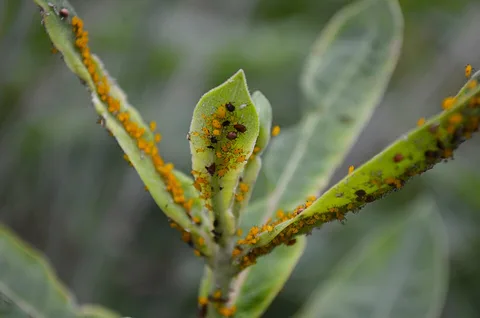
Aphids are small, soft-bodied, pear-shaped insects that pierce tender growth and suck out the fluids. They come in green, yellow, brown, red or black depending on species and host, and almost every plant has one or more that occasionally feed on it. The one feature that settles the identification is a pair of tube-like structures called cornicles projecting backward from the hind end — no other insect has them.
Start with the honest scale. University of Minnesota Extension says that in most cases aphids cause little or no damage to the health of plants, and that treating them for the plant’s sake is usually unnecessary. What you notice first is rarely the insect: curled and puckered new growth, a sticky shine of honeydew on the leaves below, black sooty mold growing on that shine, and ants running the stems.
How to know it’s aphids
Aphids carry one feature no other insect has, and it settles identification on sight once you know to look for it.
- The cornicles:
- A pair of short tubes projecting backward from the rear of the body. UC IPM states it plainly — the presence of cornicles distinguishes aphids from all other insects.
- Body:
- Soft and pear-shaped with long legs and antennae, and green, yellow, brown, red or black depending on the species and what it is feeding on. A few species look waxy or woolly.
- Wings:
- Most adults are wingless, but winged forms appear when a colony gets crowded or in spring and fall — those are the ones leaving to find a new plant.
- Behavior:
- They feed in dense groups, and unlike the insects they are confused with, they do not scatter when you disturb them.
Commonly confused with: leafhoppers and plant bugs
UC IPM separates them two ways. Neither leafhoppers nor plant bugs have cornicles, and both move rapidly when disturbed, while most aphids barely react. If the insects on your stem tips scatter the instant you touch the plant, you are probably not looking at aphids.
What’s really going on
An aphid outbreak is usually being fed and defended. UC IPM is blunt about the first half: high levels of nitrogen fertilizer favor aphid reproduction, so the soft flush of growth a heavy feeding pushes out is exactly what they multiply on. The second half is the ants. Ants farm aphids for honeydew, and to protect that food source they ward off the predators and parasites that would otherwise end the colony — which is why UC IPM calls managing ants a key component of aphid management.
What it means for you
That reframes the job. You are not going to kill your way through an insect that in mild climates reproduces without mating, gives birth to live young — often 12 a day, up to 80 offspring in a week — and goes from newborn to reproducing adult in seven or eight days. You remove what feeds the colony and what guards it. And look before you act: once the crusty, golden-brown shells of parasitized aphids appear, UC IPM says the population is likely to be reduced substantially within a week or two on its own.
The year it runs on
Generations: Many generations a year — the reason a light infestation becomes a heavy one in a week.
Where it spends the winter: In mild climates, not at all — reproduction simply continues. Where winters are harsh, some species produce a sexual generation that lays eggs, often moving to a different, usually perennial, host plant to do it.
- Continuously, in warm weather: Adult females give birth to live young without mating, often as many as 12 a day.
- Seven to eight days: The time it takes a newborn nymph to become a reproducing adult. There is no pupal stage — nymphs simply molt about four times and start reproducing.
- Within a week: A single adult can produce up to 80 offspring, which is what makes the population curve look vertical.
- When the plant declines: Winged forms are produced and disperse to new plants.
The year-round reproduction above is UC IPM’s description of California’s mild climate; where winters are cold the egg stage bridges the gap and the season starts later. What does not change with geography is the doubling speed, so the practical trigger is the size of the colony on your plant, not the month.
What the damage actually costs you
The feeding itself is rarely the problem. The honeydew and the viruses are.
- Yellowed leaves and stunted shoots where populations are large.
- Sticky honeydew coating leaves and whatever is underneath them, often turning black as sooty mold grows on it.
- Curled and distorted leaves, where the species involved injects a toxin as it feeds.
- Mottled, yellowed or curled foliage and stunted growth from aphid-transmitted viruses — squash, cucumber, pumpkin, melon, bean, potato, lettuce, beet, chard and bok choy are the crops UC IPM flags.
How much the plant can take: High, for the feeding. UC IPM notes low to moderate numbers of leaf-feeding aphids are not usually damaging in gardens or on trees. The virus risk is the exception that does not respond to the same logic: infection happens even when aphid numbers are very low, and it takes only a few minutes for an aphid to transmit a virus but far longer for an insecticide to kill it — so on a virus-susceptible crop, spraying is not a defense against the disease.
The move
Non-chemical first, and in this order. From the UC IPM Pest Notes on aphids, with University of Minnesota Extension:
- 1
Look for mummies before you treat
A parasitized aphid turns crusty and golden brown — a "mummy". Once mummies show up on your plants, UC IPM says the aphid population is likely to fall substantially within a week or two. Check for lady beetle larvae and syrphid fly larvae on the same walk; substantial numbers of any of these can mean the colony collapses without you treating at all.
- 2
Stop the ants
Ants tend aphids for their honeydew and ward off the aphids’ natural enemies. On a tree or woody plant, band the trunk with a sticky material applied over tree wrap or duct tape — never directly onto young or thin bark. Or set containerized ant baits on the ground, which control the ants without affecting the aphids’ natural enemies.
- 3
Ease off the nitrogen
High nitrogen favors aphid reproduction, so never use more than necessary. Use a less soluble form and apply it in small portions across the season rather than all at once; slow-release and organic fertilizers are the better choice.
- 4
Hose them off — and prune the curled leaves instead of spraying them
A strong stream of water knocks aphids off sturdy plants and washes the honeydew away with them; most dislodged aphids never make it back. Spray early in the day so the foliage dries. Aphids already sheltering inside curled leaves are out of reach of any contact spray, so prune those out rather than treating them.
- 5
Put reflective mulch under small plants
Silver-colored reflective mulches repel invading aphids away from seedlings and small plants, and have been used successfully to reduce transmission of aphid-borne viruses in summer squash, melon and other susceptible vegetables. Remove the mulch when summer temperatures climb, so the plants don’t overheat.
- 6
If you spray, make it soap or oil
Insecticidal soaps and horticultural oils kill by smothering, so cover the leaf undersides thoroughly and expect to repeat. They leave no toxic residue, so they don’t kill the natural enemies that arrive after the spray — unlike the longer-lasting broad-spectrum products, which University of Minnesota Extension notes kill natural enemies too and can make aphid problems worse. Don’t use soaps or oils on water-stressed plants or above 90°F.
Sources: University of California Cooperative Extension (UC IPM). Pest Notes: Aphids (UC ANR Publication 7404); University of Minnesota Extension. Aphids in home yards and gardens
The plants in this playbook
See how these plants fit your land
Enter your address for your USDA zone, your site type, and a starting plant list scored for your soil and sun. Free, no account.
We read public map data for this spot — soil, climate, flood, and parcel records. How we handle your address.
Why do aphids keep coming back after I spray?
Two reasons. Aphids reproduce faster than a spray program can keep up — in mild climates most reproduce without mating, giving birth to as many as 12 live young a day, and a newborn can be reproducing within eight days. And the longer-lasting broad-spectrum products kill the lady beetles, lacewings and parasitic wasps along with the aphids, which University of Minnesota Extension notes can make aphid problems worse. Insecticidal soaps and oils leave no residue, so natural enemies arriving afterward survive.
Does fertilizer make aphids worse?
Yes. UC IPM states that high levels of nitrogen fertilizer favor aphid reproduction, so you should never use more nitrogen than necessary. Use a less soluble form and apply it in small portions through the season rather than all at once — slow-release or organic fertilizers are best. The soft, fast flush of growth a heavy feeding produces is exactly what aphid colonies build on.
Why are ants crawling all over my aphid-covered plant?
They are farming them. Ants feed on the honeydew aphids excrete, and to protect that food source they ward off the predators and parasites that would otherwise clear the colony. UC IPM calls managing ants a key component of aphid management: band tree trunks with sticky material over a wrap, or use containerized ant baits on the ground, which control the ants without harming the aphids’ natural enemies.
Can I stop aphids from spreading plant viruses?
Not by killing them, and it is worth knowing that plainly. UC IPM notes that aphid-borne virus losses are difficult to prevent by controlling aphids, because infection happens even when aphid numbers are very low — transmission takes an aphid only a few minutes, while an insecticide takes far longer to kill it. What does help is exclusion: protective covers over seedlings, and silver reflective mulch, which has reduced virus transmission in summer squash and melon.
Sources (2)
- University of California Cooperative Extension (UC IPM). Pest Notes: Aphids (UC ANR Publication 7404)
- University of Minnesota Extension. Aphids in home yards and gardens
Related pest playbooks