Pest Playbook
Spider Mites: Why They Exploded After You Sprayed
Sources: University of California Cooperative Extension (UC IPM)
Spider mites · Tetranychus spp.
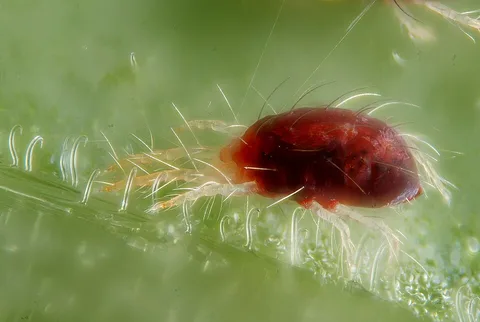
Spider mites are not insects. They are arachnids, related to spiders and ticks, and adults are less than a twentieth of an inch long — to the naked eye, tiny moving dots. They live in colonies on the undersides of leaves, and a single colony can hold hundreds. The first thing you actually see is the damage: a fine stippling of pale dots where they have sucked out the cell contents, then a bronzed cast, then yellowing leaves that drop.
The webbing is the identification. Most species spin fine silk on infested leaves, and that is what separates them from aphids, thrips and the other small things that crowd a leaf underside. Several species — the twospotted, Pacific and strawberry spider mites among them — cannot reliably be told apart in the field, and UC IPM notes there is little need to, because their damage, biology and management are virtually the same.
How to know it’s spider mites
You will find the webbing before you find the animal, and the webbing is what proves the diagnosis.
- Adult:
- Less than a twentieth of an inch, with eight legs, an oval body and two red eyespots near the head. To the naked eye they are tiny moving dots; a 10x hand lens makes them plain.
- Colony:
- They live in colonies on the undersides of leaves, and a single colony may hold hundreds of individuals.
- The webbing:
- Fine silk over infested leaves, becoming dense enough at high numbers to cover leaves, twigs and fruit.
- On the leaf:
- Stippling — a scatter of pale dots across the upper leaf surface — is usually the first thing anyone notices.
Commonly confused with: aphids and thrips
All three infest the undersides of leaves, and at this size color is not decisive. UC IPM gives the clean test: the silk webbing most spider mite species produce is an easy way to distinguish them from all other mites and from small insects such as aphids and thrips. Aphids also carry cornicles and six legs; a spider mite is an arachnid with eight.
What’s really going on
The insecticide is a leading cause of spider mites. UC IPM reports that spider mites frequently become a problem after an insecticide is applied — partly because it kills the mites’ natural enemies, but also because certain insecticides stimulate mite reproduction outright. Spider mites exposed to carbaryl in the laboratory reproduced faster than untreated populations, and carbaryl, some organophosphates and some pyrethroids apparently also favor mites by raising the nitrogen level in leaves. Applied in hot weather, these sprays can cause a dramatic mite outbreak within a few days.
What it means for you
So a mite bloom is often the bill for something you did about a different pest entirely. It also means the first question is not what to spray but whether there is anything left to spray: UC IPM warns that the mites are sometimes gone by the time you notice the damage, and that plants often recover after they leave. Confirm live mites on the leaf undersides before treating anything — and then go after the two conditions that actually drive them, which are dust and water stress, not a missing product.
The year it runs on
Generations: Too many to count in a hot summer — under favorable conditions a full generation completes in less than a week.
Where it spends the winter: As mated females, colored red or orange, tucked under rough bark scales and in ground litter. Where leaves stay green year-round they may simply keep feeding and reproducing instead.
- Spring warm-up: Overwintered females begin feeding and laying eggs.
- June through September: Populations build fastest, and this is when mites commonly become numerous.
- Under a week, in heat: Egg to adult, when temperature and food supply are favorable — the reason an infestation appears to arrive overnight.
- As the leaves decline: Females catch wind currents and disperse to other plants.
- Late summer: High populations can crash quickly as predators catch up, host plants deteriorate, weather cools, and rain knocks them back.
This is UC IPM’s account for California, where some mites feed year-round on evergreen hosts. The pattern that carries anywhere is the driver rather than the date: mites prefer hot, dusty conditions and water-stressed plants, and are found first along dusty roadsides and at garden margins.
What the damage actually costs you
Mites suck the contents out of individual leaf cells, so the damage accumulates as a loss of color before it becomes a loss of leaves.
- Stippling of light dots on the leaves, sometimes progressing to a bronze cast.
- Leaves turning yellow or reddish and dropping as feeding continues.
- Large amounts of webbing over leaves, twigs and fruit at high populations.
- Damage consistently worse where plants are water-stressed.
How much the plant can take: Considerable on woody plants, much less on annuals. UC IPM notes most woody plants tolerate low to moderate mite populations and that natural enemies are often abundant enough to handle them. On annual vegetables such as squash, melons and watermelons, losing leaves does hit yield and exposes fruit to sunburn — and on annual ornamentals very high populations can kill the plant outright.
The move
Confirm, then change the conditions. From the UC IPM Pest Notes on spider mites:
- 1
Confirm live mites before you treat
You will notice the stippling long before you notice the mite. Check leaf undersides for mites, eggs and webbing with a hand lens, or shake a few onto a white sheet of paper, where they move around rapidly once disturbed. Sometimes the colony has already left and the plant will recover on its own — treating then costs you the predators and buys nothing.
- 2
Water the plant properly
Water-stressed plants are the most likely to be damaged, and drought stress increases both mite numbers and mite damage. Adequate irrigation is the most important cultural control there is for this pest — and it is the one that is easiest to let slip in exactly the hot weather that favors them.
- 3
Kill the dust
Mites prefer hot, dusty conditions, and are usually found first on plants next to dusty roadways or at the margins of a garden. Plant ground covers, use mulches, irrigate regularly, and apply water to dusty pathways. Dust also disrupts the natural enemies that would otherwise hold mites down.
- 4
Wash the undersides, mid-season
In gardens and on small fruit trees, regular forceful spraying with water often reduces mite numbers adequately on its own — the coverage on leaf undersides is what makes it work. Mid-season washing to remove dust can head off a serious late-season infestation before it starts.
- 5
If you treat, use a selective material — and protect the predators
Insecticidal soap or horticultural oil are the selective choices. Both kill only on contact, so complete coverage of the leaf undersides is essential and repeat applications may be needed; don’t apply them to water-stressed plants or above 90°F. Above all, avoid the broad-spectrum insecticides that trigger outbreaks. The predatory mites, sixspotted thrips, spider mite destroyer lady beetles, minute pirate bugs and lacewing larvae already on the plant are the durable control.
Source: University of California Cooperative Extension (UC IPM). Pest Notes: Spider Mites (UC ANR Publication 7405)
The plants in this playbook
See how these plants fit your land
Enter your address for your USDA zone, your site type, and a starting plant list scored for your soil and sun. Free, no account.
We read public map data for this spot — soil, climate, flood, and parcel records. How we handle your address.
What causes a spider mite outbreak?
Most often an insecticide, plus heat and dust. UC IPM reports that spider mites frequently become a problem after insecticides are applied — the products kill the mites’ natural enemies, and some stimulate mite reproduction directly (mites exposed to carbaryl in the lab reproduced faster than untreated populations). Beyond that, mites prefer hot, dusty conditions, and water-stressed plants are the most likely to be damaged.
Do spider mites go away on their own?
Often, yes. High mite populations may decline rapidly in late summer as predators overtake them, as host-plant conditions turn unfavorable, as the weather cools, and following rain. UC IPM also warns that the mites are sometimes gone by the time you notice the damage, and that plants often recover after they leave — so confirm live mites with a hand lens before treating.
What are the fine webs on my plant leaves?
Almost certainly spider mites. Most species spin silk webbing on the leaves they infest, and the presence of that webbing is the easy way to tell them from every other mite and from small insects like aphids and thrips that also crowd leaf undersides. When numbers are high the webbing can cover leaves, twigs and fruit.
Does insecticidal soap kill spider mites?
It can, with real coverage. Insecticidal soap and horticultural oil are UC IPM’s preferred selective materials, but they kill only on contact, so you need complete coverage of the leaf undersides and repeat applications may be required. Don’t use them on water-stressed plants or when temperatures exceed 90°F, and test on a portion of the foliage first, since some plants are sensitive.
Sources (1)
- University of California Cooperative Extension (UC IPM). Pest Notes: Spider Mites (UC ANR Publication 7405)
Related pest playbooks