Pest Playbook
Whiteflies: The Cloud You See Isn’t What’s Hurting the Plant
Sources: University of California Cooperative Extension (UC IPM)
Whiteflies · Aleyrodidae
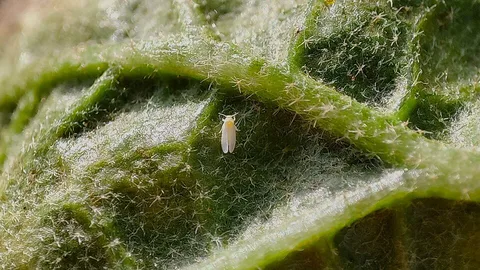
Whiteflies are tiny sap-sucking insects — not true flies at all, but relatives of aphids, scales and mealybugs — that take their name from the mealy white wax coating the adult’s wings and body. Brush an infested plant and they lift off in a puff, then settle back onto the leaf undersides. The two most common pest species, the greenhouse whitefly and the sweetpotato whitefly, have very broad host ranges that take in most vegetables and many ornamentals.
The life stages matter more here than in most pest stories. Eggs are laid on leaf undersides; the first stage crawls around for a few hours and then settles. Every stage after that is immobile — oval, flattened, legless, more like a small scale insect than anything that flies — until the winged adult emerges. UC IPM’s summary of what goes wrong is short: outbreaks often occur when natural biological control is disrupted, and management is difficult once populations are high.
How to know it’s whiteflies
The adults are the stage everyone sees and the least useful one for identification — the settled nymphs on the leaf underside are what tell you what you have.
- Adult:
- Tiny, with a yellowish body and four whitish wings, the whole insect dusted in the mealy white wax that gives the group its name.
- Egg:
- Minute and oblong, laid on the undersides of leaves.
- Crawler:
- The first nymphal stage, barely visible even through a hand lens. It moves around for a few hours, then settles down to feed and never moves again.
- Settled nymphs:
- The later stages are immobile, oval and flattened with greatly reduced legs and antennae — they look like small scale insects, and depending on species run from almost transparent yellow to black with a white fringe.
Commonly confused with: scale insects — and true flies
Two confusions, both cleared by UC IPM. Despite the name these are not flies at all but members of the order Hemiptera, related to aphids, scales and mealybugs. And the immobile later nymphs genuinely do resemble small scale insects, which is why an infestation is often misdiagnosed on the leaf underside where it is actually being decided.
What’s really going on
The white cloud is mostly not what is damaging the plant. UC IPM is precise: adults by themselves will not cause significant damage unless they are transmitting a plant pathogen, and plant losses generally do not occur unless there is a significant population of whitefly nymphs — the oval, legless, immobile immatures fixed to the leaf undersides. And the sprays will not rescue you either: even the most toxic insecticides are only partially effective against whiteflies.
What it means for you
That makes chasing the flying adults the least productive thing available — wrong stage, mobile target, and the products that would hit them hardest are the ones UC IPM names as particularly disruptive to the natural enemies holding the population down. Turn the leaf over instead. And while you are there, read the empty pupal cases: a round or oval exit hole means a parasitic wasp came out of that nymph, while a T-shaped hole means a healthy whitefly did. That one detail tells you whether help has already arrived — and whether spraying would be spraying over it.
The year it runs on
Generations: Continuous where it is warm — the most common pest species breed all year round in mild regions, moving between hosts as plants are harvested or dry up.
Where it spends the winter: By carrying on, wherever winters are mild enough, rather than by passing the season in a resting stage.
- Eggs: Laid on the undersides of leaves.
- First stage: The crawler moves for several hours before settling to feed.
- Second through fourth stages: Immobile and scale-like, fixed in place on the leaf underside, feeding continuously.
- Emergence: The winged adult emerges from the last nymphal stage — which is where the visible cloud comes from.
This year-round pattern is UC IPM’s for the warmer parts of California and for greenhouses; outdoors in cold-winter regions the populations are seasonal and often arrive on purchased plants. Wherever you are, the useful check is the same one: turn the leaves over, because that is where every stage except the adult is living.
What the damage actually costs you
Every stage feeds by sucking plant juices and excreting the excess as honeydew, and that honeydew does more visible harm than the feeding.
- Sticky honeydew on leaves and on whatever sits below them, blackening as sooty mold colonizes it.
- Large colonies on the undersides of leaves.
- Leaves distorted, discolored or silvered where immature sweetpotato whiteflies have been feeding.
How much the plant can take: Higher than the visible cloud suggests, which is the whole point of this playbook. UC IPM notes that whitefly adults by themselves will not cause significant damage unless they are transmitting a plant pathogen — so on a crop with no virus in play, a cloud of adults rising off a disturbed plant is an unpleasant sight rather than a measure of harm.
The move
Prevention beats cure here: UC IPM says management of heavy infestations is difficult and the best strategy is to stop one developing. Their moves:
- 1
Read the exit holes before you act
Check the empty whitefly pupal cases on the leaf. A round or oval exit hole means a parasite emerged from that nymph; a T-shaped exit hole means a healthy adult whitefly did. Darkening in unemerged nymphs can also indicate parasitization, though not in every species. If the wasps are working, don’t spray over them.
- 2
Inspect new plants before they come home
Whiteflies most often arrive on a nursery plant. Always inspect new plants for adults and nymphs before introducing them into a garden or greenhouse — this is the cheapest control in the whole list and the one most often skipped.
- 3
Prune out the infested leaves; pull spent plants
Hand-removing leaves heavily infested with the non-mobile nymphs can bring numbers down to a level natural enemies can contain. Prune out isolated infested leaves as soon as you detect them, promptly destroy infested annuals once the flowering or fruiting period ends, and remove and destroy whitefly-infested vegetable plants after harvest.
- 4
Reflective mulch while the plants are small
Shiny metallic-coated construction paper or reflective plastic mulch repels whiteflies, especially away from small plants. Lay it on weed-free beds, bury the edges with soil, and plant into 3- to 4-inch holes. Remove it when summer temperatures get high, so plants don’t overheat.
- 5
Use yellow traps to monitor, not to control
Yellow sticky traps are most useful for monitoring and detecting whiteflies rather than controlling them. Whiteflies do not fly far, so many are needed — as many as one trap for every two large plants — with the sticky yellow part level with the infestation, facing the plants, and out of direct sunlight.
- 6
Keep dust and ants down; skip the broad-spectrum products
Dust disrupts the natural enemies, and ants protect whiteflies from them in exchange for honeydew — so control both. UC IPM names carbaryl, pyrethroids and foliar imidacloprid as particularly disruptive. If you do spray, use insecticidal soap or neem oil with thorough coverage of the leaf undersides (usually the lowest, hardest-to-reach leaves), below 90°F, and not on drought-stressed plants.
Source: University of California Cooperative Extension (UC IPM). Pest Notes: Whiteflies (UC ANR Publication 7401)
The plants in this playbook
See how these plants fit your land
Enter your address for your USDA zone, your site type, and a starting plant list scored for your soil and sun. Free, no account.
We read public map data for this spot — soil, climate, flood, and parcel records. How we handle your address.
Why don’t insecticides work on whiteflies?
Partly biology, partly the wrong target. UC IPM states that even the most toxic insecticides are only partially effective against whiteflies, and that less-toxic products such as soaps and oils control only the whiteflies directly sprayed — so thorough coverage of the leaf undersides and repeat applications are required. Worse, broad-spectrum products including carbaryl, pyrethroids and foliar imidacloprid are particularly disruptive to the natural enemies whose loss causes outbreaks in the first place.
What are the tiny white specks on the underside of my leaves?
Most likely whitefly nymphs, and they are the stage that matters. After the first crawler stage settles, whitefly immatures are oval, flattened and legless — they look more like small scale insects than anything that flies. UC IPM notes that plant losses generally do not occur unless there is a significant population of nymphs, so this is the stage worth counting, not the adults in the air.
Do yellow sticky traps get rid of whiteflies?
They monitor better than they control. UC IPM describes yellow sticky traps as most useful for monitoring and detecting whiteflies rather than controlling them, though at high levels they may reduce numbers somewhat as part of an integrated program. Because whiteflies do not fly far, many traps are needed — as many as one for every two large plants, placed with the sticky side facing the plants and out of direct sunlight.
Can whiteflies give my tomatoes a virus?
Some whiteflies do transmit viruses to certain vegetable crops, and UC IPM notes that adults by themselves will not cause significant damage unless they are transmitting a plant pathogen. Feeding by immature sweetpotato whiteflies can also distort, discolor or silver leaves independently of any virus. Reflective mulches have been shown to deter virus-transmitting pests in commercial vegetable crops, which may help reduce disease incidence.
Sources (1)
- University of California Cooperative Extension (UC IPM). Pest Notes: Whiteflies (UC ANR Publication 7401)
Related pest playbooks