Pest Playbook
Spotted Lanternfly in Your Garden: What It Actually Harms
Sources: Penn State Extension
Spotted lanternfly · Lycorma delicatula
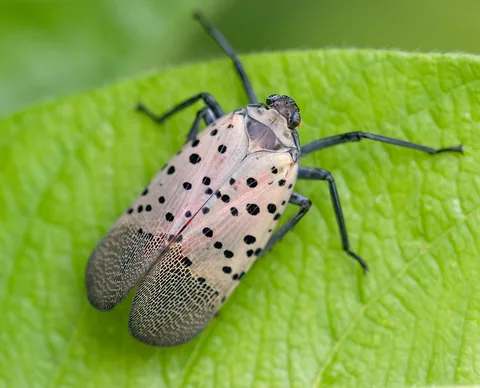
Spotted lanternfly is an invasive planthopper first detected in North America in southeastern Pennsylvania in 2014, and now established across a widening set of states. Adults are about an inch long, and at rest they show only their gray, black-spotted forewings — the red hindwings flash when they are disturbed. Egg masses look like a smear of gray-brown mud and can be laid on almost any surface: bark, decks, rocks, lawn furniture, a wheel well.
Few garden pests have generated more alarm, and the honest picture is narrower than the headlines. Lanternflies cannot bite or sting. They feed on sap through a straw-like mouthpart, and Penn State Extension — which has studied this insect since it arrived — describes it as primarily a nuisance pest in residential landscapes. That does not make it harmless. It means the harm arrives by a route most people are not watching.
How to know it’s spotted lanternfly
Only the adult has wings, and even the adult usually keeps the showy ones hidden — which is why this insect is easy to miss until there are many of them.
- Egg mass:
- A flat patch covered with a gray-brown, mud-like coating, laid on tree trunks, decks, houses, outdoor equipment and rocks. Each mass holds about 35 eggs on average.
- Early nymphs:
- The first three stages are black with bright white spots, starting around an eighth of an inch and roughly doubling in size at each molt.
- Late nymph:
- The fourth stage is unmistakable — red with white dots and black stripes, about a half-inch long.
- Adult:
- About an inch long, with a black abdomen banded in yellow, gray forewings marked with black spots, and hindwings patched with red, black and white. At rest the forewings cover everything else and read as tree bark.
- Behavior:
- Both nymphs and adults are strong jumpers and will jump when approached or prodded — a useful tell at a distance.
Commonly confused with: small ticks or spiders
Penn State notes that newly hatched nymphs are small — around an eighth of an inch — hard to find, and may be mistaken for small ticks or spiders. The black-with-white-spots stage is the one people fail to connect to the adult they have seen on the news, so an infestation is often already established by the time it is recognized.
What’s really going on
Spotted lanternfly is not known to kill plants, with three exceptions: grapevines, black walnut saplings, and the invasive tree-of-heaven it favors. The damage a home garden actually suffers usually falls from above — lanternflies feeding in a tree excrete sugary honeydew that rains down on whatever grows below, and sooty mold colonizes it. The mold does not infect the plant; it simply coats the leaves and cuts off their light. Where lanternflies gather densely, understory plants can die of the shade.
What it means for you
So the plant to worry about is often not the one crawling with lanternflies — it is the bed or the container sitting under the tree they have chosen. If you grow grapes, that is the one crop where the feeding itself is serious. Everywhere else, the useful work is not killing every insect you see: it is knowing which plant is actually at risk, and not carrying the insect somewhere new.
The year it runs on
Generations: One generation a year.
Where it spends the winter: As eggs, in those mud-coated masses on any hard surface outdoors — which is exactly why the insect travels on vehicles, firewood and outdoor furniture.
- September to December: Eggs are laid on trees, decks, houses, equipment and rocks.
- Late April to June: Eggs hatch. Nymphs feed on sap from tender new growth, are in near-constant motion, and move through plants in groups.
- July onward: Adults emerge and shift to feeding on the twigs, branches and trunks of woody plants.
- Fall, until hard freezes: Adults stay active and gather in large numbers on favored trees before being killed by hard freezes.
This calendar is Pennsylvania’s, from Penn State Extension, where the insect was first established in the United States. Because spotted lanternfly spreads largely by hitchhiking rather than by flying, whether it is on your land is a question about quarantines and movement, not about your latitude — which is what the rest of this playbook is about.
What the damage actually costs you
This is a sap feeder, so the damage is stress and honeydew rather than chewed leaves — and it falls very unevenly across plants.
- Large numbers of insects gathered on trunks and branches, often returning year after year to the same "hot" tree even when neighboring trees look identical.
- Dieback of individual tree branches where large numbers of nymphs have fed.
- Damage to perennials and annuals where nymph numbers are high.
How much the plant can take: It depends entirely on the plant. Penn State reports that heavy feeding has contributed to the death of grapevines, tree-of-heaven and black walnut saplings, and that high feeding levels may stress trees by reducing photosynthesis — with damage more apparent on plants already stressed by something else. Nymphs take less sap than adults, so the same number of nymphs does less harm. For most garden plants the honest answer is that the insect is a nuisance and a quarantine problem rather than a threat to the plant.
The move
Penn State Extension’s own first instruction is to “avoid overreacting to the situation and teach others not to overreact.” These are the moves that earn their keep, from their Spotted Lanternfly Management Guide:
- 1
Scrape the egg masses you can reach
Eggs are laid September through December under a mud-like covering — roughly 35 per mass — and sit there until they hatch from late April into June. For any mass within reach, Penn State found that scraping or smashing works better than the oil sprays sold as ovicides.
- 2
Scout before you treat anything
Penn State emphasizes that not every tree in an already-infested area needs to be treated: a few lanternflies on a large, healthy tree are unlikely to do permanent damage. Scout your own property through the season, then treat only where high populations show up and persist.
- 3
If you trap, use a circle trap — and screen any sticky band
A circle trap is a modified funnel you can buy or build, set about four feet up a smooth-barked trunk; it catches the most from hatch through June. Plain sticky bands are not recommended without a wildlife barrier — they catch bats, squirrels, small birds, lizards and beneficial insects. If you use one, guard it with mesh window screening; chicken wire is too open to help.
- 4
Never spray a plant that is blooming
To protect the pollinators that visit flowers for nectar, no insecticide should go on a plant in bloom. Penn State also notes that killing the lanternflies present today will not stop more from arriving later in the season.
- 5
Check the car, the firewood, the patio furniture
The quarantines exist to stop human-assisted spread: adults can hold onto a vehicle at 65 mph, and egg masses hide in wheel wells and on outdoor gear. The permit requirement applies to businesses, not households — what residents are asked to do is inspect belongings before travelling out of a quarantined county, and report a sighting in a new area to 1-888-4BAD-FLY.
Sources: Penn State Extension (2024). Spotted Lanternfly Management Guide; Penn State Extension (2021). How You Can Comply with the Spotted Lanternfly Quarantine Regulations
The plants in this playbook
See how these plants fit your land
Enter your address for your USDA zone, your site type, and a starting plant list scored for your soil and sun. Free, no account.
We read public map data for this spot — soil, climate, flood, and parcel records. How we handle your address.
Will spotted lanternfly kill my plants?
Usually not. Penn State Extension reports that spotted lanternfly feeding stresses plants and can cause localized branch damage, but it is not known to kill plants except grapevines, black walnut saplings, and the invasive tree-of-heaven. In a home landscape it is considered primarily a nuisance pest.
Does spotted lanternfly damage vegetable gardens?
Nymphs will feed on vegetables, fruit and herbs — Penn State names cucumber, basil, horseradish, raspberries and asparagus — but damage is seldom reported and shows up only under very high populations. The more common garden problem is indirect: honeydew falling from a tree above, and the sooty mold that grows on it, coating the leaves underneath.
How do I get rid of spotted lanternfly egg masses?
Egg masses are present from September through June and look like a smear of gray-brown mud on bark, decks, rocks, or outdoor equipment. For any you can reach, Penn State Extension found scraping or smashing more effective than the oil ovicides sold for the job.
Do I need a spotted lanternfly permit?
Not as a household. The quarantines are issued by state departments of agriculture, and the permit requirement applies to businesses and organizations operating within a quarantined county. Residents are asked to inspect their vehicles and belongings before travelling out of a quarantined area, and to report sightings in new areas.
Sources (2)
- Penn State Extension (2024). Spotted Lanternfly Management Guide
- Penn State Extension (2021). How You Can Comply with the Spotted Lanternfly Quarantine Regulations
Related pest playbooks