Pest Playbook
Tomato Hornworms — and the One You Should Leave Alone
Sources: University of Minnesota Extension
Tomato hornworm · Manduca quinquemaculata
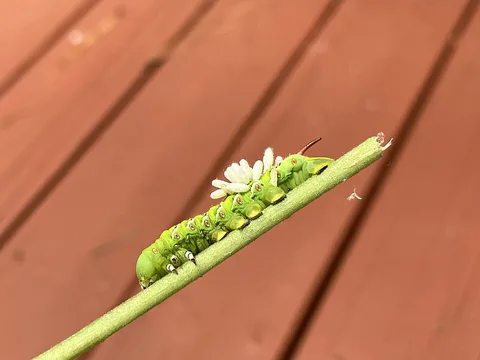
Tomato hornworms are among the largest caterpillars in a North American garden — up to four inches — with eight white V-shaped marks down each side and a dark horn on the tail. Tomato is the host of choice, though they also turn up on potato, eggplant and pepper. They start at the top of the plant and work down, and a heavy infestation can strip a plant faster than seems possible.
They are also very hard to see. A hornworm is exactly the green of a tomato leaf, and University of Minnesota Extension notes that they often go unnoticed until most of the damage is already done. Physical removal is usually the only management a home garden needs — but not on every caterpillar you find.
How to know it’s tomato hornworm
Look at the horn and the stripes together — those two features settle both what it is and which of the two hornworms you have.
- Caterpillar:
- Among the largest caterpillars you will find in a garden, reaching three to four inches. Small ones are yellow to white with no markings at all.
- The markings:
- Large tomato hornworms carry eight white V-shaped marks along each side and a black horn on the last abdominal segment.
- The frass:
- Dark green or black droppings on the leaves below, which are far easier to spot than the caterpillar itself.
- Adult moth:
- A large, heavy-bodied gray-brown hawkmoth with a four to five inch wingspan, yellow spots along the sides of the abdomen, and banded hindwings.
Commonly confused with: the tobacco hornworm (Manduca sexta)
University of Maryland Extension gives the split cleanly: tobacco hornworms have a red horn and seven diagonal stripes, while tomato hornworms have a black, less curved horn and V-shaped or arrow-like marks. The twist is that the name misleads — UMD notes the tobacco hornworm, despite what it is called, is often found on tomato plants and may be the more commonly encountered of the two. Both are managed identically, so this is a matter of naming it correctly rather than treating it differently.
What’s really going on
A hornworm studded with what look like grains of white rice should be left exactly where it is. Those are the cocoons of a braconid wasp, Cotesia congregatus, whose larvae have been feeding inside the caterpillar. When the adult wasps emerge they kill the hornworm, then go looking for the next one. University of Minnesota Extension’s instruction is explicit: leave that hornworm in the garden.
What it means for you
So two hornworms on one plant can call for opposite actions — pick the clean one, leave the parasitized one working. And there is a reason to look early rather than thoroughly: the final caterpillar stage eats nearly as much as all the younger stages combined, so a hornworm you find at full size has already done most of the damage it was ever going to do.
The year it runs on
Generations: One to two generations a year.
Where it spends the winter: As a pupa in the soil — a hard, reddish-brown case with a distinctive handle-like loop, four to six inches down, spun into no cocoon at all.
- Spring: Moths emerge from the overwintered pupae. University of Maryland Extension records adults emerging over a long stretch, from as early as May into early August.
- After mating: Females lay oval, smooth, light green eggs singly on both the lower and upper surfaces of leaves.
- Three to four weeks: Caterpillars feed and reach full size, passing through four to five growth stages.
- End of feeding: Mature caterpillars drop from the plants and burrow into the soil to pupate. Moths emerge about two weeks later to begin a second generation in mid-summer.
- Late summer to early fall: The second generation finishes feeding and pupates. Those pupae stay in the soil through the winter.
The two-generation sequence above is University of Minnesota Extension’s account for Minnesota; University of Maryland Extension records one to two generations. Since the caterpillars are large and the frass is obvious, the reliable instruction is the one UMN gives regardless of date: check plants at least twice a week through the summer.
What the damage actually costs you
They start at the top of the plant and are colored to disappear against it, so the damage is usually noticed before the animal is.
- Feeding begins on the leaves at the upper parts of the plant.
- Visible dark green or black droppings — the fastest way to locate a caterpillar you cannot see.
- On older caterpillars, several destroyed leaves plus chewed holes in the fruit itself.
- Large numbers can defoliate a plant quickly.
How much the plant can take: A plant absorbs the early stages easily; it is the end that costs you. UMN notes the last caterpillar stage consumes nearly as much as all the younger stages combined, so a hornworm found early is close to harmless and the same animal found two weeks later is not. Tomato is the host of choice, with potato, eggplant and pepper also affected.
The move
Hand-picking is the most effective control, and pesticides are generally not necessary. From University of Minnesota Extension:
- 1
Leave the one wearing white cocoons
If a hornworm has white projections like rice grains on its back, leave it in the garden so the adult braconid wasps can emerge. They kill that hornworm and then seek out other hornworms to parasitize — free, self-renewing control you would otherwise be throwing away.
- 2
Find them by the droppings, twice a week
Check plants at least twice a week through the summer. The caterpillars blend into the leaves, but their dark green-to-black droppings are clearly visible — look down at the soil and the lower leaves first, then trace upward to the feeder.
- 3
Hand-pick the rest into soapy water
This is the most effective way to manage them, and their size makes them easy to collect once you know where to look. Other allies are already helping: paper wasps hunt garden caterpillars, and lady beetles and green lacewings take the eggs and young larvae.
- 4
Cut off next year between seasons
Remove weeds that serve as alternate hosts — horsenettle, jimsonweed and nightshade — to reduce egg-laying sites, and till the soil after harvest to destroy the caterpillars and pupae overwintering there. If a treatment is genuinely needed, Bt (Bacillus thuringiensis var. kurstaki) is specific to caterpillars, does not affect bees, and works best on very young ones.
Source: University of Minnesota Extension. Tomato hornworms in home gardens
The plants in this playbook
See how these plants fit your land
Enter your address for your USDA zone, your site type, and a starting plant list scored for your soil and sun. Free, no account.
We read public map data for this spot — soil, climate, flood, and parcel records. How we handle your address.
Do tomato hornworms come back every year?
Yes, if the ground is left undisturbed. Mature caterpillars drop off the plant and burrow into the soil to pupate, and those pupae overwinter there and emerge as moths the following spring — with a second generation mid-summer. University of Minnesota Extension recommends tilling after harvest to destroy the burrowing caterpillars and pupae, and clearing alternate host weeds like horsenettle, jimsonweed and nightshade.
How do I find tomato hornworms on my plants?
Look for the droppings, not the caterpillar. Hornworms are the same green as the leaves and often go unnoticed until the damage is done, but they leave clearly visible dark green-to-black droppings below where they are feeding. Check plants at least twice a week through summer.
How do I get rid of tomato hornworms without spraying?
Pick them off and drop them in soapy water — University of Minnesota Extension calls this the most effective management, and pesticides are generally not necessary. Leave any hornworm carrying white wasp cocoons. Between seasons, clear alternate host weeds like horsenettle and jimsonweed and till after harvest to destroy overwintering pupae.
Sources (1)
- University of Minnesota Extension. Tomato hornworms in home gardens
Related pest playbooks