Pest Playbook
Not Every Stink Bug in Your Garden Is the Invasive One
Sources: University of California Cooperative Extension (UC IPM), University of Maryland Extension, NC State Extension
Brown marmorated stink bug · Halyomorpha halys
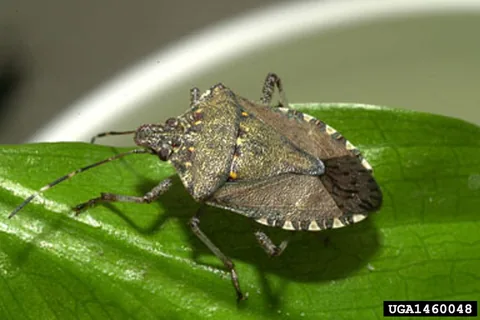
The brown marmorated stink bug arrived from East Asia — first reported in the United States in Pennsylvania in 2001 — and has since been found in at least 40 states. It feeds by injecting tissue-destroying enzymes and sucking the juices out of fruit and seeds, leaving pockmarks and distortions, with the flesh underneath turning hard and pithy. In the mid-Atlantic it has cost backyard gardeners whole crops of tomatoes, peppers and beans.
But "a brown stink bug on the tomatoes" is not one insect. Several native stink bugs look much alike at a glance, and one of them — the spined soldier bug — is a predator that feeds on caterpillars and beetle larvae on your behalf. University of Maryland Extension puts predatory stink bugs squarely in the beneficial column, feeding on more than 100 species of insect pests. Reaching for a spray without looking closely can cost you the one that was helping.
How to know it’s brown marmorated stink bug
Check the antennae. Two white bands settle this question faster than size, color or shape, all of which the native look-alikes share.
- Adult:
- A typically shaped stink bug about five-eighths of an inch long and marbled brown, with two white bands on the antennae, a blunt front edge to the head, a smooth shoulder margin, and legs marbled brown with faint white banding.
- The abdomen edge:
- A banded edge visible along the side of the folded wings, and dark bands at the tips of the membranous parts of the forewings.
- Egg:
- Barrel-shaped, white to pale green, laid in clusters on leaves.
- Nymphs:
- Five stages, from about 2.4 mm to 12 mm. Newly hatched nymphs have an orange abdomen with dark plates and cluster around the egg mass; later stages are marbled brown with white bands on the antennae and legs and spines in front of red eyes.
Commonly confused with: the rough stink bug and the consperse stink bug (Brochymena sulcata and Euschistus conspersus)
UC IPM gives both tells. The rough stink bug has a rough shoulder margin, a head whose front edge extends into two points, and no white antennal bands — only tiny light striations where the antennal segments meet. The consperse stink bug does have a banded abdomen edge like the invasive, but carries no antennal bands, has distinctly dark-spotted rather than marbled legs, and is smaller at about half an inch. The antennal bands are the feature to look for first.
What’s really going on
The reliable tell is small and takes two seconds: the invasive brown marmorated stink bug has two white bands on each antenna. The native rough stink bug has no antennal bands, a rough shoulder margin and a two-pointed head edge; the native consperse stink bug has a banded abdomen but plain antennae and distinctly dark-spotted legs. And the beneficial spined soldier bug gives itself away by its mouthparts — predatory stink bugs have a short, stout beak, more than twice as thick as their antennae, where a plant-feeding stink bug’s beak is as thin as or thinner than its antennae.
What it means for you
That turns a spray decision into a look-first decision, which is fortunate, because spraying is the weakest option anyway: most garden insecticides are not very effective against adult stink bugs, and more simply move in from elsewhere. It is also worth keeping the scale honest — a small amount of stink-bug damage is tolerable, and a pocked or pithy spot in a tomato can be cut out without affecting how the rest eats.
The year it runs on
Generations: One or two generations a year in the mid-Atlantic, with more in warmer regions.
Where it spends the winter: As an adult, in a resting state, in protected places — which for this insect very often means inside a building.
- Fall: Adults aggregate in large numbers on the sides of buildings and on trees, then move into protected places to overwinter.
- Winter: Adults do not reproduce and barely feed. They hide in narrow spaces indoors — behind baseboards, around window and door trim, around ceiling fixtures — preferring high, cool spots.
- Spring: Adults become active and move from overwintering sites out to host plants. After roughly two weeks of feeding, they mate.
- Through the season: Females lay eggs in clusters of 20 to 28, and between 212 and 486 eggs over a lifetime.
The one-or-two generation figure is UC IPM’s for the mid-Atlantic; UC IPM states plainly that the number of generations across much of California is unknown, noting only that warmer regions generally see more. That honest gap is worth carrying: the count where you live may simply not be established.
What the damage actually costs you
This is a fruit pest above all. Adults and nymphs inject tissue-destroying enzymes and suck the juices out of fruit and seeds.
- Pockmarks and distortions on fruit that make it unmarketable, with the flesh underneath turning hard and pithy.
- Damage concentrated on apple, pear, peach, nectarine, lima bean, snap pea, pepper, sweet corn, tomato and soybean — the mid-Atlantic crops UC IPM lists as most affected.
- Feeding on buds, flowers, leaves and stems, including through the bark of young trees.
- Indoors, an offensive odor when the insects are disturbed or crushed.
How much the plant can take: Low on fruit, because one insect feeds on many fruits and losses compound quickly. Indoors, though, the honest answer is that the nuisance is the whole problem: UC IPM is explicit that these bugs are not harmful to people, houses or pets, do not bite or sting, do not spread disease, do not eat or bore into wood, and will not reproduce or cause damage inside a structure.
The move
Identify first, then exclude and remove by hand — the sprays mostly do not earn their place. From the UC IPM Pest Notes and University of Maryland Extension:
- 1
Check the antennae before you act
Two white bands on each antenna means the invasive one. No antennal bands with a rough, two-pointed head edge is the native rough stink bug; plain antennae with dark-spotted legs and a banded abdomen edge is the native consperse stink bug. A short, thick beak means a predator — leave it be.
- 2
Hand-pick, and destroy the egg clusters
They are large enough to knock into soapy water, though they hide in dense foliage and drop when startled, so a dedicated hand-held vacuum used regularly works better on a real infestation. Look for the barrel-shaped egg clusters on leaf undersides and destroy those too.
- 3
Row-cover, but not while it is flowering
A row cover prevents stink-bug feeding outright — but it also keeps pollinators off the flowers, which may be exactly when protection is wanted. Cover selectively, and expect it to be impractical on a full-size fruit tree.
- 4
Keep any pheromone trap away from the rows
Traps are useful for telling you the bugs have arrived, but probably not for preventing damage. In a 2013 Maryland home-garden study, a single pheromone trap set a meter from the garden rows produced more stink bugs and more damage on the nearby plants — a spillover effect worth avoiding in a small yard.
- 5
Seal the house instead of spraying it
In fall the adults move indoors to overwinter, where they do not reproduce, feed, bite, or damage the building. Caulk the gaps around windows, doors, utility pipes and vents, repair screens and fit door sweeps: exterior sprays break down within days, and sealing is both more effective and more environmentally sound.
Sources: University of California Cooperative Extension (UC IPM). Pest Notes: Brown Marmorated Stink Bug (UC ANR Publication 74169); University of Maryland Extension (2021). Predatory Stink Bugs; NC State Extension (2018). Spined Soldier Bug Look-a-Likes
The plants in this playbook
See how these plants fit your land
Enter your address for your USDA zone, your site type, and a starting plant list scored for your soil and sun. Free, no account.
We read public map data for this spot — soil, climate, flood, and parcel records. How we handle your address.
How can I tell a brown marmorated stink bug from a native one?
Look at the antennae. The invasive brown marmorated stink bug has two white bands on each antenna. The native rough stink bug has no antennal bands and a rough, two-pointed head edge; the native consperse stink bug has plain antennae and dark-spotted legs. Predatory stink bugs such as the spined soldier bug have a short beak more than twice as thick as their antennae.
Are all stink bugs bad for the garden?
No. University of Maryland Extension counts predatory stink bugs — including the spined soldier bug — as a gardener’s friend, feeding on more than 100 species of insect pests, and they are especially fond of caterpillars. They are found on the same plants as the pest species, so identifying before treating matters.
Do stink bug traps work in a home garden?
They are better for monitoring than protection. UC IPM reports that pheromone traps can remove large numbers of stink bugs but probably have little value in preventing crop damage, and a 2013 Maryland home-garden study found a trap placed a meter from the rows led to more stink bugs and more damage on the nearby plants.
Are the stink bugs in my house in the fall dangerous?
No. Brown marmorated stink bugs are not harmful to people, pets or houses — they do not bite, sting, spread disease, or bore into wood, and they neither reproduce nor cause damage indoors. Sealing entry points works better than spraying, since exterior sprays break down within days.
Sources (3)
- University of California Cooperative Extension (UC IPM). Pest Notes: Brown Marmorated Stink Bug (UC ANR Publication 74169)
- University of Maryland Extension (2021). Predatory Stink Bugs
- NC State Extension (2018). Spined Soldier Bug Look-a-Likes
Related pest playbooks