Pollinator Story
The Yucca and Its Moth: Nature’s Tightest Partnership
Sources: USDA NRCS, Marr, Leebens-Mack, Elms & Pellmyr, Pellmyr et al.
Some plants are pollinated by whatever insect happens by. The yucca is not one of them. It has exactly one pollinator — the yucca moth — and the moth has exactly one food for its young: yucca seeds. Neither can reproduce without the other, which makes their relationship one of the most famous partnerships in all of biology.
That tight bond has a practical consequence for gardeners. The yucca moth flies only where yucca is native — the Southeast and south-central states — so a yucca planted far outside that range blooms beautifully yet sets almost no seed, because the one partner that can pollinate it never arrives.
The partnership
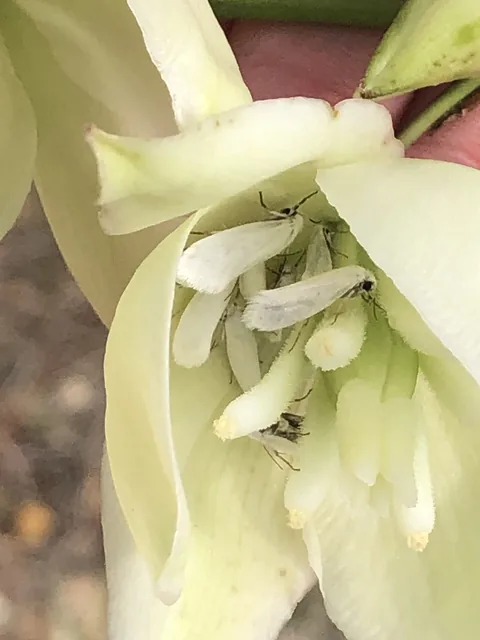
The yucca and its moth are one of biology's textbook mutualisms. A female Tegeticula moth gathers a ball of sticky yucca pollen with specialized mouthpart tentacles, flies to another yucca flower, lays her eggs inside its ovary, and then deliberately packs the pollen onto the stigma — guaranteeing seeds for her larvae to eat. The moth is the yucca's only pollinator and the yucca is the moth larvae's only food; neither reproduces without the other. The larvae eat a share of the developing seeds, but 60–80% survive, so the plant still sets a full seed crop. It is the tightest pollination partnership in the North American flora — and the reason a yucca planted far outside its native range, where the moth doesn't fly, blooms beautifully yet sets almost no seed.
Three different ranges decide whether it sets seed
"It grows here" and "it sets seed here" are not the same question. Seed set needs the plant and its pollinator in the same place — so it helps to keep three ranges apart.
Where it's native
Native to the Southeastern U.S. — roughly Maryland and Virginia south to Florida, west to Louisiana and eastern Texas. Not native to the far West (CA, OR, WA, AZ, NM). Native status is documented at the county and ecoregion level, and the record has known gaps (USDA NRCS 2006).
Where it grows
Yucca is a tough evergreen that grows — and often escapes into the wild — well north of its native range. So the fact that it thrives in a yard tells you nothing about whether it can set seed there.
Where its pollinator lives
Its pollinators are two moths, each tied to part of the range: Tegeticula yuccasella — Eastern North America — the Great Plains from southern Texas to southern Canada, and east of the plains north to Michigan and Connecticut (per the post-1999 literature: COSEWIC status report; Pellmyr 1999).; Tegeticula cassandra — North-central Florida and bordering areas of Georgia (per the post-1999 literature: Pellmyr 1999).. Look-alike moths (Tegeticula intermedia, Tegeticula corruptrix, Prodoxus spp.) share the plant but do not pollinate it, so their presence never means seed set. No county-level map exists for these moths, so their presence is a regional statement — we can't confirm it at your exact site (Pellmyr 2003; Pellmyr 1999).
The overlap
Where yucca is native and its moths range, seed set is possible. Planted outside that range it blooms beautifully but sets little or no seed — it still thrives as an evergreen, so propagate it from offsets or division.
The plants in this story
See what your land is suited to
Enter your address for your USDA zone, your site type, and a starting plant list for your soil and sun. Free, no account.
We read public map data for this spot — soil, climate, flood, and parcel records. How we handle your address.
What pollinates a yucca?
A single partner: the yucca moth (Tegeticula). The female moth deliberately packs yucca pollen onto the flower’s stigma while laying her eggs, guaranteeing seeds for her larvae to eat. No other insect pollinates the yucca, and the plant sets little or no seed without it.
Why won’t my yucca bloom or set seed?
A yucca grown outside its native Southeastern and south-central range blooms but rarely sets seed, because the yucca moth that pollinates it does not fly there. Your plant will still thrive as a striking evergreen — propagate it from offsets or division rather than seed. Enter your location and Growable Ground will tell you whether the moth is likely present where you garden.
Is red yucca a real yucca?
No. Red yucca is Hesperaloe parviflora, a different genus from true Yucca. It is pollinated mainly by hummingbirds and has no yucca-moth dependency, so it sets fruit readily in cultivation — the name is the only thing it shares with the yucca.
Sources (4)
- USDA NRCS (2006). Plant Guide — Yucca filamentosa (Adam's needle)
- Marr, Leebens-Mack, Elms & Pellmyr (2000). Pollen dispersal in Yucca filamentosa (Agavaceae)
- Pellmyr et al. (2010). How to become a yucca moth: minimal trait evolution needed to establish the obligate pollination mutualism
- Pellmyr et al. (2002). Origin of a complex key innovation in an obligate insect-plant mutualism (PNAS)
Related pollinator stories