Microclimates: Why One Yard Holds Several Climates
Sources: Standard micrometeorology, USGS elevation, USDA soil survey
Features
14
Covered in this guide
Categories
4
Cold air to shelter
Scale
Your parcel
Not your region
Your hardiness zone is a regional number. Your frost dates are a regional number. They describe a broad area, and they are the right place to start — but they are not a description of the ground you actually garden on. A single property routinely holds a low corner that frosts weeks before the rest of it and a sunny wall that carries a plant the zone map says you cannot grow. The gap between the regional number and your ground is a microclimate, and it is the difference between planning on paper and planning on your land.
This guide is about that gap. It is not about what to do when the weather turns — weather protection covers that — and it is not about buying extra weeks with covers, which is season extension. It is about reading the climates you already have, for free, and putting the right plant in each one. Nearly every feature below comes down to two physical facts: cold air sinks, and dense material stores heat. Once you can see those two working on your own ground, most of what looks like bad luck in a garden turns out to be geography.
Each entry covers three things: why the feature happens, how to recognise it on your own property, and what to do about it. Then the walk at the end turns the whole guide into a routine you can run on your own ground in five mornings a year.
Free Report
Start from the real shape of your ground
Enter your address and we read your parcel's elevation, slope, sun, soil drainage, and frost dates from the federal record — the inputs every microclimate on this page is built from — then score 1,086 plants against them.
Three things about your exact spot that zone averages miss:
Your soil pHYour frost-free daysYour sun & shade
We read public map data for this spot — soil, climate, flood, and parcel records. How we handle your address.
25+ data sources analyzed in seconds
Cold Air & Frost Pockets
Cold air is heavier than warm air, and on a still, clear night it behaves like water: it slides downhill, pools in the lowest place it can reach, and stacks up behind anything that blocks it. That single fact explains most of the frost damage that seems unfair — the bed that gets hit while the identical bed upslope is untouched, the low corner that loses tomatoes weeks before the rest of the garden. Once you can see where the cold water of the air would run on your ground, you can stop planting tender things in the puddle.
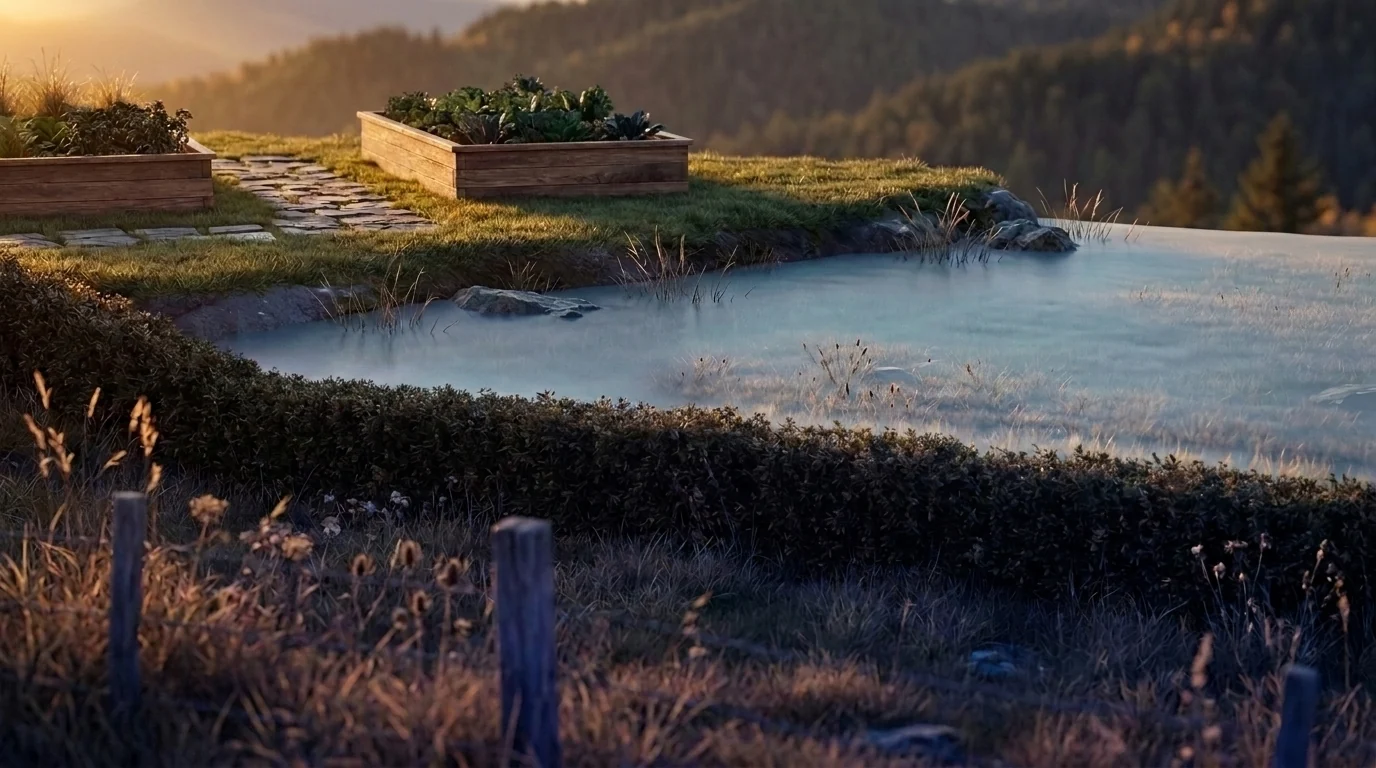
Cold air is denser than warm air. On clear, still nights it drains downhill and pools in the lowest enclosed ground; a hedge across the slope dams it, and the slope above that pool stays warmer.Every feature in this group is a different place on this same slope: the frost pocket is where the pooled cold collects, cold-air drainage is the flow that fills it, the thermal belt is the band that stays drained, and the hilltop above trades the cold pool for wind.
Frost Pocket
Colder
Also called: Frost hollow · Cold hollow
Why it happens
On a clear, still night the ground radiates its heat away to open sky and chills the thin layer of air touching it. That chilled air is denser than the air above it, so it flows downhill and collects in the lowest enclosed spot it can find — a dip, a hollow, the flat bottom of a small valley, or the uphill side of anything solid. Penn State puts the consequence plainly for orchards: sites at lower elevations see more frost damage because of this collection of cold air, which is why site selection matters so much. Minnesota Extension notes the same pockets form at very small scales, and that landscape features such as a forest edge at the bottom of a slope can dam the drainage and worsen the risk for everything around it.
How to spot it
Walk your property at dawn after the first cold clear night of autumn and look for where the frost is: a frost pocket shows as a distinct silvered patch in the low ground with a clean upper edge, while the ground above it is green. Mist and dew settle in the same place. Over a season the tell is repetition — the same corner is always the first to be frosted and the last to thaw, and tender plants there fail while their twins uphill sail through.
What to do with it
Site around it rather than fighting it — Penn State is blunt that good site selection is the most economical and effective frost protection there is, and that no protection mechanism overcomes a poor site. So do not plant frost-tender crops or early-blooming fruit in the pocket; the blossom of an apricot or peach in a frost hollow will be killed in most years even where the regional climate could carry the tree. Use the low ground for what genuinely likes it: late-planted hardy greens, brassicas, and anything harvested before frost matters. Where a barrier is damming the flow, Minnesota Extension's advice is direct — remove landscape features such as hedges that dam cold air, avoid planting near forest edges at the bottom of a slope, and run rows parallel to the slope so the cold can drain through.
The shape of your ground is the input here, and it is public data: our report reads your parcel’s elevation from the USGS 3D Elevation Program, so the low ground on your land is measurable rather than a guess.
The same dense night air that pools in hollows also moves — it runs downhill along the surface like a slow, invisible river, following the shape of the land through swales, driveways, and gaps between buildings on its way to the lowest ground. Anywhere along that path is colder at night than ground just outside it, even where there is no hollow at all.
How to spot it
Look for a channel: a shallow swale, a gap in a hedgerow, a gently sloping drive that lines up with the low ground. On a frosty morning the frost follows the channel as a stripe rather than a patch. Growers often notice it as a row of plants that fails along one line across an otherwise healthy bed.
What to do with it
Keep the drainage path open and put nothing tender in it. Because the flow is shallow and slow, a modest obstruction placed ACROSS it deflects a surprising amount — but only put one there if you can send the cold somewhere harmless, since a barrier that dams the flow simply creates a new frost pocket behind it. The best use of the knowledge is siting: place the tender beds to the side of the channel, not in it.
Mid-Slope Thermal Belt
Warmer
Also called: Thermal belt · Banana belt
Why it happens
If cold air drains off the top of a slope and pools at the bottom, the band in between gets the best of both: the cold has already left it and has not yet collected there. On a still night this mid-slope band stays measurably warmer than either the hilltop above or the valley floor below. It is the reason orchards in hilly country are planted on the sides of hills rather than in the fertile bottoms, which look like better ground and are not.
How to spot it
On a frosty morning the mid-slope band is the green stripe between the frosted bottom and the exposed, wind-scoured top. In old agricultural country you can often read it off the landscape itself — the historic orchards, vineyards, and fruit farms sit on the slope, not in the valley.
What to do with it
This is the premium ground on a sloping property, and it is where the marginal crop belongs: the fruit tree that blooms too early, the fig, the tender perennial that is one zone out of reach. If your parcel has usable slope, walk it before you decide where the orchard goes — the difference between the bottom and the middle of a slope can be worth more than any amount of winter protection you could add later.
Hilltop & Ridge Exposure
Exposed
Also called: Ridge top · Exposed crest
Why it happens
The top of a rise sheds cold air rather than collecting it, so it escapes the frost-pocket problem — but it pays for that with wind. A crest has nothing upwind to slow the air, so it takes the full speed of every blow, all year. Steady wind dries soil and foliage, strips the still air that plants rely on, and in winter desiccates evergreens on the windward side.
How to spot it
Trees on an exposed crest tell you plainly: they lean, they are one-sided, and their windward branches are stunted. Snow scours off the top and drifts in the lee. The soil is often thinner and drier than downslope.
What to do with it
Take the frost advantage and fix the wind problem: plant a permeable windbreak on the windward side rather than trying to garden in the open. A filtering barrier — a shrub row, a slat fence — protects a long zone downwind, while a solid wall throws turbulence that can do more damage than the wind it blocked. The /guides/weather-protection guide covers windbreak design in depth.
Pro Tip
The cheapest microclimate instrument you can own is a cheap thermometer and a habit. Put one in the low corner and one by the sunny wall, read them on the same cold morning, and you will know the real spread on your own property — a number no map can give you, because it depends on the shape of your ground and what is built on it.
Warm Spots & Heat Traps
The mirror image is just as useful. Masonry, paving, and any large dense object soak up sun through the day and release that heat slowly through the night, holding the air beside them above the temperature the rest of the yard falls to. A sunny wall with a solid surface at its foot is the warmest ground most properties have, and it is where growers have always cheated their climate — the espaliered fruit against the south wall is a centuries-old trick, not a novelty.
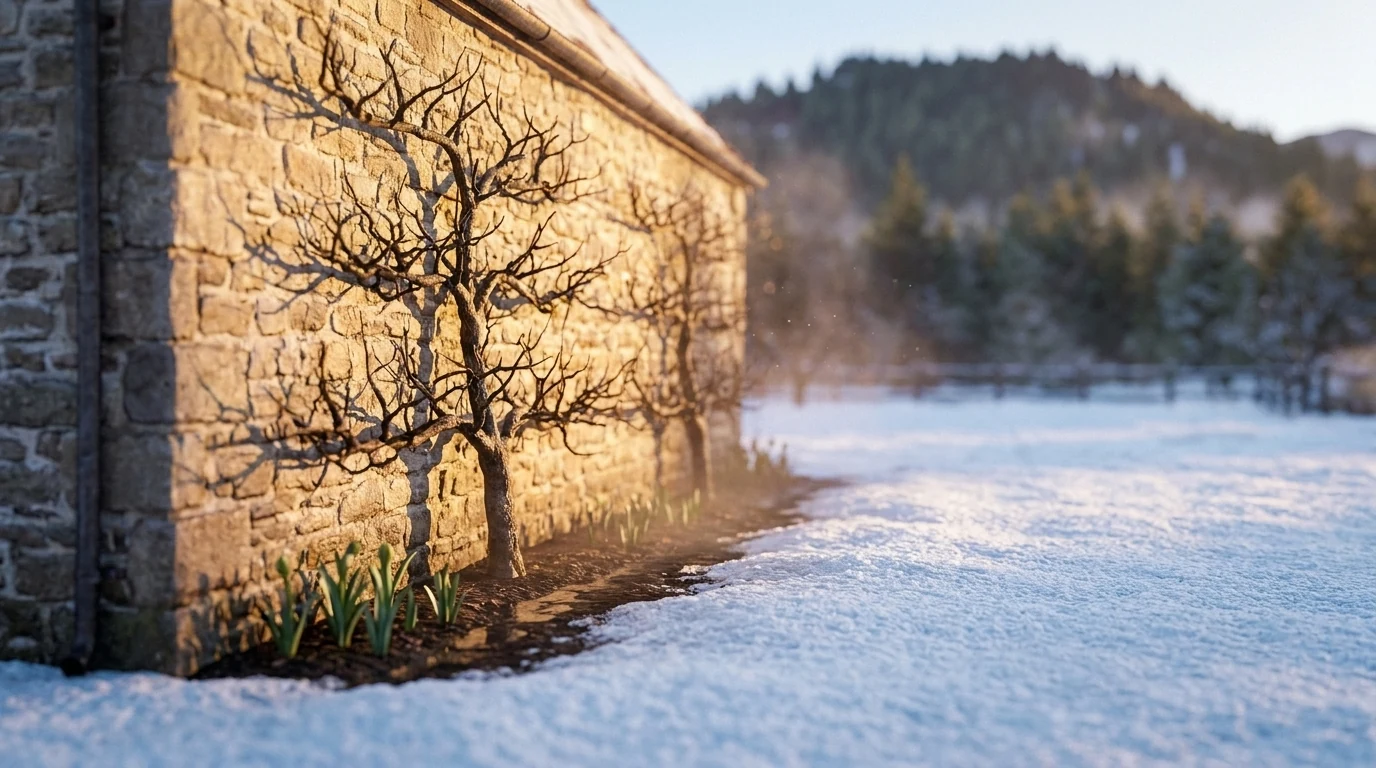
An illustration of the mechanism, not a photograph of anyone's wall: the snow has gone at the foot of the wall and nowhere else, which is the whole of this group in one picture — stored heat released overnight into the few feet nearest the masonry.
Sun-Facing Wall
Warmer
Also called: South wall · Warm wall
Why it happens
A wall that faces the midday sun does three separate things at once. It absorbs solar energy through the day and re-radiates it at night, so the air beside it cools more slowly than open ground. It blocks wind from one whole side, leaving still air where a plant can hold its own warm layer. And it reflects light back onto whatever is planted against it, so the plant gets more energy than its footprint would suggest. Stone, brick, and masonry do this far better than wood or siding, because they store more heat.
How to spot it
It is the spot where snow melts first and where the daffodils come up two weeks early. In the northern hemisphere the strongest effect is on a wall facing south, with south-east and south-west close behind; a north wall does the opposite and is the coolest, shadiest ground on the property.
What to do with it
This is where you cheat your climate — University of Georgia Extension's advice is exactly this: to encourage early blooming, place flowering plants near a south-facing wall that reflects light and radiates heat. Put the marginal fruit here (an espaliered apple, pear, peach, or fig trained flat against the masonry) along with heat-lovers that struggle in your open garden: peppers, eggplant, basil, tender herbs. Leave a small air gap between plant and wall so nothing bakes or sits in dead air, and water more often than elsewhere — the same heat that helps also dries the ground faster.
How much warmer is a warm wall? Honestly, nobody publishes a number we could verify. UGA describes the adjacent area as "a tad warmer", and we could not find any Extension source putting a degree figure or a zone-equivalent on it. The effect is real and growers have used it for centuries; the quantity is folklore, so treat your own thermometer as the authority.
Anything dense and dark — a stone path, a gravel bed, a boulder, a concrete slab, a water barrel — stores heat during the day and gives it back after sunset. The effect is small in the open but real right at the surface, and it is why seedlings beside a path often outrun the ones in the middle of the bed. Cold-tender plants benefit most, because what the mass is buying them is the last couple of degrees on the one night that would have killed them.
How to spot it
Look at where the frost is thin or absent on an otherwise white morning: the ground beside paving, along a gravel path, or on the lee side of a big rock. Snow melts in the same pattern.
What to do with it
Use it deliberately rather than by accident. Site the earliest spring planting along a stone or gravel edge, tuck tender perennials beside a boulder, and if you already run a cold frame or low tunnel, a dark stone or a water jug inside it stores daytime heat and releases it overnight. This is the cheapest warmth on a property because it is usually already there.
Sheltered Corner & Courtyard
Sheltered
Also called: Suntrap · Enclosed corner
Why it happens
Where two walls or hedges meet, the effects compound: sun from one side, shelter from two, and still air that neither cools by convection nor dries by evaporation. An enclosed corner open to the sun is usually the single mildest spot on a property, and often functions as if it were most of a zone warmer than the open ground fifty feet away.
How to spot it
It is where you would sit with a cup of coffee in early spring. If snow lingers everywhere else and this corner is bare and dry, you have found it.
What to do with it
Reserve it for the plant that has failed for you twice. Tender perennials, an overwintering rosemary, a fig, a citrus in a pot that gets a little too cold on the patio — these are the residents. Watch two things in exchange: an enclosed corner has poor air circulation, which invites fungal disease on crowded plants, and it can become genuinely too hot in a midsummer heat wave, so pair it with airflow and shade you can deploy.
Urban & Built-Up Warmth
Warmer
Also called: Urban heat island
Why it happens
A city is one enormous heat sink. Pavement, buildings, and roofs absorb and re-emit the sun’s heat more than the forest or field they replaced, while the loss of plant cover removes the evaporative cooling a landscape provides. The EPA puts the resulting difference in the United States at roughly 1–7 °F warmer by day and 2–5 °F warmer at night than the outlying area, with the largest gaps in humid regions and in larger, denser cities. The night-time end of that range is the one a gardener feels, because that is when frost happens.
How to spot it
A city garden gets its first frost later and its last frost earlier than a rural garden in the same county, and the difference grows toward the centre of the built-up area. Rooftops, back courtyards, and gardens hemmed in by buildings feel it most; a park or a large open green space in the same city runs cooler.
What to do with it
Treat the published frost dates for your area as the conservative end if you garden in a dense urban core — but confirm against your own record before you bet a crop on it, because the size of the offset depends on how built-up your immediate surroundings are, not on the city’s name. A rooftop or paved courtyard adds heat and wind exposure together, so plan for both.
Which way your ground faces decides how much sun energy each square foot receives, because a slope tilted toward the sun catches the beam closer to square while a slope tilted away catches it at a glance. That difference shows up as soil that warms and dries earlier in spring on one side of a property and stays cold and wet on the other, weeks apart, on the same parcel. Elevation adds a second, simpler effect: air cools as it rises, so higher ground runs colder than lower ground in the same region — except at night, when the cold-air rule above can invert it.
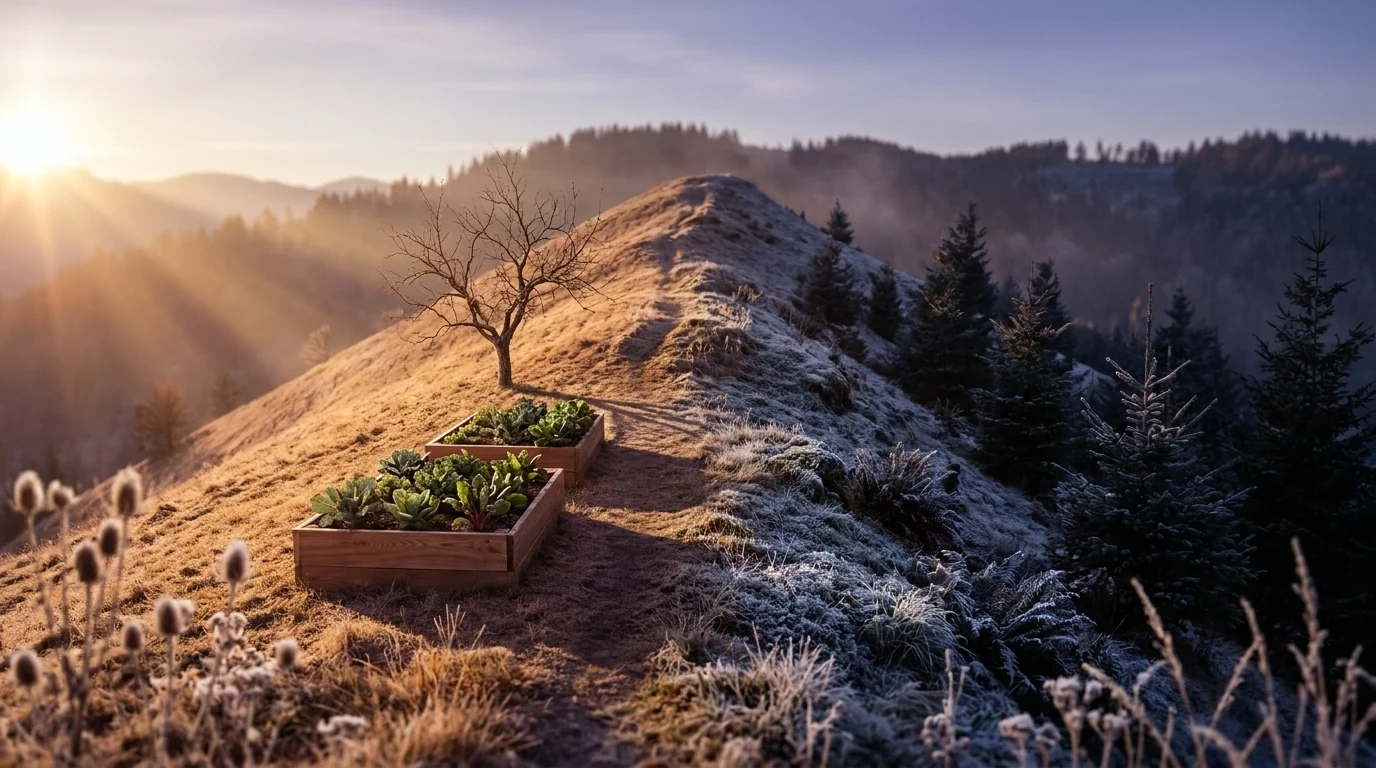
The winter sun tracks low across the southern sky, so a south-tilted face takes its light close to head-on and a north-tilted face only gets a graze.That angle — not soil or luck — is why one face of a hill is workable weeks before the other, and both entries in this group are plays on it: which way your ground tilts, and how far up or down the slope it sits.
Slope Aspect
Warmer
Also called: Which way the ground faces · Exposure
Why it happens
Sunlight delivers the most energy per square foot when it strikes a surface square-on. A slope tilted toward the sun meets the beam closer to perpendicular and therefore collects more energy than flat ground; a slope tilted away meets it at a glancing angle and collects less. In the northern hemisphere that makes south-facing ground the warmest and driest and north-facing ground the coolest, dampest, and slowest to wake in spring. The steeper the slope, the bigger the gap — and the further north you are, the more it matters, because the sun sits lower in the sky.
How to spot it
Spring is the season that shows it. Snow goes off the south-facing side of a property first, its soil dries and warms enough to work weeks before the north side, and the same species leafs out earlier there. The north side stays green, damp, and mossy through summer.
What to do with it
Match the plant to the face. Colorado State summarises the four exposures usefully: south is hotter and drier, north cooler and moister, east cooler and more sheltered from wind, and west takes intense afternoon heat and drying winds but can also extend the season. So south-facing ground is where the early spring planting, the heat-lovers, and the drought-tolerant plantings belong — and because it dries fastest, mulch it and expect to water more. North-facing ground is genuinely valuable rather than second-rate: it holds moisture and stays cool, which makes it the right home for shade-tolerant crops, salad greens that bolt in heat, woodland natives, and ferns. Georgia Extension adds the water half of the picture: ridges and hilltops shed water and run drier, while low, bowl-shaped ground holds moisture — and collects the cold air.
Aspect and slope are both derivable from elevation data, and sun is measured directly rather than inferred — our report models the actual sun reaching your parcel through terrain, buildings, and tree canopy, which is the /guides/sun-hours story.
Air generally cools with height, so higher ground tends to run colder than lower ground in the same region. Higher elevation also brings stronger sunlight, because there is less atmosphere overhead to absorb it, which is why transplants that are fine at sea level burn at altitude. Note the interaction with cold-air drainage: elevation cools by day and on windy nights, but on a still clear night the drainage effect can flip it entirely, leaving the valley floor colder than the slope above it. We deliberately give no degrees-per-thousand-feet figure here — the commonly quoted garden rule could not be traced to NOAA or to any Extension source, and the only lapse rate NOAA puts a number on describes a rising parcel of air rather than the difference between two pieces of ground.
How to spot it
Compare your own conditions against a weather station in the nearest town at a noticeably different elevation. If your season starts later, ends earlier, and your snow lasts longer than the regional forecast implies, elevation is usually the reason. Colorado State puts the scale of local variation vividly: gardeners on opposite sides of a valley can be in completely different climates despite sitting at the same elevation.
What to do with it
Use elevation-honest numbers rather than the regional average: pick varieties by days-to-maturity that fit the season you actually get, start more crops indoors, and lean on season extension at both ends. At altitude, extend the hardening-off period for transplants and give them a few days of shade — the light is stronger than the plants are used to. Colorado State adds a lever specific to mountain gardens: the pale decomposed-granite soils common at altitude reflect rather than absorb heat, and amending them with compost darkens the soil so it takes up more warmth while also helping thin, rocky ground hold water and air.
Your parcel’s elevation is read from the USGS 3D Elevation Program rather than a town average, so a property that sits well above or below its own town centre is described as it actually is.
Water and wind both move heat around, in opposite directions. A pond, lake, or ocean stores an enormous amount of heat and gives it up slowly, so ground near water runs milder at both ends of the year than ground a few miles inland. Wind does the reverse — it strips away the thin warm layer a plant builds around itself and the still air that shelter creates. Most of what a windbreak, a hedge, or a tree canopy does for a garden is simply to leave that layer alone.
An illustration, not a reading: water moderates the swing between night and day near it, and a permeable hedge slows the wind for a long stretch downwind. How far either reaches on your ground depends on the size of the water and the height of the hedge.
Water-Body Moderation
Warmer
Also called: Lake effect · Maritime moderation
Why it happens
Water absorbs and releases heat far more slowly than land, so a large body of water acts as a flywheel on the local climate: it holds back spring, then holds off autumn. Ground downwind of a big lake, a bay, or the ocean warms more slowly in spring — which delays bloom past the late frosts that would have killed it — and cools more slowly in autumn, which stretches the growing season at the other end. This is why so much of the country’s fruit is grown in a narrow band beside big water.
How to spot it
Compare your first- and last-frost dates with somewhere the same distance north but well inland. A moderated site has a later last frost, a later first frost, and a narrower swing between its summer and winter extremes. Even a farm pond does a small version of this for the ground immediately around it.
What to do with it
If you garden near large water, the moderation is most useful for perennials and fruit: the delayed spring protects blossom, and the delayed autumn ripens late crops. Expect higher humidity as part of the bargain, which raises fungal-disease pressure — space plants for airflow and water at the roots rather than over the leaves.
Wind Exposure
Exposed
Also called: Windward side · Open exposure
Why it happens
A plant in still air builds a thin layer of warmer, more humid air around its leaves, and that layer is most of its protection against both cold and drying. Wind strips it away continuously. So an exposed site is effectively colder than a sheltered one at the same temperature, and much drier, because water is pulled from the leaves faster than the roots can resupply it. The effect is chronic rather than dramatic — plants on exposed ground do not die suddenly, they just never thrive.
How to spot it
One-sided, leaning, stunted growth; browned or scorched leaf edges on the windward side despite moist soil; evergreens brown on one side after winter; and soil that dries out faster than the same soil in a sheltered bed.
What to do with it
Slow the wind rather than stopping it — a permeable windbreak protects a long zone downwind, while a solid wall creates turbulence behind it. Everything about windbreak design lives in /guides/weather-protection; the microclimate point is simply that shelter creates a genuinely different growing climate on its lee side, so a windbreak does not just prevent damage, it opens ground you could not use before.
Tree Canopy & Rain Shadow
Drier
Also called: Under a tree · Dry shade
Why it happens
A tree canopy creates its own climate underneath: it cuts the sun, holds warmth in at night by blocking the open sky that ground radiates its heat to, slows wind, and raises humidity. But it also intercepts rain before it reaches the ground and its roots drink first, so the soil directly under a mature tree is often far drier than open ground even in a wet climate. The frost protection is real — plants under a canopy are noticeably less frosted on a clear night than the same plants a few feet out in the open.
How to spot it
The dry ring under a mature tree where nothing much grows, and grass that stays green outside the canopy line and thins beneath it. On a frosty morning, the clean unfrosted circle under the tree while the open lawn is white.
What to do with it
Treat under-canopy ground as its own habitat — dry shade — rather than a failed garden bed. Plant things adapted to it: woodland natives, shade-tolerant perennials, spring ephemerals that finish before the tree leafs out. Mulch heavily to hold what moisture there is, and accept that you will water there in a dry spell even when the rest of the garden does not need it. Use the frost-shelter deliberately: the edge of a canopy is a good place for something that needs a couple of degrees on a cold clear night.
Wet Hollow & Seep
Wetter
Also called: Low wet spot · Seasonal seep
Why it happens
Water runs downhill for the same reason cold air does, and it collects in the same places. A low spot, the base of a slope, or a break where a slower-draining soil layer meets the surface will hold water long after the rest of the property has drained. Saturated soil has no air in it, and most roots suffocate without air — which is why the wet spot kills plants that the climate could otherwise carry. Wet ground is also slower to warm in spring, so it delays planting on top of everything else.
How to spot it
Standing water or spongy ground days after rain; a distinct change in what grows there — rushes, sedges, willows, moss — and often a darker, greyer soil when you dig. It is frequently the same low ground as the frost pocket, which is why that corner is doubly hard.
What to do with it
Work with it rather than fighting it: plant species that genuinely tolerate wet feet, or raise the planting above the water with a raised bed or a mound. Do not simply amend a wet hollow with compost and hope — if water is arriving faster than it leaves, the fix is drainage or elevation, not organic matter. What your soil does with water is the /guides/drainage-water story; what you do about watering the rest of the time is /guides/watering-irrigation.
Drainage class is mapped nationally: our report reads the USDA SSURGO soil survey for the map units under your parcel, so "this ground drains poorly" is a documented classification rather than a hunch.
Two Kinds of Freeze — Only One Is a Microclimate Problem
Before you invest in a warm corner, know which enemy you are fighting. Everything on this page works by exploiting an inversion — warmer air sitting above colder air near the ground. When there is no inversion, there is nothing to exploit.
Radiation frost
Heat stored in the upper soil radiates back to the sky on a still, clear night. Wind speeds are low and an inversion develops, with the air right at the ground falling to or below freezing while air above it stays warmer.
Does a microclimate help?
Yes. This is the frost every feature on this page acts on — cold pooling, warm walls, thermal mass, and ground cover all work because of the inversion.
Advective freeze
A large mass of cold air moves into the region. Temperatures at the surface are below freezing and get colder with height — there is no inversion to exploit.
Does a microclimate help?
Barely. Penn State notes little can be done other than possibly covering the crop, and that heating is not economically feasible because there is no inversion. Your warm corner will not save a plant through this, which is the honest limit of the whole approach.
The Ground Surface: A Microclimate You Can Change This Afternoon
Most of this guide is about reading features you cannot move. This one you can. What is lying on the soil surface decides how much of the day’s heat the ground stores and gives back at night — and Penn State has actually measured it. The differences are large enough to decide whether a marginal night damages your crop.
All figures are relative to the warmest condition, which is bare, firm, moist ground.
Night temperature in the plant canopy by ground-surface condition, relative to bare, firm, moist ground.
Ground surface
Night temperature
Bare, firm, moist ground
Warmest
Shredded cover crop, moist ground
½ °F colder
Low-growing cover crop
1–3 °F colder
Dry, firm ground
2 °F colder
Freshly dug, fluffy ground
2 °F colder
High cover crop or tall weeds
2–4 °F colder
Cover crop that restricts air drainage
6–8 °F colder
What this means in practice
Penn State reports a tall, dense cover crop can reduce night temperatures by up to 10 °F, while a closely mown one is usually only about 2 °F colder than bare soil — so mowing before a frost night is a real, free intervention.
A bare, undisturbed, moist soil with no ground cover can release enough stored heat to raise the temperature in the plant canopy by 2 to 3 °F compared with a sod-covered soil.
Moisture is what lets the soil store that heat. Heat moves into and out of roughly the top foot of soil on a daily cycle, and wet soil stores and transfers it better — watering deeper than about a foot does nothing for this, because temperature barely fluctuates below that.
Dark and gravelly soils absorb more daytime heat; heavier clay soils retain heat better than sandy ones, which tend to be paler and reflect more of it away.
⚠️ The honest tension: mulch conserves water (see the watering guide) but makes a crop MORE frost-prone, because it insulates the soil from taking up the daytime heat it would otherwise release at night. Both are Extension positions. Pull the mulch back before a frost night if the crop is what matters; leave it on if the water is.
You cannot look a microclimate up. You find it by being outside at the right five moments of the year, and the whole method fits on a card. Nature does the survey; you just have to be there when it publishes the results.
1
The first frosty morning of autumn, at first light
Where is the frost, and where is it not? Go out before the sun burns it off. The silvered ground is your cold zone and the green ground is your warm one — this single walk tells you more about your property than any map.
2
After a snowfall, as it melts
Watch the order in which the snow disappears. First bare patches mark your warm spots — the sun-facing wall, the stone path, the south slope. The last white patches mark the cold and shaded ground.
3
Two days after heavy rain
Where is the ground still soft, spongy, or standing in water? That is the wet hollow, and it is very often the same low ground as the frost pocket — which is why that corner defeats you twice.
4
A windy afternoon
Walk the boundary and feel where the wind drops. The sheltered pocket behind a hedge or building is a different growing climate from the open ground ten steps away, and you can find it with your face.
5
Late winter, when nothing should be growing
Look for anything that has jumped the gun — bulbs up early, buds swelling, a patch of green lawn. Plants are honest instruments. Wherever they are ahead of schedule, you have found warm ground.
Write down what you see, with the date. Two years of these notes beat any published average, because they describe your ground and nobody else’s.
What a Microclimate Can’t Do
A warm corner is worth real money on an ordinary cold night, and worth much less in a severe, prolonged freeze. Radiating warmth from a wall or a stone helps most on the clear, still nights when heat is escaping to open sky — which is exactly the kind of night that produces a light frost. When an air mass simply sits at well below freezing for days, the whole property goes with it, warm corner included.
So use microclimates the way growers always have: to site things, to gain a couple of weeks, and to give a marginal plant its best shot — not to claim a whole zone you do not have. Plant the marginal fig against the warm wall by all means, and know you may still lose it in the hard winter that comes every decade. That is an honest bet, and it is a much better one than planting it in the open.
One more honest note: microclimates cut both ways. The same sheltered corner that holds warmth also holds still, humid air, which raises fungal-disease pressure — and the same canopy that shields from frost also takes the rain and the soil moisture. Every feature on this page has a cost as well as a benefit, and the entries above name both.
And a note on numbers. This is the least-quantified topic we write about. The mechanisms here are settled physics, but published degree figures for most of them simply do not exist in the Extension literature — we could not find a sourced figure for how much colder a frost pocket runs, how much warmer a south wall is, or how much a nearby lake moderates your frost dates. Where a number exists we cite it; where it does not, we say so rather than repeat one. Be sceptical of any page that gives you a confident degrees-per-thousand-feet rule or tells you a warm wall is worth a hardiness zone — we went looking for the sources behind those and did not find them.
We read your parcel's real elevation, slope, sun exposure, soil drainage, and frost dates from federal data — then score 1,086 plants against them. It is the starting map your own walk fills in.
Three things about your exact spot that zone averages miss:
Your soil pHYour frost-free daysYour sun & shade
We read public map data for this spot — soil, climate, flood, and parcel records. How we handle your address.
25+ data sources analyzed in seconds
Frequently Asked Questions
What is a microclimate?
A microclimate is a small area whose growing conditions differ from the regional average around it — warmer, colder, wetter, drier, or more sheltered. Your hardiness zone and frost dates describe a whole region; a microclimate is the local offset from those numbers on your actual ground, and on a single property it can be worth weeks of season or more than a full zone.
Why does frost hit one part of my garden and not another?
Because cold air behaves like water. On a clear, still night the ground radiates heat away and chills the air touching it; that chilled air is denser, so it flows downhill and pools in the lowest spot it can reach. The low ground fills up with cold all night while ground a short way upslope drains and stays warmer — so the hollow frosts and the slope above it does not.
How do I find the warmest spot on my property?
Look for a surface that faces the midday sun, stores heat, and blocks wind — most often a masonry wall facing south, especially where two walls meet in a sheltered corner. Confirm it by observation: it is where snow melts first, where bulbs come up early, and where frost is thin on a white morning. That spot is where a plant that is one zone out of reach has its best chance.
Does a south-facing slope really make that much difference?
Yes, and the difference is largest in spring and further north. Ground tilted toward the sun meets the light closer to square and so collects more energy per square foot, which means it warms and dries enough to work weeks before north-facing ground on the same property. North-facing ground is not worse, just different — it is the right home for shade-tolerant crops, greens that bolt in heat, and woodland plants.
Can a microclimate change which plants I can grow?
It can change which plants survive in a specific spot, so treat it as a siting tool rather than a new zone for the whole property. A sheltered, sun-facing, heat-storing corner genuinely carries plants the open ground will not. The honest limit: a microclimate helps most against an ordinary cold night and least against a severe, prolonged freeze, so bet a marginal perennial on it knowing you may lose it in a hard winter.
Every microclimate on this page is a deviation from a regional baseline, so the baseline has to be right first. Growable Ground reads yours from your exact coordinates — elevation and terrain from the USGS 3D Elevation Program, soil drainage from the USDA SSURGO soil survey, frost dates from the NOAA U.S. Climate Normals, and hardiness from the USDA Plant Hardiness Zone Map. Your Cooperative Extension knows which local quirks matter most in your area — and your own five mornings a year finish the picture that no dataset can.

 Features