Season Extension: How to Add Weeks to Your Growing Season
Sources: Standard protected-culture practice, NOAA frost normals
Tools
6
Ranked by what each buys
Calendar plays
4
Spring, autumn, winter
The unit
Days
Not damage avoided
Season extension is arithmetic, not rescue. It starts from a single number — how many frost-free days your ground actually gets — and asks a question you can answer on paper before you spend anything: which crops would I be able to finish if that window were three weeks longer at each end? Everything else in this guide is in service of that question. The covers are not the point. The extra crop is the point.
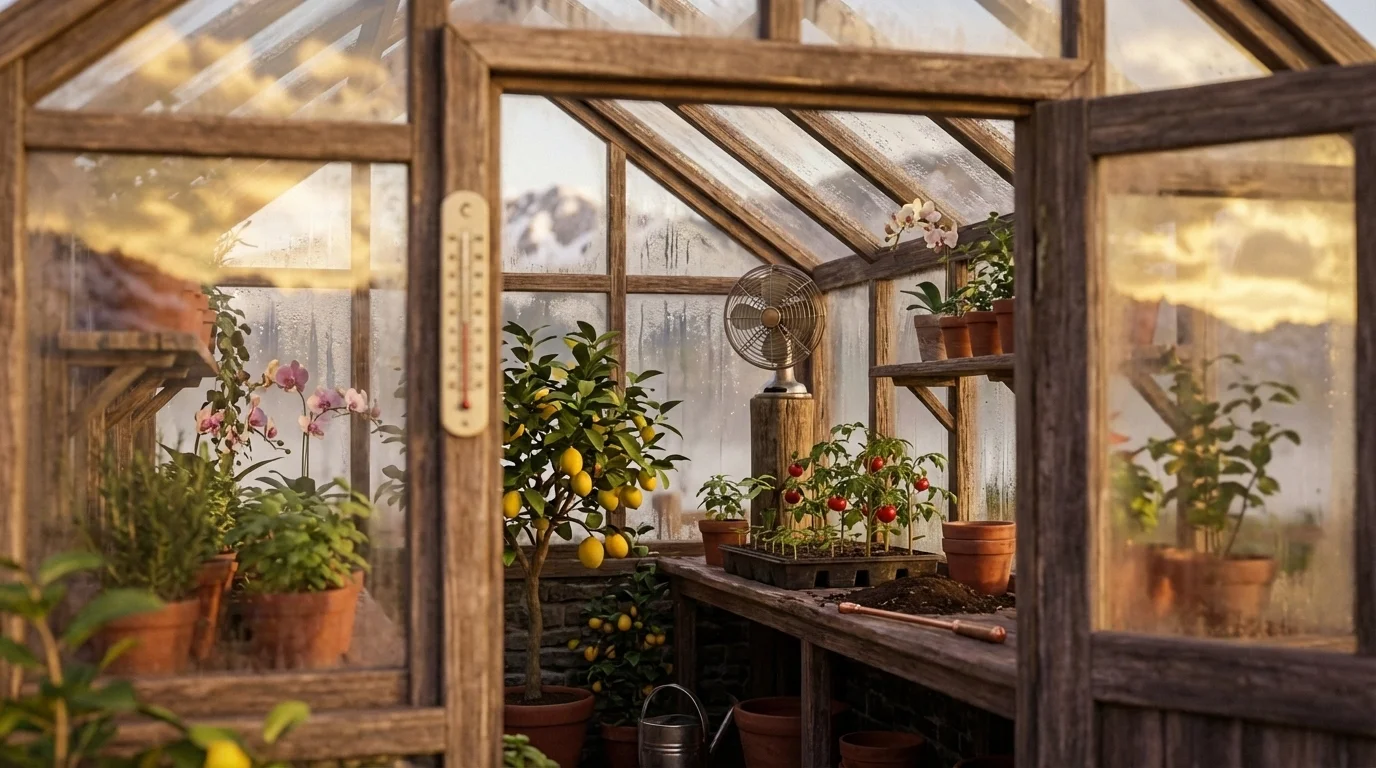
That is what separates this from the two guides it sits between. If a frost is forecast tonight and you need to save what is already planted, you want weather protection — the same fabric, used reactively, measured in damage avoided. If you are considering a permanent walk-in structure with glazing, foundations, and ventilation to run year-round, you want greenhouse growing. This guide is the cheap, removable middle: light covers, planned in advance, bought in days of calendar.
One warning before the tools, because it is the mistake that wastes the most money: most gardeners buy equipment before they do the arithmetic, and end up protecting a crop that was never short of time while the crop that actually needed the weeks goes unplanted. Start with the four questions below.
The Arithmetic
Four questions, in order. They cost nothing, they take ten minutes, and they tell you whether you need any of the equipment below — and if so, which end of the year to spend on.
1
Your window
How many frost-free days do I actually have?
Count the days between your average last spring frost and your average first autumn frost. That is your frost-free window, and it is the number every other decision in this guide is measured against. Use dates for your own coordinates rather than your state — the difference across one county can be weeks.
2
Your crop
How many days does the crop need?
Read days-to-maturity off the packet, and check whether it is counted from sowing or from transplanting. Add a margin: the figure assumes good growing weather, and a cool or cloudy stretch stretches it.
3
The gap
Is the crop longer than the window?
Subtract. If the crop fits with room to spare, you do not need any of this — plant it. If it fits only just, extension turns a gamble into a reliable harvest. If it overruns by more than a few weeks, no cover is going to close that gap, and the honest answer is a shorter-season variety or a different crop.
4
The play
Which end do I need, and how much?
A crop that needs an earlier start is a spring problem — warm the soil and cover the planting. A crop that needs longer to finish is an autumn problem — hold it under cover past the first frosts. Knowing which end you are short at tells you which tool to buy, and stops you buying all of them.
Step 1 needs real dates for your ground, not your state — the frost dates guide explains where they come from, and a frost pocket on your own property can shorten your real window well below the published one.
Free Report
Start with your real frost-free window
Enter your address and we read your first and last frost dates from NOAA normals for your exact coordinates — the number step 1 needs — then score 1,086 plants against the season you actually have.
Three things about your exact spot that zone averages miss:
Your soil pHYour frost-free daysYour sun & shade
We read public map data for this spot — soil, climate, flood, and parcel records. How we handle your address.
25+ data sources analyzed in seconds
The Toolkit
Six tools, roughly in order of what they cost you to adopt. They stack: a cover over hoops beats a cover on the leaves, a cover inside a frame beats either, and every one of them works better over soil you warmed first. Start at the top of the list and only move down it when the tool above has genuinely run out of room.
Every tool below is the same move at a different size: a clear barrier that lets the sun in and holds the day's warmth around the plants after dark.
Floating Row Cover
Lowest effort
Also called: Row cover · Garden fabric · Frost blanket
What it is
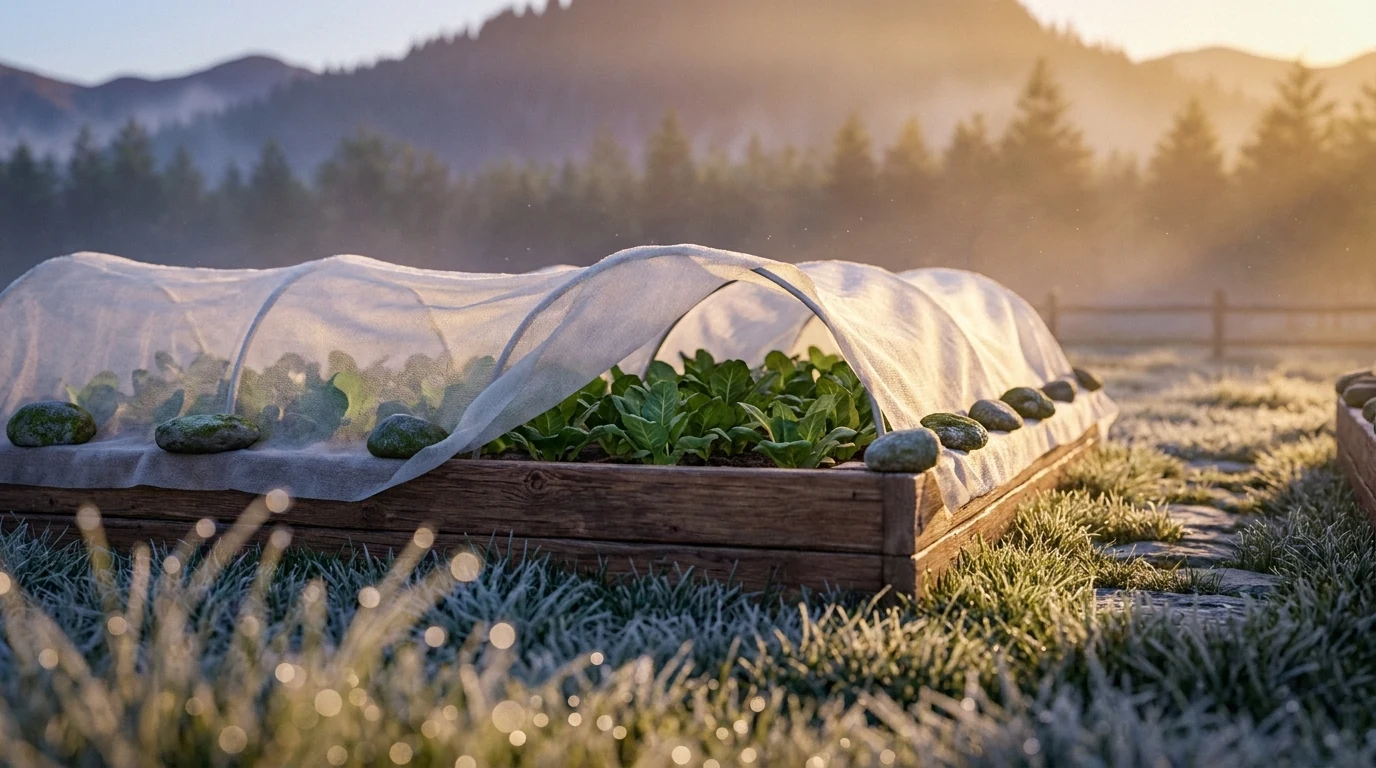
A sheet of lightweight spun-bonded fabric laid straight over a bed — either resting on the plants themselves ("floating") or draped over wire hoops. It passes light, air, and water, so it can stay on for weeks at a time without the plants needing anything from you. It comes in a range of weights: the lightest is nearly transparent and is mostly an insect barrier, the heaviest blocks noticeably more light but holds more warmth.
How it buys days
It works by trapping the heat the ground releases at night, the same way a cloud does. Bare ground on a clear night radiates its warmth straight out to the open sky; a cover puts a lid on that, so the air right around the plants stays warmer than the air in the open garden. It also cuts wind, which matters more than most gardeners expect — a covered plant is not being stripped of the warm, humid layer it builds around its own leaves.
When to use it
The workhorse at both ends, and it buys roughly 2 to 8 °F depending on how heavy the fabric is — see the weight table, which is the single most useful thing on this page. In spring it goes over direct-sown and transplanted crops to let you plant earlier than the bare calendar allows; in autumn it keeps hardy greens and roots cropping past the point where uncovered rows are finished. UMass notes covers are typically left on for several weeks, and for fruiting crops and cucurbits for about three to five weeks — until pollination is needed or the crop outgrows the space.
The honest limit
Lightweight cover is not reliable frost protection: UMass says it may help when temperatures drop 2–3 °F below freezing and no further, and its real job is excluding insects. Four Extension sources give four different ceilings for heavy cover (UMass and Maryland say up to 8 °F, UNH says 6–10 °F, NC State says 4–5 °F), so treat any single quoted figure as approximate. And the widely repeated claim that a layer of row cover is worth some number of hardiness zones is not an Extension finding — we searched Extension publications specifically and every one of them states protection in degrees or in weeks, never in zones.
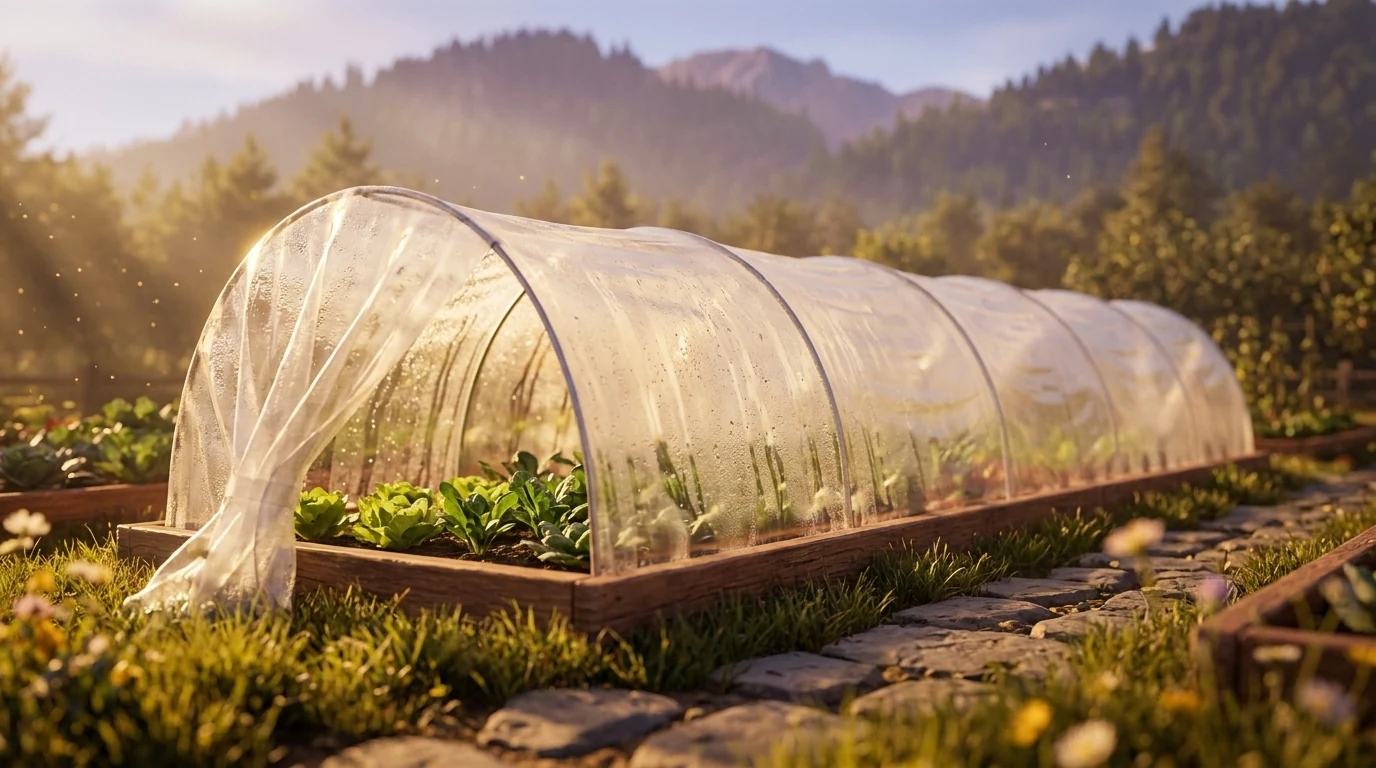
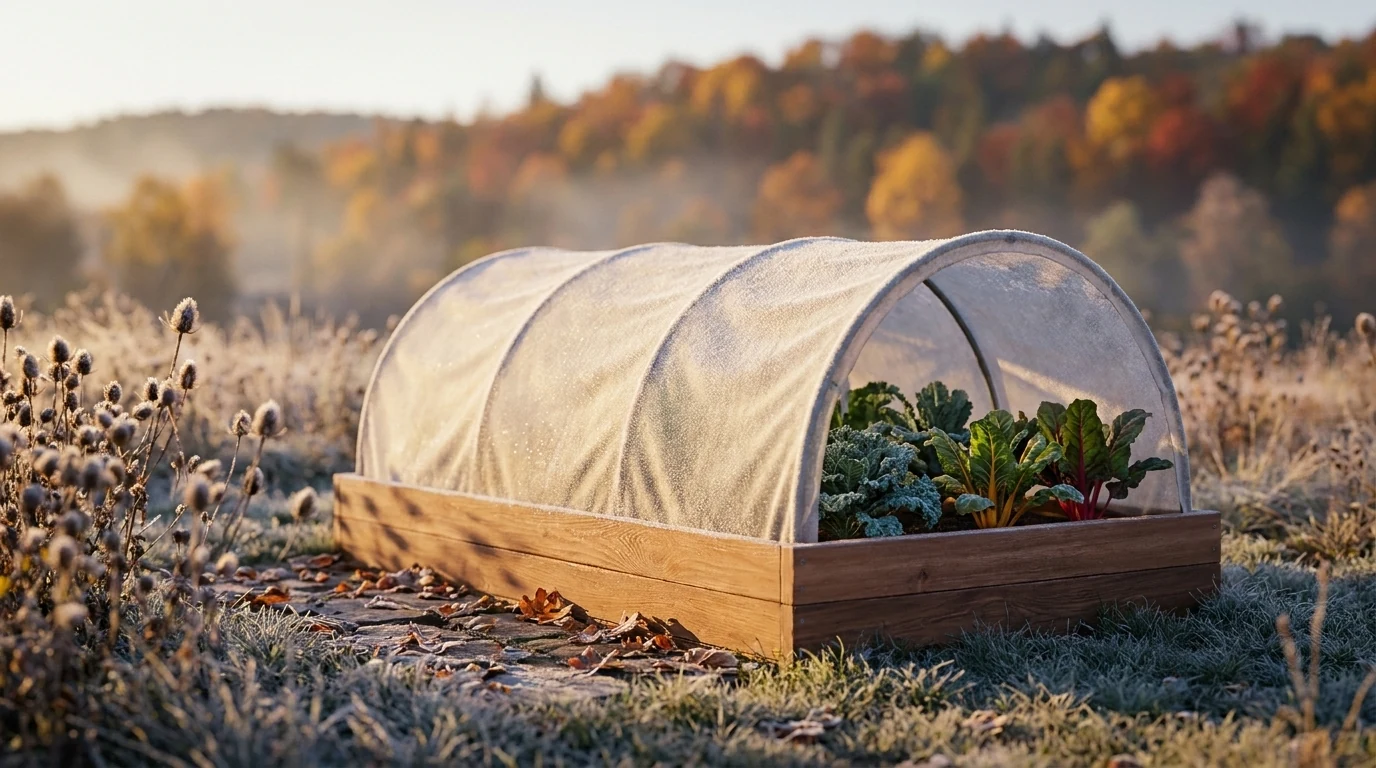
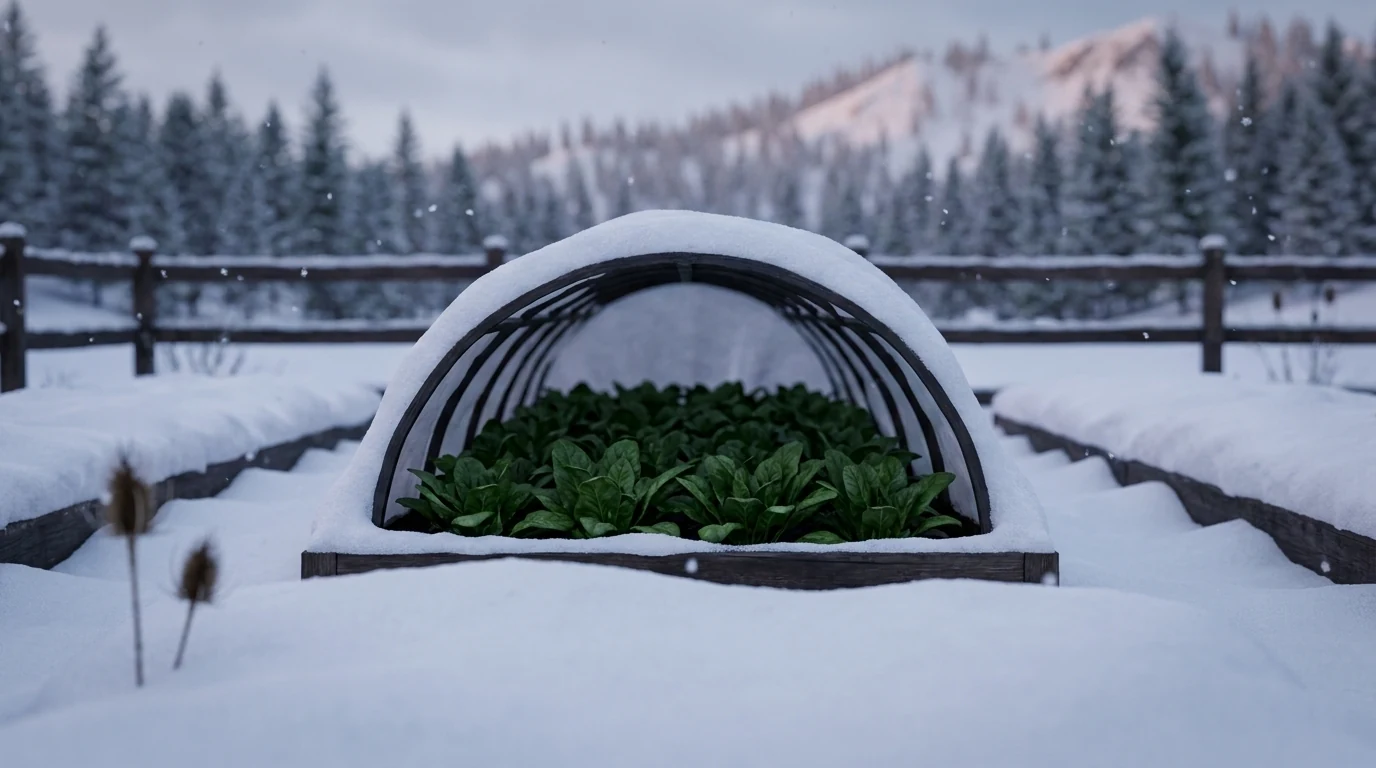
Row cover or clear plastic stretched over a line of hoops so it stands clear of the plants, forming a low tunnel you reach into rather than walk into. The hoops are the whole difference: they hold the fabric off the foliage, create an air space that stores warmth, and let you use heavier or double coverings without crushing the crop.
How it buys days
The trapped air volume is the point. A cover lying on leaves protects the leaves; a cover held above them warms a pocket of air and the soil under it, and warm soil is what actually gets a crop moving in spring. Two layers over hoops beat one layer for the same reason a double window beats a single one — the still air between them is the insulation.
When to use it
When row cover alone is no longer enough, and before a greenhouse is justified. WVU puts a low tunnel at about a two-week early start on summer crops such as peppers, tomatoes, and sweet corn, and it is the standard way to carry cool-season crops — broccoli, spinach, kale, cabbage, lettuce, strawberries, peas — through the cold half of the year.
The honest limit
A tunnel is a heat trap in both directions: on a sunny shoulder-season day it can cook the crop inside, so it needs venting on mild days and not just closing on cold ones — Iowa State says vent whenever it is sunny and above 40 °F. Clear plastic amplifies this far more than fabric does. Build the hoops strong enough and steep enough for the snow you actually get, because a collapsed tunnel takes the crop with it.
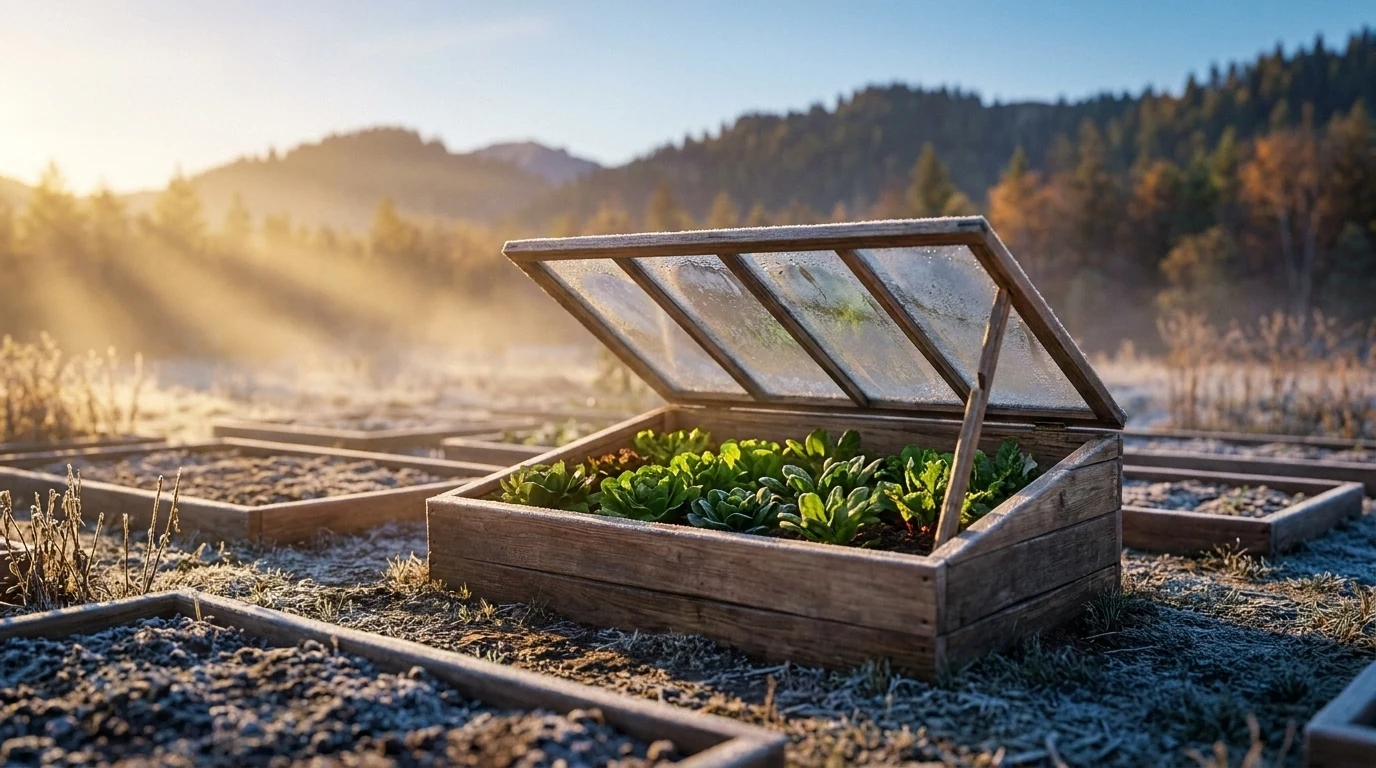
A low, bottomless box with a clear hinged lid, set on the ground so the soil inside is the growing bed. Traditionally a timber box with an old window on top, which is still an excellent way to build one. It is permanent enough to have a fixed location and light enough to be a weekend project.
How it buys days
It combines all three mechanisms at once: solid insulated walls, a glazed lid that traps solar gain, and the thermal mass of the soil inside, which absorbs heat all day and releases it at night. That combination is why a frame holds more warmth than any cloth cover, and why it is the classic tool for keeping things alive through the coldest part of the year rather than just extending either shoulder.
When to use it
Three distinct jobs. Overwintering hardy greens for cutting through the cold months; starting seedlings weeks before the open ground is workable; and — the job most gardeners forget — hardening off transplants, where a frame with a lid you open a little wider each day is the ideal machine for the purpose. Iowa State and the University of Vermont independently put the gain at two to four weeks at each end of the season, and UVM notes that when outside temperatures are in the 40s you can expect the frame to sit comfortably above 50 °F.
The honest limit
A closed frame in sun overheats fast, even in cold weather, and that is the commonest way people lose a frame crop. Iowa State says vent above 85 °F inside; Clemson says hold winter greens below 60 °F — match the number to the crop. That attention is a real cost a row cover does not impose, which is why an automatic opener is worth it for anyone not home midday. Site it facing the midday sun, and against a wall if you have one: it stacks with the warm-wall microclimate.
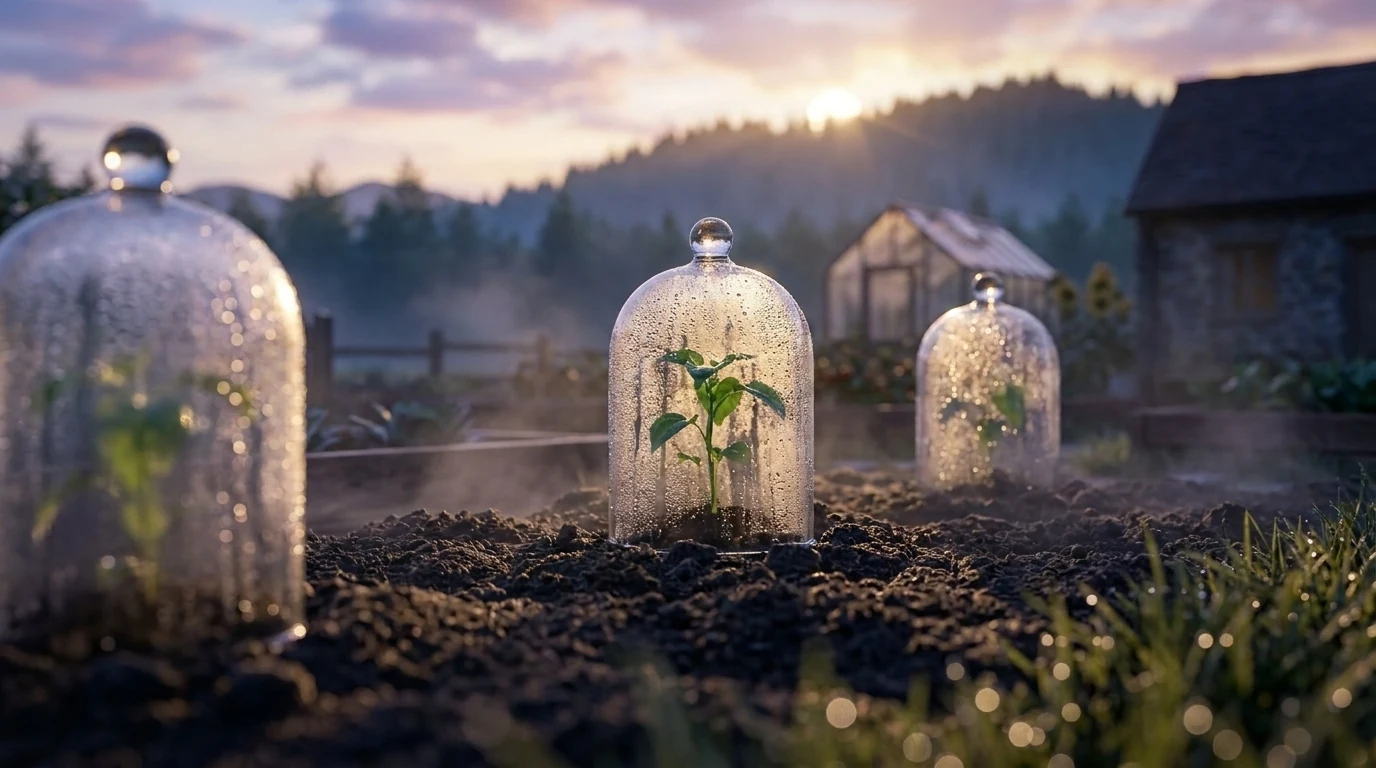
A clear cover over one plant — traditionally a glass bell, in practice a cut-down plastic jug, a large jar, or a purpose-made plastic cap. The lowest-commitment tool in the kit and the only one that costs nothing if you have a recycling bin.
How it buys days
A tiny greenhouse for one plant: it traps solar warmth during the day, holds it around the plant at night, blocks wind entirely, and raises humidity around a transplant that has not yet grown roots to supply itself. For the first week or two of a tender transplant’s life outdoors, that combination is worth more than its size suggests.
When to use it
Getting a handful of individual plants out earlier than the bed as a whole — the first tomatoes, peppers, or squash — and sheltering new transplants through their establishment. The water-filled variety (the "wall of water" type, whose cells store heat by day and release it overnight) earns its place here: the University of Minnesota puts it at three weeks earlier than normal for transplanting tomatoes, peppers, and eggplant.
The honest limit
Tiny volume means violent swings: a sealed jug over a plant on a sunny spring day will cook it by lunchtime. Cut the top off, or take it off in the morning and replace it at dusk. It is a nursery for young plants, not a system — once a plant fills its cloche, the cloche has done its job.
Also called: Black plastic mulch · Soil pre-warming
What it is
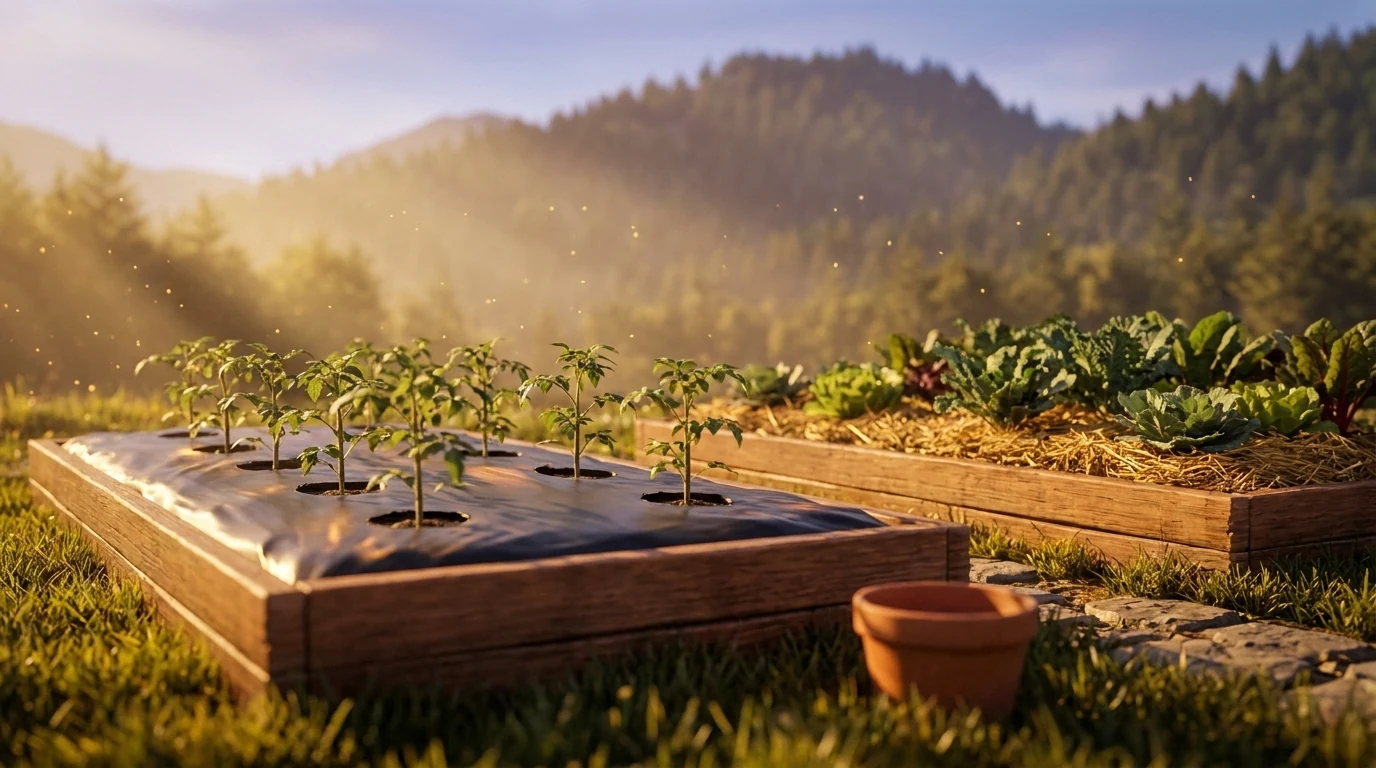
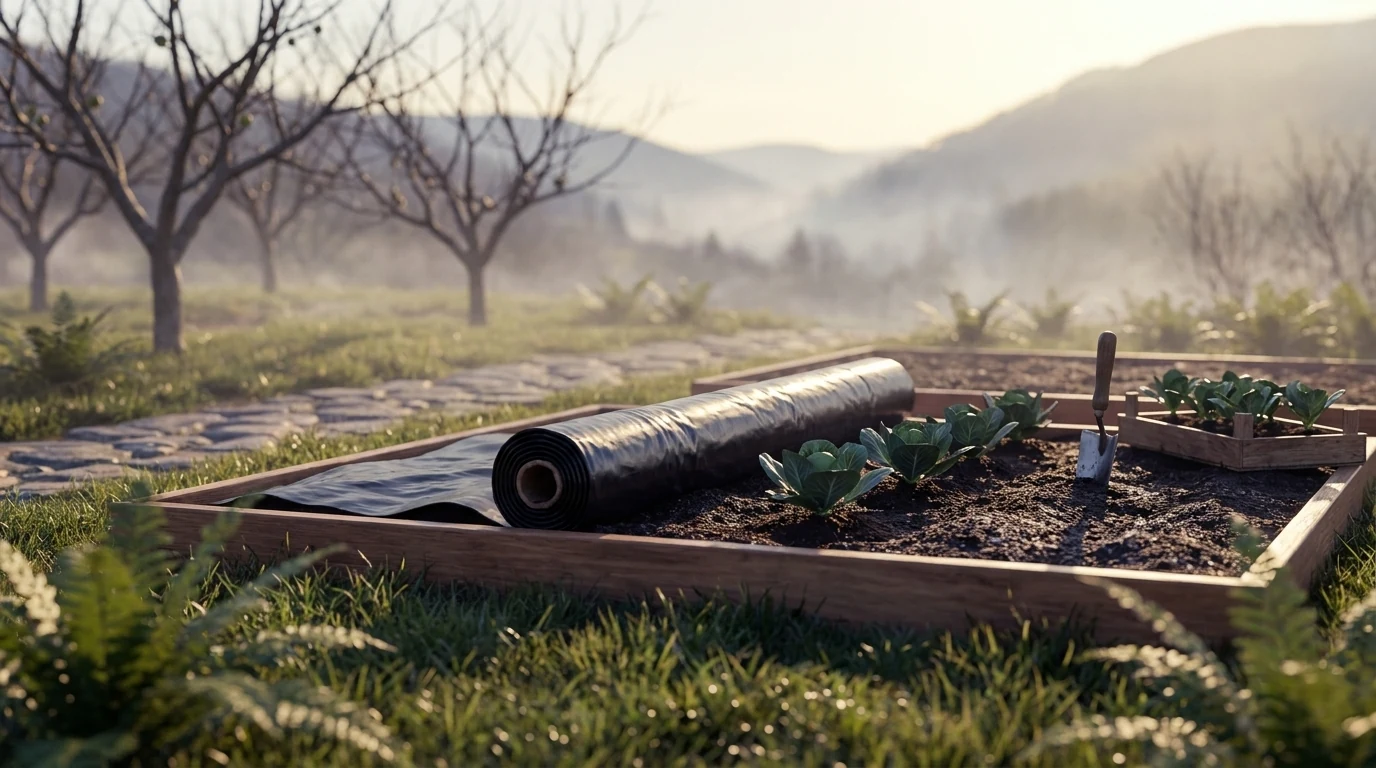
Managing the temperature of the soil rather than the air above it — laying dark plastic or fabric over a bed a couple of weeks ahead of planting to pull solar heat into the ground, and conversely pulling organic mulch back off a bed in early spring so the sun can reach the soil surface.
How it buys days
Most spring planting is limited by soil temperature, not air temperature. Seeds of warm-season crops sit and rot in cold ground rather than germinating, and transplants sulk in it for weeks. The University of Minnesota puts black plastic at about 5 °F of soil warming, and clear plastic at as much as 14 °F — the largest single soil-side lever available, and it costs almost nothing.
When to use it
Spring, ahead of the warm-season crops — tomatoes, peppers, squash, melons, sweet potatoes. Also the reason to delay laying summer organic mulch: a heavy straw mulch put down too early insulates cold soil and holds the bed back, so wait until the ground has warmed, then mulch to keep it there.
The honest limit
The two plastics trade off against each other: clear warms the soil far more, but weeds flourish underneath it in mild weather, while black suppresses weeds and warms less. This lever buys spring only — it does nothing in autumn — and a dark plastic mulch left down through high summer can push soil past what roots like in hot regions. It pairs with, rather than replaces, air-side covers: warm soil under a frosted plant is still a dead plant.
Not a cover at all — the practice of reading the days-to-maturity figure on a seed packet and choosing varieties that finish inside the window you actually have. It belongs in this guide because it solves the same problem as every tool above, from the other direction: instead of stretching the season to fit the crop, you fit the crop to the season.
How it buys days
It is free, it is instant, and it is the only tool here with no failure mode. Two varieties of the same vegetable can differ by several weeks in days to maturity, so a short-season selection can close a gap that no amount of row cover would have closed — and where the gap is genuinely too big, it is the honest answer rather than a heroic one.
When to use it
At the point of ordering seed, before anything else. Work out your frost-free window first, subtract a margin for the fact that days-to-maturity assumes good growing weather, and then buy only what fits — plus, if you want, one long-season gamble you cover.
The honest limit
Days to maturity is a comparison figure, not a guarantee: it is measured under favourable conditions, and it is counted from transplanting for some crops and from sowing for others, so read which. A cool summer, a shady bed, or poor soil all stretch it. Treat the number as a way to rank varieties against each other rather than as a date on your calendar.
How Much Does Row Cover Actually Buy?
Row cover is sold by weight, and the weight is the whole specification. UMass and the University of Maryland publish this table independently and agree exactly on every figure, which is why it is the one table on this page.
Read the trade-off across the row, not down the column: every degree of extra protection is bought with light the crop no longer receives. That is why the heaviest fabric is a winter tool for holding a crop, not a growing tool.
Row cover fabric weight, light transmission, frost protection in degrees Fahrenheit, and what each weight is for.
Weight
oz / yd²
Light through
Frost protection
LightweightMarketed as an insect barrier, and that is its real job. It can stay on some crops — beets, snap beans, salad greens — from seeding right through to harvest.
0.45 oz/yd²
90–95%
~2 °F
Medium weightThe general-purpose choice for spring, autumn, and overwintering crops — the best balance of warmth kept against light given up.
0.5–1.0 oz/yd²
70–85%
4–6 °F
HeavyweightOverwintering, where holding the crop matters more than growing it. It blocks so much light that growth slows markedly, so it is a winter tool rather than a season-long one.
1.5–2.2 oz/yd²
30–50%
up to 8 °F
What the table does not say
Lightweight cover is NOT reliable frost protection — UMass notes it may help when temperatures drop only 2–3 °F below freezing, and no further.
Other Extension sources put the heavy-cover ceiling differently: UNH says a heavyweight cover might give 6–10 °F, while NC State puts row covers and low tunnels at 4–5 °F. Treat roughly 2–8 °F by fabric weight as the working range, and expect your own result to land inside a spread that four universities do not agree on.
The cover must not touch the leaves. Clemson is explicit that where row cover rests directly on foliage, frost can still form and the leaves under it can still freeze — hoops are what make the fabric work.
Fine-mesh insect netting is not row cover. UMass notes it provides little or no frost protection and much less heat retention, despite looking similar.
Absolute floors, where sources give them: Clemson puts light covers at frost down to about 28 °F; WVU says most row covers protect down to roughly 24–28 °F depending on grade, and that a second layer buys more.
Venting: The Skill That Decides Whether Any of This Works
Almost everyone who loses a crop under protection loses it to heat on a bright day, not to cold on a dark night. The published thresholds differ by tool and by crop, so they are listed separately here rather than merged into one number that would be wrong for most of them.
Cold frame
Raise the lid when the air inside rises above 85 °F, and close it before sunset to hold the day’s heat.
Iowa State’s general rule. Use a thermometer inside the frame, prop the lid on a board or dowel, and consider an automatic opener — a wax- or gas-filled cylinder that expands to push the lid open as it warms and closes it as it cools — if you are not home midday.
On sunny days, vent to keep the inside below 60 °F.
Clemson’s target, which is much lower than Iowa State’s 85 °F — not a contradiction but a different crop. Cool-season greens are damaged by warmth that a general frame crop would shrug off, so match the number to what is growing inside.
Open the ends or roll up the sides when it is sunny and above 40 °F. Close at night unless the overnight low will stay above 40 °F.
Iowa State. Watch the forecast so the tunnel is closed before temperatures drop into the mid-to-low 30s. On small tunnels, venting for heat is often unnecessary unless the outside air stays above freezing for a long stretch.
Consider extra ventilation once outside air reaches about 80 °F. For fruiting crops, open in the daytime if it will exceed 90 °F under the cover for several hours.
UMass and NC State. University of Maryland quantifies the failure mode: leaving covers on past late June or early July can raise the temperature underneath by 10–15 °F and cause flowers and fruit to drop. In an unseasonably warm year, covers can do more harm than good and should come off.
If you are not home in the middle of the day, design around it rather than hoping. Fabric forgives far more than clear plastic, and a wax- or gas-filled automatic opener on a cold frame — which expands to push the lid up as it warms and contracts to close it as it cools — removes the single biggest failure mode in this entire guide for the price of one lost crop.
The Calendar Plays
The tools are inert on their own. These are the four plays they serve — each one a different way of converting days into food, and each one with a different sowing date you have to hit months in advance.
The Spring Jump-Start
The Autumn Hold
Overwintering
Succession Planting
Illustrations of the four plays, not photographs of any one garden — and deliberately undated: which weeks each one occupies depends on your own frost window, which is what the rest of this page is about.
The Spring Jump-Start
Spring end
The idea
Get the bed producing before the open ground is ready, without gambling the whole planting on an early frost. The trick is to move the SOIL date first and the PLANT date second — most failed early plantings fail because the ground was cold, not because a frost came.
How to run it
Two or three weeks before you intend to plant, pull back any winter mulch and cover the bed to pull heat into the soil. Sow or transplant under a cover you can leave in place — row cover on hoops is the usual choice — and keep it sealed at the edges. Vent on bright days once the plants are up. Take the cover off for good only when the risk you were covering against has genuinely passed, and harden plants to full exposure over several days rather than all at once, since growth under cover is soft.
What it unlocks
The early crops that are worth the most: the first salad, the first radishes and spinach, peas that finish before the heat ruins them, and a head start on brassicas. For warm-season crops it usually means bringing the planting date forward rather than growing something new — but on a short-season site, that shift is exactly what makes a long-season tomato or melon finishable.
The Autumn Hold
Autumn end
The idea
The most under-used play in gardening. The first frost of autumn does not end the season — it ends the season for the tender half of your crops. Hardy crops carry on well past it, and a single layer of cover often carries them a great deal further, into a stretch when nothing else in the garden is producing and nothing needs weeding.
How to run it
Work backwards from your first frost date and sow in late summer, while the ground is still warm — the step people miss, because it means sowing greens in the heat. Iowa State states the principle precisely: for a crop to produce well into winter under a low tunnel it must be full-sized by the beginning of November, which in central Iowa means planting from mid-August to late September, and because daylength is shortening rapidly, planting just a couple of days later in autumn can push maturity weeks later. That non-linearity is the whole reason autumn sowing dates are unforgiving. Cover before the first hard nights, then harvest as you need it and expect the crop to hold in good condition rather than keep bulking up.
What it unlocks
Kale, spinach, leeks, chard, mâche, carrots, and the rest of the hardy roster, cropping through weeks when the store price of the same greens is at its highest. Frost improves the flavour of several of them — carrots, parsnips, kale, and Brussels sprouts sweeten after cold — so this is not a consolation season.
Overwintering
Through winter
The idea
Not growing through winter, but holding a crop through it. Plants established in autumn go nearly dormant in the short days of midwinter, survive under protection, and then explode into growth extremely early in spring — weeks ahead of anything you could sow at that point.
How to run it
Establish the planting early enough in autumn that it has real size and a root system before deep cold. Protect it — a cold frame, a double-covered low tunnel, or a deep mulch depending on how cold your winters run. Expect very little to happen for the darkest stretch of the year; this is storage, not production. Then vent aggressively as the light returns, because the same cover that saved the crop in January will cook it in March.
What it unlocks
The earliest spring harvest possible on your site — overwintered spinach, mâche, and hardy salad, garlic planted in autumn, and overwintered onions. It is also the play with the biggest gap between regions: what survives uncovered in a mild-winter garden needs a frame in a cold one, and in the coldest regions some of it is not on the table at all.
Succession Planting
Spring end
The idea
The point of extending a season is to fit more crop cycles into it, and that only happens if you plan the cycles. Succession is the habit of sowing the same quick crop repeatedly at intervals rather than all at once, and of having the next crop ready to go in the moment a bed comes free.
How to run it
Pick the quick crops — salad, radishes, bush beans, spinach, turnips — and sow a short row every couple of weeks instead of a long row once. Keep a note of what comes out of each bed and when, so the follow-on crop is started before the bed is empty rather than after. Stop when the remaining days in your window are fewer than the crop needs, plus a margin; that stop date is the arithmetic this whole guide is built on.
What it unlocks
A steady supply instead of a glut and a gap, and genuinely more food from the same ground. Extension and succession compound: extra weeks at each end are only worth having if there is a crop planned to occupy them, and succession is how you make sure there is.
A note on The “Persephone period”
You will meet this term in winter-growing writing: the stretch of the year when daylength drops to ten hours or fewer, during which plant growth is said to effectively stop, so anything you want to harvest in midwinter has to be full-grown before it starts.
The term was coined by the grower and author Eliot Coleman, and it is repeated through Master Gardener columns — a University of California column credits him by name. We could not find an Extension research publication that defines or validates it, and in particular the ten-hour threshold is not an Extension finding.
The underlying behaviour is real and Extension does document it, just without the name or the hard number: Iowa State notes that because daylength shortens rapidly in autumn, planting even a couple of days later can push maturity weeks later, and that a crop must be full-sized by the start of November to produce into winter. Use that — it says the same practical thing, and it is sourced.
If you want your own daylength figures rather than a rule of thumb, the US Naval Observatory publishes a Duration of Daylight/Darkness table for any location and date.
Free Report
How long is your season, really?
We read your parcel's first and last frost dates, growing-season length, and hardiness zone from federal data — then score 1,086 plants against them, so you can see which crops are already comfortable and which ones the extra weeks would unlock.
Three things about your exact spot that zone averages miss:
Your soil pHYour frost-free daysYour sun & shade
We read public map data for this spot — soil, climate, flood, and parcel records. How we handle your address.
25+ data sources analyzed in seconds
Frequently Asked Questions
What is season extension?
Season extension is the practice of adding growing days to each end of your frost-free window with light, removable covers — row cover, low tunnels, cold frames, cloches — so that you can plant earlier in spring, harvest later in autumn, and finish crops the bare calendar would not allow. It is a plan you make in advance, not a response to a forecast.
How is season extension different from weather protection?
They use some of the same equipment for different jobs. Weather protection is reactive: a frost, hail, or heat wave is coming, and you cover to prevent damage. Season extension is planned arithmetic: you start from your frost-free window and add days to it so a longer crop cycle fits. If you are covering tonight because of a forecast, that is weather protection; if you are covering in August so you can still be cutting spinach in December, that is season extension.
Do I need a greenhouse to extend my season?
No, and for most gardeners a greenhouse is the wrong first purchase. A roll of row cover and a set of hoops costs a tiny fraction of a greenhouse and buys most of the shoulder-season benefit. A greenhouse is a permanent structure with foundations, glazing, and ventilation to plan — it is worth it when you want to grow through the whole winter or raise plants at scale, not when you want a few extra weeks.
How many weeks can I actually gain?
Extension figures cluster around two to four weeks at each end. Iowa State and the University of Vermont both put a cold frame at two to four weeks in spring and autumn; WVU puts a low tunnel at about a two-week head start on summer crops; NC State gives the upper bound at as much as a month at each end for warm-season crops. On the soil side, the University of Minnesota puts black plastic at about 5 °F of soil warming and clear plastic at as much as 14 °F, and water-filled cloches at three weeks earlier for tomatoes, peppers, and eggplant. Your own site will land somewhere in that spread — record your dates for two seasons and you will have a better figure than anyone can give you.
How many degrees of frost protection does row cover give?
Roughly 2 to 8 °F depending on fabric weight. UMass and University of Maryland Extension agree exactly: lightweight fabric (0.45 oz/yd²) passes 90–95% of light and gives about 2 °F; medium (0.5–1.0 oz/yd²) passes 70–85% and gives 4–6 °F; heavyweight (1.5–2.2 oz/yd²) passes only 30–50% and gives up to 8 °F. Other Extension sources disagree at the top end — UNH says 6–10 °F, NC State says 4–5 °F — so treat any single figure as approximate. And note that lightweight cover is not reliable frost protection at all; its real job is excluding insects.
Is a layer of row cover worth a hardiness zone?
That claim is not an Extension finding. We searched Cooperative Extension publications specifically for it, and every Extension source expresses row-cover protection in degrees Fahrenheit or in weeks of season — never in hardiness zones. The zone framing appears to come from garden catalogues and popular books. Use the degrees: your fabric buys roughly 2 to 8 °F on a cold night, which is a claim you can actually check with a thermometer.
What can I grow in the extended season?
The extra weeks mostly belong to the hardy crops, not the tender ones. Kale, spinach, chard, leeks, mâche, carrots, and other cold-tolerant greens and roots will crop far past the first autumn frost under a cover, and several of them sweeten after cold. At the spring end, the gain is earlier salad, peas, and brassicas, plus a head start that can make a long-season tomato or melon finishable on a short-season site.
When should I sow for a late-autumn harvest?
Earlier than feels right — usually in late summer, while the ground is still warm. Plants need to reach most of their size before the days get short, because growth slows sharply as light declines. Late-season covering holds a crop in good condition rather than growing it, so a bed sown too late will simply sit small all winter.
Everything here is measured against your frost-free window, so that number has to be yours. Growable Ground reads your average first and last frost from the NOAA U.S. Climate Normals at your exact coordinates rather than your state or ZIP, alongside your hardiness zone from the USDA Plant Hardiness Zone Map. For the local half — which varieties are proven to finish in your area, and the sowing dates for an autumn crop where you live — your Cooperative Extension publishes planting calendars that no national guide can replace.

 Tools
Tools