You cannot change your soil’s texture. Sand stays sand and clay stays clay, whatever you add to it. You can change its pH, once, deliberately, with a measured dose. But organic matter is different from both: it is the property you change continuously, a little every year, and it is the one that changes how your ground actually behaves — how it holds water, how it admits air, how easily it packs down, how much life is in it.
That is what this guide is about, and it is why it sits apart from its neighbours. What your ground is lives in soil types; a measured chemical correction lives in soil pH amendment; how your soil moves water lives in drainage and water. This page is the practice you never finish — and, just as importantly, the honest account of what it will not do for you.
Fair warning: this is a topic where confident numbers circulate that do not survive checking. We have gone after two of them below — the pathogen-kill temperature and the famous “20,000 gallons per acre” water-holding claim — and shown our working rather than picking a figure.
What Organic Matter Actually Does
Four things, in descending order of how much they matter. Notice that feeding the plant is last on the list, not first — that ordering is the whole argument of this guide.
It builds structure
Organic matter and the microbial life it feeds glue mineral particles into crumbs, so the soil becomes an assembly of aggregates with pore space between them rather than a uniform mass. That crumb structure is the single physical property that separates good garden soil from bad.
Why it matters to you
Structured soil takes water in instead of shedding it, holds air for roots, resists compaction underfoot, and is simply easier to dig. It is also why the same clay can be either the best soil in the neighbourhood or the worst — the texture is identical, the structure is not.
It changes how the soil handles water
Adding organic matter improves both the soil’s water-holding capacity and its infiltration rate — the ground accepts water faster AND keeps more of what it accepts. The gain is biggest in coarse sandy soils, which have only large pores and need organic matter to build small ones; fine loams and clays already aggregate readily and see diminishing returns.
Why it matters to you
A garden with good organic matter needs watering less often and loses less to runoff. Be careful with the gallons-per-acre figures you will see quoted for this, though — see the honest note further down the page, because the most-repeated one traces back to a blog post rather than a measurement.
It feeds the soil food web
Organic matter is the energy source for essentially all soil life — bacteria, fungi, and the larger creatures that eat them. Adding compost increases microbial diversity, and that community is what cycles nutrients out of organic material and into a form roots can take up.
Why it matters to you
You are not feeding the plant directly, you are feeding the system that feeds the plant. That is also why compost releases nutrients slowly and steadily rather than in a pulse — an advantage for steady growth and a disadvantage when a plant needs something now.
It supplies nutrients — slowly
Compost does contain plant nutrients, but they are held in organic form and become available only as soil organisms break them down. UNH Extension is direct about the consequence: compost should not be considered your primary source of garden nutrients, and it does not replace a fertiliser programme.
Why it matters to you
Treat compost as a soil conditioner that happens to feed a little, not as a fertiliser that happens to condition. If a soil test shows a real nutrient deficiency, fix that deficiency directly; use compost for the structural and biological job it is genuinely good at.
How much should you have? At least 2% — and 5–10% in vegetable and flower beds
University of Maryland Extension puts it this way: most garden and landscape plants perform best when soil organic matter is at least 2%, and the goal for vegetable and flower beds should be 5–10%. Those soils are loose, easy to prepare, and full of earthworms. Organic matter is measured by weight rather than volume, and most soil-testing labs include it in a basic test — so this is a number you can actually find out rather than guess at.
It is consumed. Organic matter oxidises away and moves down through the profile continuously, so it has to be replenished every year in flower and vegetable beds. Maryland Extension puts the maintenance dose at just one inch of compost per year — which is a much smaller commitment than most people assume, and a much more regular one.
Enter your address and we read the USDA soil survey for the map units under your parcel — texture, drainage, and pH — then score 1,085 plants against it. Organic matter is what you add on top of that starting point.
Three things about your exact spot that zone averages miss:
Your soil pHYour frost-free daysYour sun & shade
We read public map data for this spot — soil, climate, flood, and parcel records. How we handle your address.
25+ data sources analyzed in seconds
The Four Conditions a Pile Needs
Composting is not a recipe, it is four conditions held roughly right. Everything that goes wrong with a pile is one of these four being off — which is why the troubleshooting section below maps each symptom straight back to one of them.
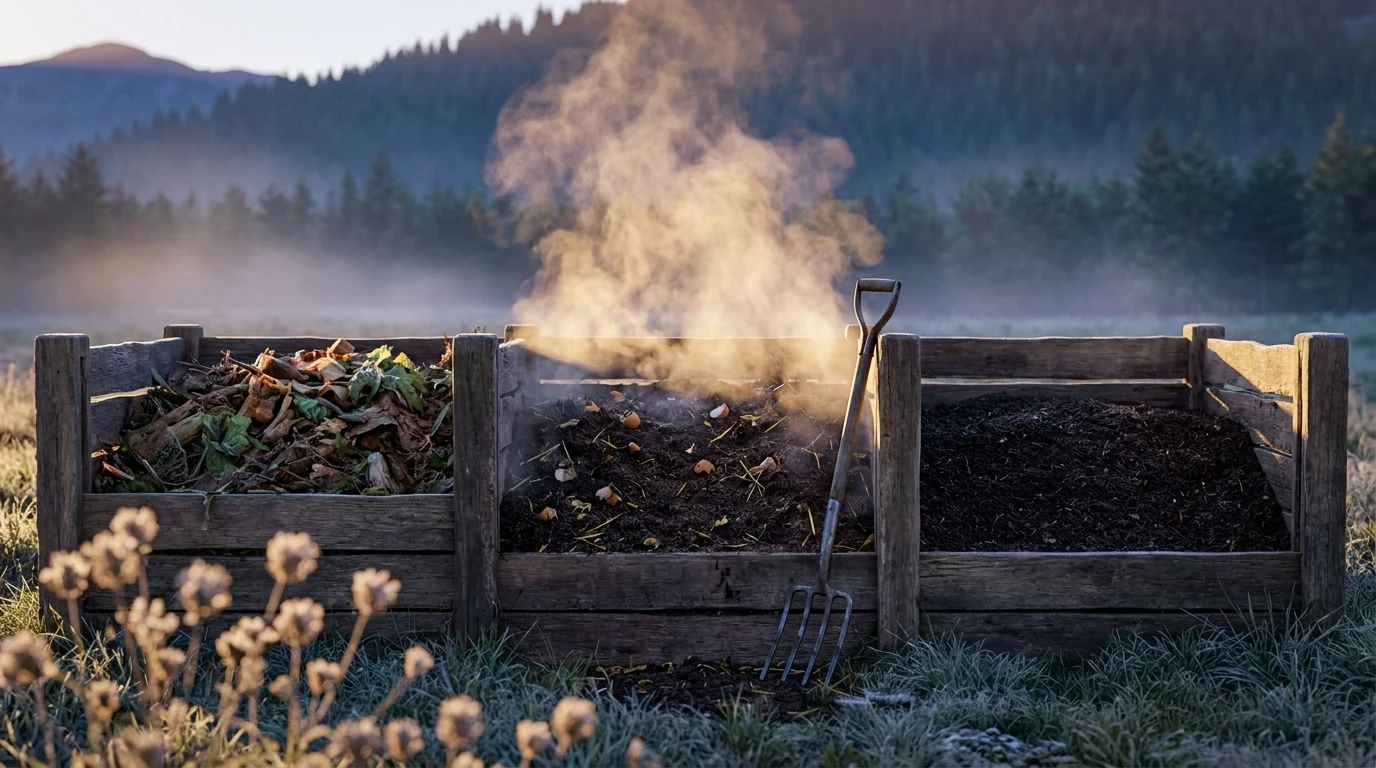
An illustration of a working pile, not a photograph of a measurement: the steam off a freshly turned face is what all four conditions holding at once looks like. No temperature is shown — the three authorities this guide cites do not agree on one.
1
The carbon-to-nitrogen balance
The target
A carbon-to-nitrogen ratio of about 30:1 by weight across the whole mixture. (The National Organic Program allows a starting range of 25:1 to 40:1.)
How to hit it
Mix high-carbon "browns" with high-nitrogen "greens". Cornell publishes the actual ratios, and they are more lopsided than most people expect: autumn leaves run 30–80:1, straw 40–100:1, wood chips and sawdust 100–500:1, and cardboard around 560:1, while vegetable scraps sit at 15–20:1, coffee grounds at 20:1, grass clippings at 15–25:1, and manure at 5–25:1. So 30:1 across the mixture does NOT mean thirty buckets of leaves per bucket of scraps — it means combining materials from both ends of that table. In practice: build mostly of browns, mix greens through, and top every addition of food scraps with browns.
When it is wrong
Too much nitrogen and the excess is lost as ammonia gas — that is exactly the smell of a pile gone wrong. Too much carbon and there is not enough nitrogen for the microbes to multiply, so the pile stays cool and decomposes very slowly. As composting proceeds the ratio falls on its own, from around 30:1 to 10–15:1 in the finished product, because about two-thirds of the carbon leaves as carbon dioxide each time microbes consume it.
At least 3 ft × 3 ft × 3 ft, and no more than about 5 ft × 5 ft × 5 ft.
How to hit it
Build to at least the lower size before expecting the pile to heat, and mix coarse material (stalks, twigs, wood chips) with fine material so there is pore space for air. If you want something bigger than the upper size, UNH notes a long narrow pile composts more efficiently than a tall compact one.
When it is wrong
There is a floor and a ceiling, for opposite reasons. Below about 3 ft on a side, the pile loses heat to its own surface faster than the microbes generate it, so it never gets warm — it still composts, just slowly and coolly, which means it will not kill weed seeds or pathogens. Above about 5 ft on a side, air cannot reach the middle, so the centre goes anaerobic; a pile that big is also miserable to turn.
40–60% moisture while the pile is working — as damp as a wrung-out sponge. Finished compost sits around 40%: squeeze a handful and it feels damp but yields only a drop or two.
How to hit it
Water the pile as you build it if the material is dry, and cover it if your rainfall would otherwise drown it. The squeeze test is the whole method — you do not need a meter.
When it is wrong
Too dry and everything stops: the microbes need water to live and work, so a dry pile simply sits. Too wet and the pile goes airless, switching to anaerobic decomposition — the slow, sour, foul-smelling kind. Moisture also matters for the kill: eOrganic notes that dry heat is less effective than moist heat at killing weed seeds, so seeds in a dry pile survive higher temperatures for longer than seeds in a moist one.
Enough pore space that the middle of the pile is not airless. Turning is how you restore it.
How to hit it
Clemson's rule is a turn with a fork or shovel about once a week; if turning is not practical, at least poke the pile with a tool handle to let air in. Always move the outside material to the middle — eOrganic notes the edges and surface of a pile may never reach kill temperature, so thorough mixing during the active phase is what gives every part of the material its turn in the hot centre. Coarse material mixed in keeps channels open between turns.
When it is wrong
A compacted, airless pile stops composting aerobically and starts fermenting, which produces the sour smell people associate with compost. It is also the reason an all-grass-clippings pile turns into a slimy mat: no structure, no air. An unturned pile still finishes — it just takes considerably longer.
Above about 113 °F the community of organisms in the pile shifts to thermophilic — heat-loving — species. That handover is what makes a pile "hot".
If the pile is big enough to insulate itself, eOrganic reports temperatures in the active phase may reach 131–170 °F within one to three days.
The National Organic Program sets a real, checkable bar for compost that is supposed to be sanitised: 131–170 °F held for 3 days in an in-vessel or static aerated pile, or 131–170 °F for 15 days in a windrow with at least five turnings during that period.
Controlled tests give a sense of scale: 90% of the seeds of all six weed species examined were killed after less than three hours at 140 °F, and all six reached 100% mortality after less than an hour at 158 °F. Field composting is harsher going — in composting manure, some species needed three days at 120 °F, Johnsongrass needed three or more days at 160 °F, and field bindweed survived until seven days at 180 °F.
Three authorities, three different numbers
Extension sources do not agree on the home-garden threshold. Clemson says most harmful pathogens and weed seeds are destroyed above 140 °F, and suggests checking with a long-stemmed compost thermometer at least 12 inches into the pile. Iowa State puts it at 150–180 °F. The National Organic Program uses 131–170 °F with a time requirement attached. We are not going to pick one for you.
All three reach the same practical conclusion, and it is the one that matters: a backyard pile does not reliably reach and hold kill temperature all the way through. Clemson and Iowa State both therefore advise discarding weed seeds and diseased plant material rather than composting them. That is the rule to follow — not because your pile definitely will not get hot, but because you cannot verify that every part of it did.
Every exclusion below carries its reason, so you can apply the logic to something we have not listed.
Compost these
Autumn leaves
Brown. The best free carbon source most gardens have — stockpile them in autumn and use them all year.
Straw
Brown. Coarse enough to keep air channels open as well as supplying carbon.
Wood chips and sawdust
Brown, and very high in carbon — use sparingly relative to their bulk, and expect them to break down slowly.
Cardboard and paper
Brown. Tear or shred it so it does not mat into airless layers.
Fruit and vegetable scraps
Green. Always bury them in the middle and cap with browns so they do not attract animals.
Grass clippings
Green, and the most concentrated one most people have. Mix them through rather than piling them, or they mat into a slimy airless layer.
Coffee grounds
Green, despite being brown to look at — a useful reminder that the browns-and-greens shorthand is about chemistry, not colour.
Keep these out
Meat and bones
Meat attracts animals, and bones take a very long time to break down in a home-scale pile.
Pet waste and cat litter
Can contain pathogens. Keep it out of any compost destined for food crops.
Diseased plants and weeds gone to seed
Proper composting can kill these, but a home pile struggles to bring every part of itself to the 150–160 °F needed to do it reliably. Keeping them out avoids re-infecting the garden with your own compost.
Persistent spreading weeds
Plants such as morning glory, buttercup, quack grass, and comfrey can survive a cool pile and become a nuisance wherever the compost is spread.
Why: Usually not enough nitrogen, or the pile is too dry — and sometimes simply too small to hold heat.
Fix: Add green material (fresh grass clippings, kitchen scraps), water it if it is dry, and mix it thoroughly. A few scoops of finished compost inoculates a brand-new pile with the organisms it needs. If it is under a cubic yard, build it up.
Why: Too many kitchen scraps and not enough browns, and usually not enough air — the pile has gone anaerobic.
Fix: Mix in plenty of brown, coarse material and turn it to open up air space. Ammonia smell specifically means excess nitrogen; a sour, rotten smell means it is airless and waterlogged.
Fix: Always bury food scraps in the middle of the pile and top them with brown material. Keep meat, bones, and fats out entirely — those are what attract animals, and they break down badly in a home pile anyway.
Why: The pile never got hot enough for long enough, throughout, to kill the seed.
Fix: This is the reason for the do-not-compost list. A home pile struggles to bring every part of itself to the temperature that reliably kills weed seed and pathogens, so keep seeding weeds and diseased plants out rather than trusting the pile to handle them.
If you only remember one diagnostic, make it the smell. A working pile smells of damp forest floor and almost nothing else. Sharp ammonia means too much nitrogen — add browns. Sour and rotten means it has gone airless — turn it and add coarse material. Nothing at all, and cold, means it is too dry or too small.
Knowing When It Is Finished, and Using It
The test is heat, not appearance. A finished pile no longer warms up after being turned, and the product is fine, dark, and crumbly. At home that takes somewhere between six months and two years depending on size, materials, and turning frequency; a well-managed commercial operation gets there in six to twelve weeks. Squeeze a handful of the finished product and it should be damp — around 40% moisture — yielding only a drop or two.
Do not use it before then. Unfinished compost is still actively decomposing, and that process competes with your plants for nitrogen — adding “hot” compost to a garden can set it back rather than helping. If the finished product still has coarse woody pieces in it, screen them out through quarter-inch hardware cloth and return them to the next pile.
To use it as a mulch on flower and vegetable beds, UNH suggests half an inch to an inch over the whole bed, or in rings around each plant extending out as far as the outermost leaves — and always keeping the mulch a few inches clear of the plant’s base, so you are not holding moisture against the stem and inviting pests and disease. That one inch a year is also, conveniently, the maintenance dose for keeping organic matter up.
“Organic Matter Holds More Water” — How Much, Honestly
Organic matter is what lets a soil form aggregates — crumbs — and it is the pore space between and inside those crumbs that holds plant-available water. So the relationship is real and positive, and it works hardest where it is needed most: coarse sandy soils gain more from added organic matter than fine loams and clays do, because sand has only large pores and needs organic matter to build small ones, while fine soils already aggregate readily and hit diminishing returns.
University of Minnesota Extension works the arithmetic from a recent compilation of studies: in a medium-textured soil, each 1% increase in organic matter raised available water capacity by about 1.03 percentage points — roughly 3,400 extra gallons per acre in the top foot, on top of an existing capacity of about 71,000 gallons. To put 3,400 gallons in perspective, they note it is about a one-ninth-inch rainfall event.
UMN attaches its own warning to that figure, and so do we: "just an estimate." What actually matters, they say, is that organic matter fundamentally changes soil structure — you cannot push a loamy sand into behaving like a clay loam.
Be careful with the big number
You will see a far bigger number quoted: "every 1% increase in organic matter holds up to 20,000 more gallons per acre," usually attributed to the USDA-NRCS. Follow the citation and it resolves, on the same Extension page that prints it, to an advocacy blog post rather than any NRCS technical publication — and that same fact sheet reports its own laboratory result of about 10 gallons per acre-foot a few paragraphs later. A single document printing two figures roughly 2,000 times apart is a good reason to treat the whole genre of gallons-per-acre claims with suspicion. Build organic matter because it changes your soil's structure. Do not build it against a number.
Compost is the most over-prescribed remedy in gardening, and using it on the wrong problem costs you a season. Each of these hands you to the guide that actually solves it.
“Compost replaces fertiliser.”
It does not, and the numbers say why. Plant-based compost analyses at roughly 1.0-0.5-1.0 N-P-K, and only 5–10% of that nitrogen is mineralised — actually available to plants — in the year you apply it. Oregon State puts it plainly: the fertiliser value of compost is low compared with salt fertilisers, and lawns, vegetables, and fruiting trees and shrubs often need additional fertiliser to thrive. UNH says the same. If a soil test shows a genuine deficiency, address it directly.
Compost buffers soil — it makes pH somewhat more stable and harder to swing — but it is not a pH treatment. If your pH is genuinely out of range for what you want to grow, that is a measured, dosed intervention with lime or sulfur, and it needs a soil test first.
Organic matter improves how a soil handles water, which genuinely helps a heavy soil. But if water is arriving in a low spot faster than it can leave — a high water table, a seep, or a hollow that collects runoff — no amount of compost will change that. The answer there is drainage, or raising the planting above the water.
Unfinished compost put on a garden can harm plants — it is still actively decomposing, and that process competes for nitrogen. The test is heat: a finished pile no longer warms up after being turned, and the product is fine, dark, and crumbly. At home this takes somewhere between six months and two years depending on size, materials, and how often you turn it.
We read your parcel's soil texture, drainage, and pH from the USDA survey and score 1,085 plants against them. Organic matter improves whatever you start with — but it helps to know what that is.
Three things about your exact spot that zone averages miss:
Your soil pHYour frost-free daysYour sun & shade
We read public map data for this spot — soil, climate, flood, and parcel records. How we handle your address.
25+ data sources analyzed in seconds
Frequently Asked Questions
What is the right carbon-to-nitrogen ratio for compost?
About 30 parts carbon to 1 part nitrogen by weight across the whole mixture; the National Organic Program allows a starting range of 25:1 to 40:1. Note that this is the ratio of the mixture, not a recipe of thirty buckets of leaves per bucket of scraps — autumn leaves are already 30–80:1 on their own and cardboard is around 560:1, while kitchen scraps are 15–20:1. Build mostly of browns, mix greens through, and cap food scraps with browns.
How hot does a compost pile need to get?
Above about 113 °F the pile shifts to heat-loving organisms, and a self-insulating pile can reach 131–170 °F within one to three days. For actually sanitising compost, the National Organic Program requires 131–170 °F held for three days in a static pile, or fifteen days in a windrow turned at least five times. Extension sources disagree on the home-garden threshold — Clemson says over 140 °F, Iowa State says 150–180 °F — but they agree on the conclusion: a backyard pile does not reliably get there throughout.
How big does a compost pile need to be?
At least 3 feet by 3 feet by 3 feet, and no more than about 5 feet on a side. Below the minimum the pile loses heat to its own surface faster than the microbes generate it and never warms up. Above the maximum, air cannot reach the middle and the centre goes anaerobic — and it is exhausting to turn.
Can I compost diseased plants and weeds that have gone to seed?
You should not. In principle proper composting kills both, but it takes sustained high temperature throughout the pile, and a home pile cannot reliably deliver that — the edges and surface in particular may never reach kill temperature. Iowa State and Clemson both advise discarding this material rather than composting it. The risk is re-infecting your own garden with your own compost.
Does compost replace fertiliser?
No. Plant-based compost analyses at roughly 1.0-0.5-1.0 N-P-K, and only 5–10% of that nitrogen is available to plants in the year of application. Oregon State Extension states the fertiliser value of compost is low compared with salt fertilisers and that lawns, vegetables, and fruiting plants often need additional fertiliser. Use compost for what it is genuinely excellent at — building structure, water-holding, and soil biology — and treat nutrient deficiencies as a separate question answered by a soil test.
How much organic matter should my soil have?
At least 2% for most garden and landscape plants, with 5–10% the goal in vegetable and flower beds. It is measured by weight, and most soil-testing labs include it in a basic test, so you can find out rather than guess. It is also consumed continuously by oxidation and needs replenishing every year — University of Maryland Extension puts the maintenance dose at just one inch of compost annually.
How long does compost take?
At home, somewhere between six months and two years depending on the size of the pile, what went into it, and how often you turn it; well-managed commercial operations finish in six to twelve weeks. The test for "finished" is heat: a completed pile no longer warms up after being turned, and the product is fine, dark, and crumbly. Unfinished compost put on a garden can harm plants, because it is still actively decomposing and competing for nitrogen.
Where these numbers come from
Cornell Composting — Compost Chemistry — the 30:1 carbon-to-nitrogen target, the per-material ratio table, and why the ratio falls to 10–15:1 in finished compost
Clemson HGIC — Composting — pile dimensions, weekly turning, the wrung-sponge moisture test, and one of the three disagreeing kill temperatures
For what your local soils are short of, and which materials are worth hauling in your area, your Cooperative Extension and its soil-testing laboratory are the right place to ask — a basic test will report your organic matter alongside your pH, which turns this whole page from a practice into a measurement.

 What it changes