Watering is the thing you do most often and think about least. It is not a system you install once — it is a weekly judgement you make all season, and almost all of it comes down to four decisions: how much, how often, how deep, and where the water lands.
This is deliberately a different guide from drainage and water. That one is about what your soil does with water — its drainage class, its texture, why some plants drown — read off the USDA soil survey and fixed. This one is about what you do, and can change tomorrow. They meet at exactly one point, and it is the most important thing on this page: your soil’s texture is the single biggest input to your watering schedule. Sand needs little and often; clay needs a lot and rarely.
One framing worth having before the detail: the commonest watering mistake is not watering too little, it is watering shallowly and often. That grows a shallow root mat in the layer of soil that dries fastest and heats up most, which makes the plant permanently dependent on you. Nearly every principle below is downstream of that one idea.
About one inch of water per week, from rain and from you combined.
Iowa State, the University of Minnesota, and Clemson all publish this independently for vegetable gardens. Install a rain gauge by the garden: when rain has delivered an inch over the week, Iowa State notes no supplemental irrigation is needed at all.
An inch of water is far more than it sounds. The University of Minnesota does the conversion: an inch over 100 square feet is 62 gallons — so a 20-by-30-foot garden needs about 372 gallons after a dry week. Clemson gives it as roughly six gallons per square yard.
Clemson notes that inch wets the root zone to a depth of about 6 to 8 inches, which is where most vegetable roots are. Iowa State gives the target slightly wider, at 6 to 12 inches.
For a sprinkler, put straight-sided containers — tin cans work — in the wetting pattern and run it until an inch has collected. For drip or soaker lines, Iowa State suggests soaking thoroughly to 10–12 inches the first time, digging a hole to check, and then timing it: once you know how long your system takes to wet a foot of soil, you know how long to run it thereafter.
Each one comes with what going wrong looks like, so you can work backwards from a symptom in your own garden rather than forwards from a rule.
1
Check before you water
Put a finger — or better, a trowel — into the soil before you turn anything on. Water because the soil is dry at depth, never because it is Tuesday.
Why
The surface of a bed dries out and looks thirsty long before the root zone does, especially in sun and wind. Watering on a fixed schedule without checking is the most common way gardens are simultaneously over-watered and under-watered — soaked at the top, bone dry below. Digging a small hole beside a plant and feeling the soil a few inches down takes ten seconds and answers the question directly.
What going wrong looks like
Plants wilting in the afternoon on soil you watered this morning (the water never got down), or yellowing lower leaves and a sour smell in a bed you water daily (it never dries out and the roots have no air).
Aim to wet the whole root zone each time you water, then leave it alone until it has genuinely started to dry. Frequent shallow sprinkles are worse than useless.
Why
Roots grow toward water. A bed watered lightly every day grows a shallow root mat right at the surface — the layer that dries out fastest and heats up most — so the plant becomes permanently dependent on you and collapses the moment you skip a day or the weather turns. Water that reaches deep encourages deep roots, and a deeply rooted plant can carry itself through a dry stretch that would kill a shallow one.
What going wrong looks like
A garden that wilts dramatically the first hot day you go away, or plants that fall over easily and have a dense white root mat visible right under the surface when you lift them. Iowa State names the specific failure: hand watering with a hose is the most inefficient method there is, because the flow is faster than most soils can absorb, so it runs off and washes soil away — and most people do not water long enough to wet the soil deeply, leaving the surface wet and the root zone dry.
Deliver water at the base of the plant. Wet foliage is a disease invitation and a large share of overhead spray never reaches the roots at all.
Why
Most common garden fungal and bacterial diseases need leaf wetness to establish and spread, and overhead water both wets the leaves and splashes soil-borne spores up onto them. Water aimed at the ground also loses far less to evaporation and to drift on a breezy day. It is the single change that most improves both disease pressure and water efficiency at once.
What going wrong looks like
Recurring leaf spot, blight, or mildew that starts on the lowest leaves and works upward — the classic signature of splashed soil and foliage that stays wet. Iowa State adds a second cost of overhead watering that has nothing to do with disease: a sprinkler waters the root zone AND all the space between rows, giving weeds enough moisture to compete with your vegetables.
Early morning is the best time to water. If you cannot manage mornings, water at the roots in the evening — but avoid wetting leaves at night.
Why
Morning watering sends plants into the heat of the day fully charged, and any foliage that does get wet dries quickly as the sun comes up. Midday watering loses the most to evaporation. Evening overhead watering leaves leaves wet for many hours in still, cool, humid air — the exact conditions fungal disease needs. Watering at the roots in the evening is a reasonable compromise; overhead sprinkling at dusk is the worst option available.
What going wrong looks like
Disease that appears despite good spacing and healthy plants, in a garden watered by sprinkler after work. One important exception, from the University of Minnesota: if plants are already wilting or heat-stressed, water them straight away even if it is the middle of a hot afternoon. Early morning is the better practice, but do not make a drought-stressed plant wait for it.
A layer of organic mulch over the soil does more for your water use than any change of equipment.
Why
Bare soil loses water straight to the air from its surface and bakes hard in sun, so rain and irrigation run off rather than soaking in. A mulch shades the surface, slows evaporation, buffers soil temperature, and keeps the top layer soft enough to accept water — which also means the shallow feeder roots can use the top few inches instead of abandoning them. It breaks down into organic matter as a bonus, which is the /guides/composting-organic-matter story.
What going wrong looks like
Soil that has crusted into a hard surface water runs off rather than into, and beds that dry out within a day or two of a good soak. Timing matters in a vegetable garden, though: Iowa State advises applying several inches of mulch in early June once the soil has warmed, because putting it down too early insulates cold soil and slows plant growth.
Newly sown seed and freshly planted transplants need frequent, light watering — the opposite of the deep-and-infrequent rule — until they have roots.
Why
The deep-watering rule assumes a plant has a root system to reach down with. A germinating seed has none, and a transplant has only the small root ball it arrived with, sitting in the top few inches. Until those roots grow out into the surrounding soil, the plant can only drink from the layer that dries fastest, so it needs the surface kept damp. Then you transition: as the plant establishes, water less often and more deeply to draw the roots down.
What going wrong looks like
Patchy germination in a bed you watered deeply but rarely, or transplants that sit and sulk for weeks and then die in the first hot spell.
Dig, do not guess. University of Minnesota: pull the mulch aside and dig in with a spade or trowel. The top inch may be dry, but the soil below it should be somewhat moist — if it is dry two inches down, it is time to water. Clemson: dig down 2 to 4 inches with a trowel and feel it. On Piedmont clay soils, simply not being able to dig down easily is itself enough to tell you the soil is dry. Ten seconds with a trowel beats any schedule, any moisture meter, and any amount of standing in the garden wondering.
Free Report
Your soil decides your schedule
Enter your address and we read the USDA soil survey for the map units under your parcel — texture and drainage class, the two things that set how often you water — then score 1,085 plants against your real conditions.
Three things about your exact spot that zone averages miss:
Your soil pHYour frost-free daysYour sun & shade
We read public map data for this spot — soil, climate, flood, and parcel records. How we handle your address.
25+ data sources analyzed in seconds
Why Your Soil Sets Your Schedule
Different soils hold wildly different amounts of water that plants can actually use. This is the number underneath every “water twice a week” rule you have ever read — and it is why no single schedule can be right for everyone.
Plant-available water holding capacity by soil texture, in inches of water per foot of soil.
Soil texture
Available water (in / ft of soil)
Very coarse sands
0.4 – 0.75
Coarse sands, fine sands, loamy sands
0.75 – 1.25
Sandy loams, fine sandy loams
1.25 – 1.75
Very fine sandy loams, loams, silt loams
1.50 – 2.30
Clay loams, silty clay loams, sandy clay loams
1.75 – 2.50
Sandy clays, silty clays, clays
1.60 – 2.50
UC ANR states the practical consequence in one sentence: a given plant uses water at the same rate regardless of soil texture, but it runs out sooner in a sandier soil. That is the whole reason sandy gardens are watered more often — not more heavily, more often. The University of Minnesota turns it into a schedule: on sandy, well-drained soil you may need to water twice a week; on heavier clay or loam rich in organic matter, once a week is fine; and mulched soil holds water better still, so you can go longer.
Roughly in order of efficiency. Every one of them has something it is bad at, and those are named here as plainly as the strengths — a method chosen for its strengths and abandoned over an unmentioned weakness is money wasted.
Drip Irrigation
at the roots
Also called: Drip line · Emitter tubing · Micro-irrigation
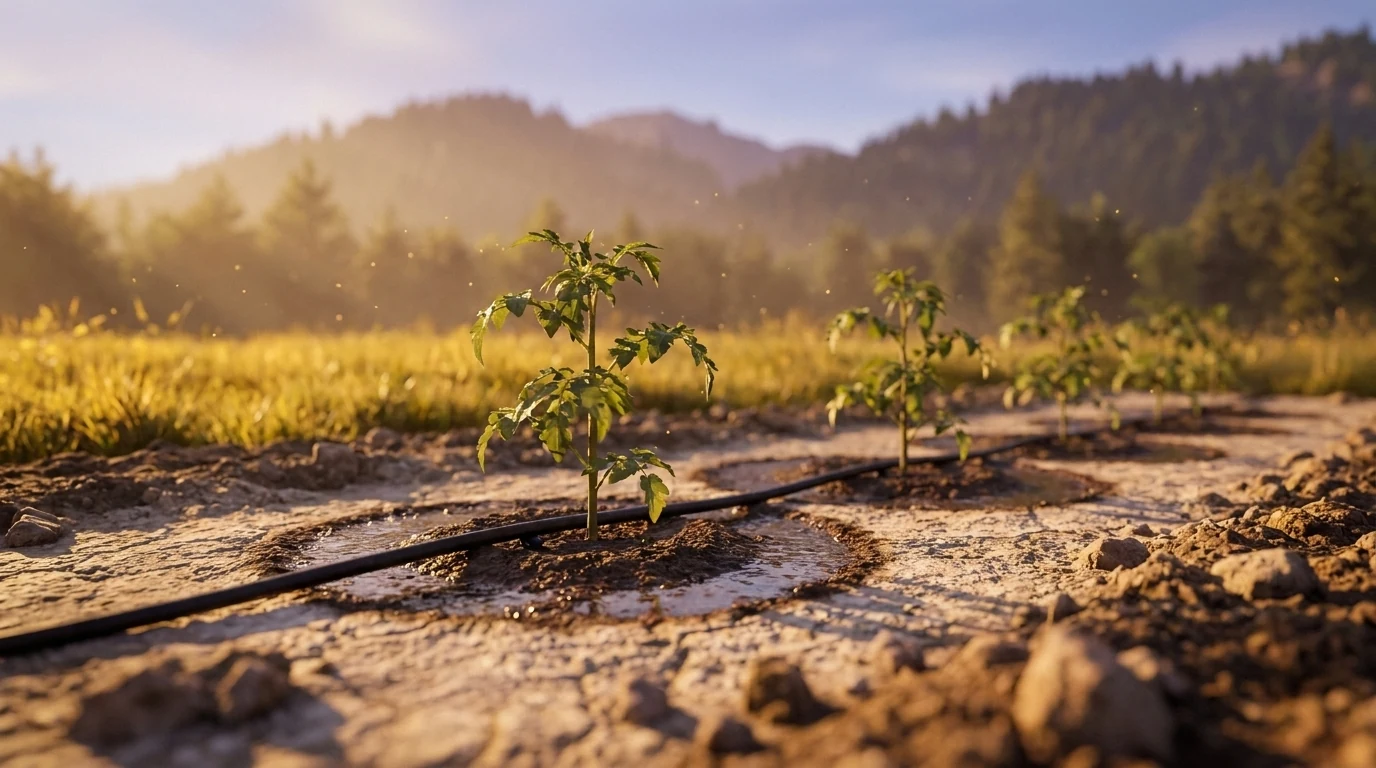
Small-diameter tubing with emitters spaced along it, laid on the soil surface (usually under mulch) so water is released slowly at each plant. It runs at low pressure for a long time rather than at high pressure briefly, so the water has time to soak in instead of running off.
Good at
The most efficient common method: water goes exactly where the roots are, almost none is lost to evaporation or drift, and the foliage stays completely dry, which removes a whole category of disease pressure. It is easy to automate with a simple timer, it waters evenly whether or not you are paying attention, and because it wets only the planted strip, the paths between beds stay dry and grow fewer weeds.
Bad at
Emitters clog, especially on hard or unfiltered water, so it needs a filter and an occasional flush. It is a system to install and maintain rather than a tool to pick up, and because you cannot see the water working you have to check the soil to confirm it is doing anything. Rodents chew the tubing. It also wets a limited pattern, so plant spacing and emitter spacing have to agree.
Best for
Permanent vegetable beds, rows, and anything you want on a timer. Iowa State puts the saving at 30–50% less water than hand-watering or sprinklers, and Clemson calls drip simply the most efficient irrigation method available — so it is the strongest choice anywhere water is scarce or expensive.
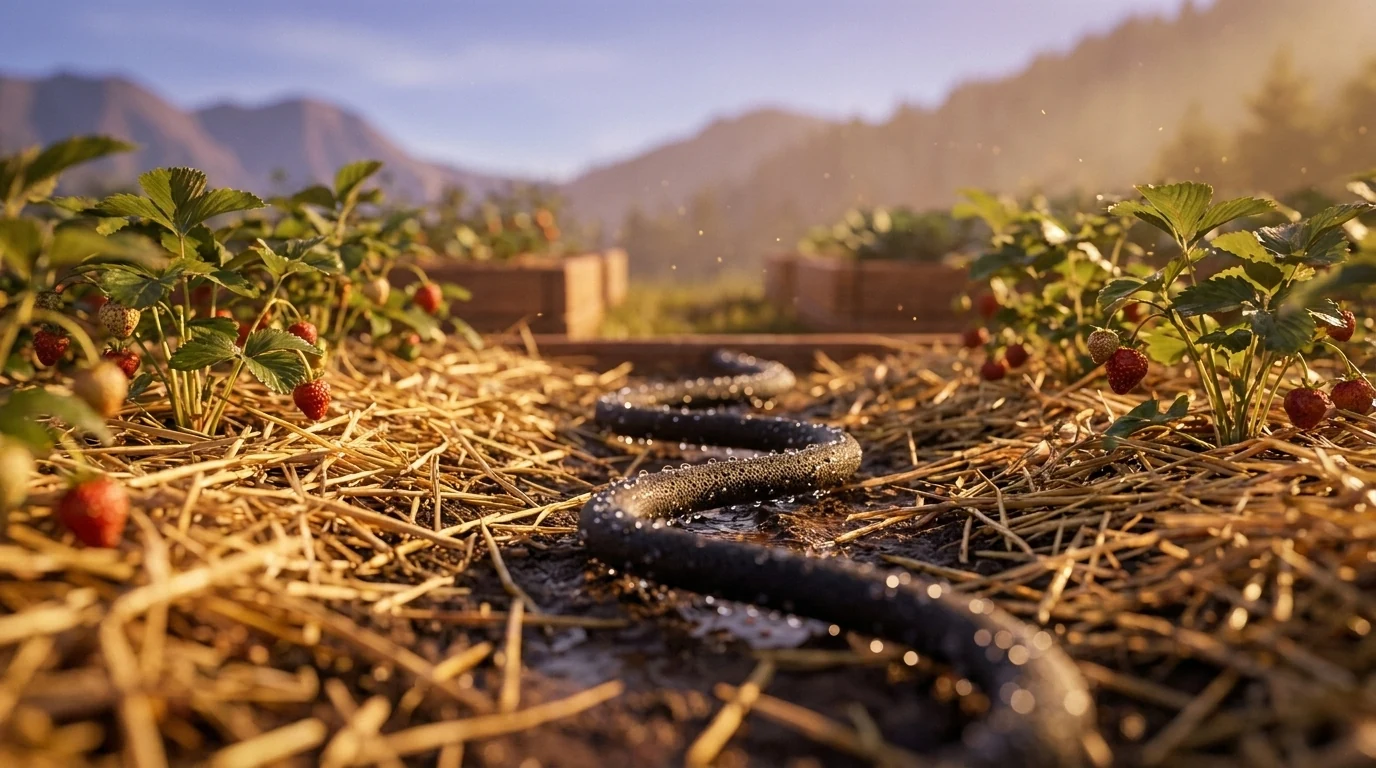
A porous hose that seeps water along its whole length rather than through discrete emitters. Laid along a row and, ideally, covered with mulch. Effectively the low-tech version of drip: most of the same benefits, far less setup.
Good at
Cheap, immediate, and needs no design — you uncoil it along the bed and turn it on. It keeps foliage dry and delivers water slowly enough to soak in. For a small garden it captures most of the value of a drip system for a fraction of the cost and none of the planning.
Bad at
Output falls off along the length of the hose, so the far end gets less than the near end and very long runs water unevenly; the effect worsens on a slope. Pores clog with time and mineral deposits, and the hose stiffens with age and sun. You have far less control over how much lands where than a drip system gives you.
Best for
Small to medium beds, straight rows, and anyone who wants the disease and efficiency benefits of root-level watering without installing a system. Keep runs short and check the far end. Iowa State's calibration advice applies here too: soak to 10–12 inches the first time, dig to confirm, then run it on the clock.
Also called: Oscillating sprinkler · Impact sprinkler
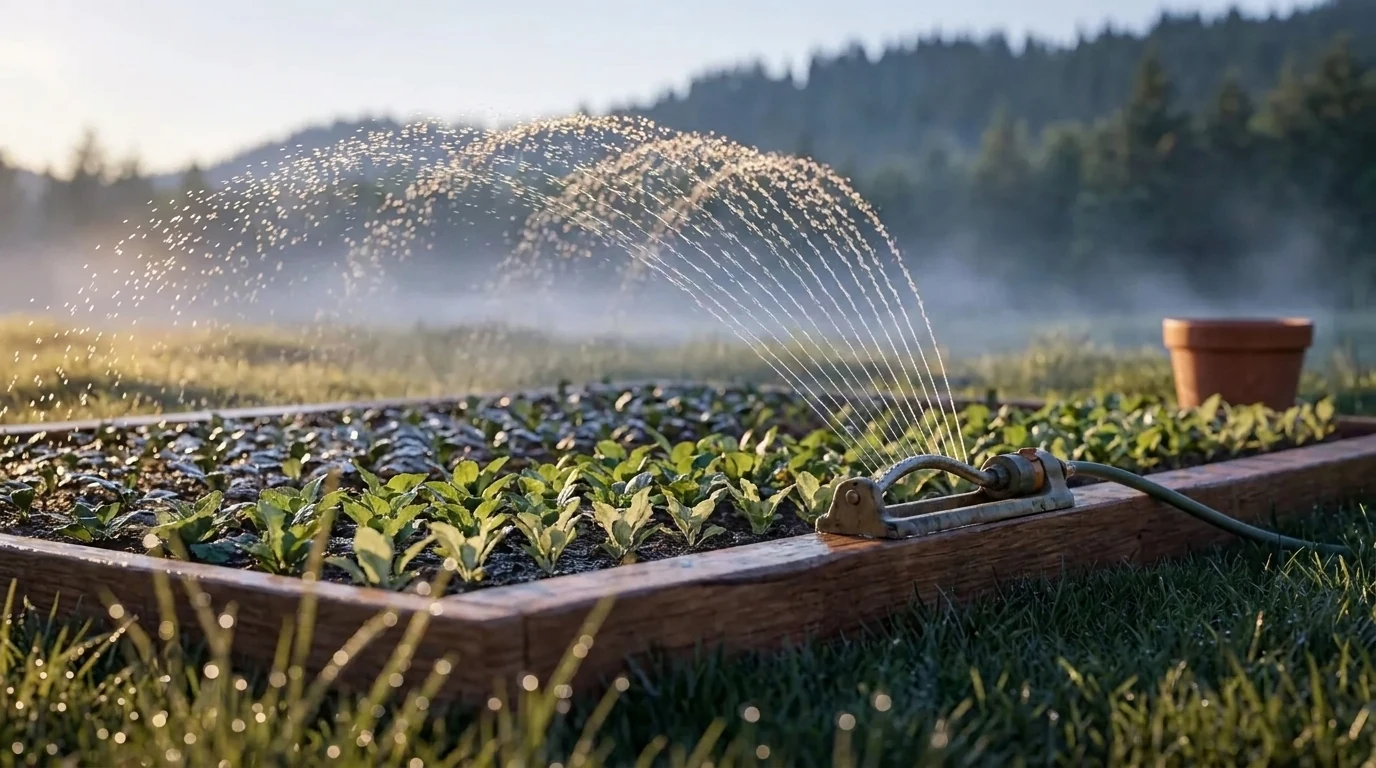
Water thrown into the air to fall over an area, the way rain does. Universal, cheap, and the default most gardens start with.
Good at
Covers a large area with no setup, and it is genuinely the right tool for a few jobs: watering in a newly sown bed or a new lawn where you need the whole surface damp, and washing dust or aphids off foliage. It also puts water on evenly across an area you have not planted in rows.
Bad at
It wets the leaves, which raises disease pressure on most vegetables, and it loses a substantial share of the water to evaporation and to wind drift before it ever lands — the losses are worst in exactly the hot, dry, breezy conditions where you most need the water. It waters the paths and the weeds along with the crop, and its distribution is far less even than it looks.
Best for
Germinating seed beds, lawns, and cover crops. For established vegetables it is the method to graduate away from, and if you must use one, run it early in the morning and on a still day. For sizing: Iowa State notes most sprinklers deliver about 3 gallons a minute at the 25–35 psi typical of a household faucet, and recommends one good watering a week rather than frequent light passes.
A can or a hose with a wand, aimed at the base of individual plants. The most controllable method and the one most likely to be done badly, because it takes far longer than people think to deliver a real soak.
Good at
Perfect precision: you give the thirsty plant a lot and the wet corner nothing, and you can water a new transplant differently from its established neighbours. It also puts you in the garden looking at your plants every day, which is worth more than the water — most problems are caught by the person holding the hose.
Bad at
The universal failure is under-delivery. It takes a surprising volume to wet a root zone properly, and a pass with a wand that feels generous is often only wetting the top inch. It also does not scale, and it stops entirely when you go away.
Best for
Containers, new transplants, small gardens, and spot-watering. If it is your main method, count the seconds you spend on each plant and then dig down to check what actually arrived — most people are shocked the first time.
Not a method so much as a category with different physics. A pot holds a tiny, finite reservoir of water, has far more surface exposed to sun and wind than a bed does, and drains freely by design — so it behaves nothing like ground soil.
Good at
Total control: you decide the medium, the water, and the feeding, and nothing is competing for it. A container can be moved into shade during a heat wave, which no bed can.
Bad at
Containers dry out fast — in hot, windy weather a small pot can need water more than once a day, and there is no deep reserve for the plant to fall back on. Frequent watering also flushes nutrients out of the bottom, so container plants need feeding in a way ground plants often do not. A pot allowed to dry out completely can develop a gap at the edge that water then runs straight down without wetting the medium at all.
Best for
Anywhere the ground is unavailable or unsuitable, which is the /guides/container-gardening story. The watering rule to carry over: water until it runs freely from the drainage holes, then stop — that is your confirmation the whole medium is wetted.
Six Things That Change Your Schedule
A watering schedule is not a fixed thing you set once. These are the six factors that move it, and the direction each one pushes.
Your soil texture
more often
This is the biggest single driver, and it is a property of your ground rather than a choice. A very coarse sand holds under an inch of plant-available water per foot of soil; a loam or clay loam holds more than twice that. Since a plant drinks at the same rate either way, the sandy garden simply runs out sooner — so it needs watering more OFTEN, not more heavily. The University of Minnesota turns that into a schedule: twice a week on sandy well-drained soil, once a week on heavier clay or organic-rich loam. Find out which you have before you set any schedule; the /guides/drainage-water and /guides/soil-types guides cover how to read it.
Whether the soil is mulched
less often
Mulched beds hold their moisture substantially longer than bare ones, because the surface evaporation that drives most of the loss is shaded and slowed — Utah State puts the reduction in evaporative loss from mulched beds at as much as ten-fold, and Nebraska reports mulched soil running 8 to 13 °F cooler than bare soil in summer. Which mulch matters: Nebraska found coarse organic mulch such as shredded wood or wood chips conserved moisture best, while landscape fabric, fine sawdust, and waxy materials like bark and cardboard can turn hydrophobic and actually repel water. Expect to lengthen the interval between waterings after mulching — and check rather than assume, since mulch makes the surface look drier than the soil beneath.
Heat, sun and especially wind
more often
Hot, bright, dry, and windy weather all pull water out of both the soil surface and the leaves. Wind is the one gardeners consistently underestimate: a steady breeze can dry a bed faster than still heat does. Treat a windy week like a hot one, and expect an exposed site to need more water than a sheltered one at the same temperature.
What stage the crop is at
more water
Water need is not flat across a plant’s life, and root depth changes it too. Clemson groups the crops: shallow-rooted vegetables — lettuce, corn, potato, radish — demand the most watching; bean, carrot, cucumber, eggplant, cantaloupe, pepper, pea, summer squash, and turnip are moderately deep; asparagus, lima bean, pumpkin, winter squash, sweet potato, tomato, and watermelon root deep and cope better. Beyond that, germination and establishment need constant surface moisture, and most fruiting crops have a critical window as they set and swell fruit when a shortage costs the harvest outright. Uneven watering has its own signature: an alternating drought-and-flood cycle splits tomato and root-crop skins and drives blossom-end rot.
How long the plant has been there
less often
A first-year planting needs regular water while it builds a root system. An established perennial, shrub, or tree that has been in the ground for several seasons has reached far more soil than you can water and often needs nothing at all outside a genuine drought. The trap is watering a mature planting on the schedule it needed as a youngster — which keeps its roots shallow and wastes a great deal of water.
What you chose to plant
less water
The largest water saving available to a gardener is not an irrigation upgrade, it is planting things adapted to the water your site actually gets. Drought-adapted and locally native species, grouped together so the thirsty plants are not forcing you to irrigate the tough ones, can cut a garden’s water demand more than any change of hose ever will. Group plants by water need — the practice usually called hydrozoning — so each zone can be watered for what it holds.
And the other direction
Clemson is blunt about the other end: do not go overboard. Beyond being wasteful, excessive watering leaches nutrients down out of the root zone, encourages disease, and can reduce flavour — noticeably so in cantaloupes and watermelons. More water is not a safe default.
We read your parcel's soil texture and drainage class from the USDA survey — the two facts that decide how often you water — alongside your rainfall and climate, and score 1,085 plants against them.
Three things about your exact spot that zone averages miss:
Your soil pHYour frost-free daysYour sun & shade
We read public map data for this spot — soil, climate, flood, and parcel records. How we handle your address.
25+ data sources analyzed in seconds
Frequently Asked Questions
How much should I water my vegetable garden?
About one inch of water a week, counting rain and irrigation together — Iowa State, the University of Minnesota, and Clemson all publish this independently. An inch is more water than it sounds: the University of Minnesota puts it at 62 gallons per 100 square feet, so a 20-by-30-foot garden needs roughly 372 gallons after a dry week. Put a rain gauge by the garden, because when rain has already delivered the inch, you do not need to water at all.
How deep should the water go?
Wet the soil to 6 to 12 inches, where most vegetable roots are — Clemson notes that one inch of water reaches about 6 to 8 inches down. Water slowly and deeply rather than in a quick splash, because shallow watering grows shallow roots and shallow roots mean poor drought tolerance. With a drip or soaker system, soak to 10 to 12 inches the first time, dig a hole to confirm, and then run it on a timer for however long that took.
How often should I water?
That depends on your soil more than anything else. The University of Minnesota gives the rule: twice a week on sandy, well-drained soil; once a week on heavier clay or on loam rich in organic matter; and less often again once the bed is mulched. A plant uses water at the same rate whatever the soil, but it runs out sooner in sand — which is why sandy gardens need watering more often rather than more heavily.
When is the best time of day to water?
Early morning, roughly 5 to 9 a.m., if you are using anything that wets the foliage. The leaves dry quickly as the sun comes up, which guards against fungal disease, and less is lost to evaporation than at midday. Evening sprinkling is the worst option because the leaves stay wet all night. The exception: with drip or soaker hoses, which never wet the foliage, evening is perfectly fine. And if a plant is already wilting, water it immediately — do not make it wait for morning.
Is drip irrigation worth it?
For a permanent bed, usually yes. Iowa State puts drip at 30 to 50 percent less water than hand-watering or sprinklers, because it delivers straight to the roots with very little lost to evaporation or runoff, and Clemson calls it simply the most efficient method available. It also keeps foliage completely dry, which removes a whole category of disease pressure, and it can run on a timer. The trade-offs are real: emitters clog, rodents chew tubing, and you have to dig to confirm it is working.
How do I know when it is time to water?
Dig, do not guess. The University of Minnesota says pull the mulch aside and dig in with a trowel — the top inch may be dry, but if the soil is dry two inches down, it is time to water. Clemson says go down 2 to 4 inches and feel it, adding that on Piedmont clay, simply not being able to dig down easily tells you the soil is dry.
Can you over-water a garden?
Yes, and it costs you more than the water. Clemson notes that excessive watering leaches nutrients down out of the root zone, encourages disease, and can reduce flavour — noticeably in cantaloupes and watermelons. Saturated soil also has no air in it, and most roots suffocate without air. More water is not a safe default.
Does mulch really reduce watering?
Substantially. Utah State Extension reports mulching can cut evaporative water loss from soil as much as ten-fold, and Nebraska Extension found mulched soil ran 8 to 13 °F cooler than bare soil in summer. Which mulch matters: Nebraska found coarse organic material such as shredded wood or wood chips worked best, while landscape fabric, fine sawdust, and waxy materials like bark and cardboard can turn hydrophobic and repel water. In a vegetable garden, wait until the soil has warmed in early June — mulching too early holds cold soil back.
UMN Extension — Watering the Vegetable Garden — the gallons conversion (62 gallons per inch per 100 square feet), the once-or-twice-a-week rule by soil type, the dig-two-inches field test, and when to break the morning rule
One provenance note, because it matters: the soil-texture table above is UC ANR’s, not the USDA-NRCS table it is often confused with. For how much water your own climate actually delivers, and which weeks it does not, your Cooperative Extension is the local authority — and Growable Ground reads your parcel’s own soil from USDA SSURGO, which is where the texture that sets your schedule comes from.

 The rule