
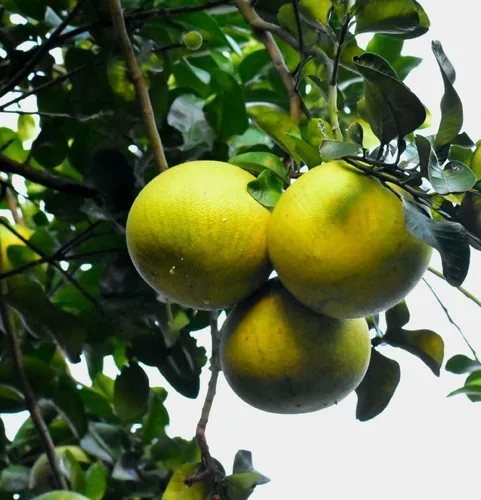
Pomelo is a perennial grown for its fruit. It's hardy across USDA zones 9 through 11. Its flowers are a real draw for honeybees, even though the fruit is the prize. It roots deep, which helps it reach moisture in a dry spell and open up tight soil as it establishes.
Pomelo — the short answer
Pomelo: grown in zones 9–11, full sun, pH 4.5–8.
- USDA zones
- 9–11
- Manual horticultural correction (source not retained); NC State Extension and Missouri Botanical Garden, with the remaining rows from other published sources or Growable Ground compilation
- Soil pH
- 4.5–8
- FAO ECOCROP
- Sun
- Full Sun
- Growable Ground Plant Database
Plant data: Growable Ground Plant Database, compiled from FAO ECOCROP, USDA PLANTS and university Extension sources — each tile names its own row's source, because per-field provenance varies.
Score Pomelo on your exact land.
Zone averages can't see the slope, soil, frost, and sun that decide whether pomelo actually takes — and those shift from one yard to the next. Enter your address and we'll score pomelo against your land's real conditions.
We read public map data for this spot — soil, climate, flood, and parcel records. How we handle your address.
No card required · your full report in seconds
What Pomelo is
Pomelo grows as a perennial.
How to grow Pomelo
Pomelo grows in USDA zones 9 through 11. Pomelo does best in full sun — at least 6 hours of direct sun a day — and soil from pH 4.5 to 8, on well-drained ground.
 USDA Zones
9-11
USDA PHZM 2023
Soil pH
4.5 - 8
FAO ECOCROP
Sun
Full Sun
Growable Ground plant catalog
Drainage
well (dry spells)
Growable Ground plant catalog
Minimum Growing Temperature
53.6°F
Below this it stops growing rather than dies — a pace limit, not a survival limit.
FAO ECOCROP
Frost-Free Days
0+
The frost-free stretch it needs start to finish — short-season areas may need an indoor head start.
Growable Ground plant catalog
Start the season right
Plant pomelo in full sun with at least 6 hours of direct sun, once the soil has warmed and frost risk has passed.
Match the soil
Pomelo prefers pH 4.5 to 8 (FAO ECOCROP). A quick soil test from your local Extension lab tells you whether to add lime or sulfur to land in band.
Water steadily
Keep the root zone evenly moist through establishment. A 2–3 inch mulch layer holds moisture without waterlogging.
Harvest at maturity
Pick when the fruit is full-colored and parts easily from the stem. Local Cooperative Extension guides publish timing tables.
Where Pomelo thrives
Pomelo is hardy across USDA zones 9 through 11. Zone is only the starting point, though: the soil pH, drainage, and frost dates on your specific land decide how well it actually does.
A USDA zone is a 10°F band of average annual extreme winter minimum, so zones 9–11 spans average winter lows from 20°F to 50°F (USDA PHZM 2023). Across the 50 states and DC, that band covers none outright but splits 17 down the middle — and which side of that line your land sits on changes the answer.
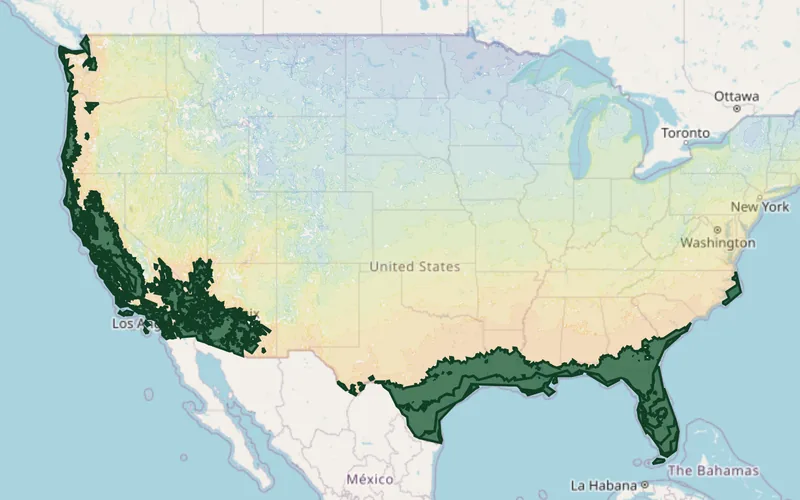
Zones 9–11·Where Pomelo growsOpen map →
This map is derived from the USDA ARS / PRISM Plant Hardiness Zone Map (2023) and is not the official USDA Plant Hardiness Zone Map.
Where Pomelo stands, state by state
Pomelo is rated for zones 9–11 — a cold floor USDA puts at 20 to 30°F. Across the 50 states and DC, 0 sit fully inside that band, the line runs through 17 more, and 34 sit outside it — and inside every split state, the same line runs on at county grain.
The line runs through
17 states
- Alaska · zones 1a-9a
- California · zones 4b-11a
- Nevada · zones 4a-10a
3 of 17 shown
Pomelo’s band covers part of each of these states — which side of the line your county sits on changes the answer, and each state page draws it.
State zone extents: USDA Plant Hardiness Zone Map (PHZM) 2023. A zone is a 10°F band of average annual extreme minimum temperature, so a state that splits the band contains the boundary — its own page draws the county line, and a parcel report resolves which side your land sits on.
What grows around Pomelo
Growing guides for pomelo
In rotation planning, pomelo counts as a Other — beds recover best when other crops don’t follow each other in the same spot year over year. (Growable Ground derivation — crop-rotation group from botanical family)
Good to know
One caution for pet owners — pomelo is toxic to dogs and cats (mild severity). Keep it out of reach, and call ASPCA Animal Poison Control at (888) 426-4435 in an emergency. (Source: ASPCA.)
Pomelo is a standout pollinator plant — high value to bees and other pollinators.
Before you harvest pomelo, know your soil
Anything you grow to eat takes up what's in the ground it grows in, so it's worth knowing what's documented near you before you plant pomelo for food. Our free screen reads 9 federal source types across roughly 1.8M indexed sites and shows which sit near your address and which way they drain. It's a screening estimate from public records and proximity — not a soil test — so a nearby record means a soil test is worth it, not that your soil is unsafe.
Your land is one point inside Pomelo's range
This page resolves to the species. Your state page draws the county line, and a report reads the parcel — the soil pH, drainage, sun, and frost dates on your exact ground, which no species average can see.
See if Pomelo will thrive on your land
Zone averages are a start. Your exact soil pH, drainage, sun exposure, and frost dates shape whether pomelo actually takes — we score it against the real conditions at your address.
Three things about your exact spot that zone averages miss:
We read public map data for this spot — soil, climate, flood, and parcel records. How we handle your address.
25+ data sources analyzed in seconds
How we know this about Pomelo
The figures above are cited per row, not per site: the pH band names this plant’s own source column, the three temperature figures each carry their own, and days-to-maturity cites the publication that actually lists it. All of it comes from the Growable Ground Plant Database — a compilation over FAO ECOCROP, USDA PLANTS, and university Extension sources, published openly with per-field provenance.
Grounded inUSDA PLANTS Database•USDA PHZM•ASPCA
Frequently asked questions
Can I grow Pomelo in my zone?
Pomelo grows in USDA hardiness zones 9 through 11 (USDA PHZM 2023). Zone is one factor — soil pH, drainage, and frost dates on your specific parcel also shape whether it takes.
When should you plant Pomelo?
Most growers plant pomelo after the last spring frost, once the soil has warmed. Your local frost dates set the exact window — a Growable Ground report reads them for your address.
How much sun does Pomelo need?
Pomelo needs full sun — a spot that catches at least 6 hours of direct summer sun a day. In more shade it still grows, but usually gives a smaller, later crop. The catch is that a yard rarely gets even light everywhere — a fence, the house, or one tall tree can quietly take those hours. A Growable Ground report reads the real sun-hours across your land, canopy and buildings included, so you can pick the brightest bed before you plant.
What soil does Pomelo need?
Pomelo prefers soil pH 4.5 to 8, on well-drained ground (FAO ECOCROP). Your report scores your parcel's actual soil against that using USDA SSURGO data.
Does Pomelo attract pollinators?
Yes — pomelo's flowers are a strong nectar and pollen source for honeybees.
Is Pomelo safe for pets?
Pomelo is toxic to pets (dogs,cats) with mild severity. Keep it out of reach, and call ASPCA Animal Poison Control at (888) 426-4435 in an emergency. (Source: ASPCA.)
Keep exploring Pomelo
Pomelo state by state
Every state pomelo's zone reaches — 10 link straight to that state's pomelo growing page; the rest open the state's full growing guide.